
The Fool + Five of Cups
Explore how these two tarot cards interact in a reading through symbolic overlap, contrast, and shared narrative. Tarot combinations often reveal meaning that neither card fully expresses on its own.

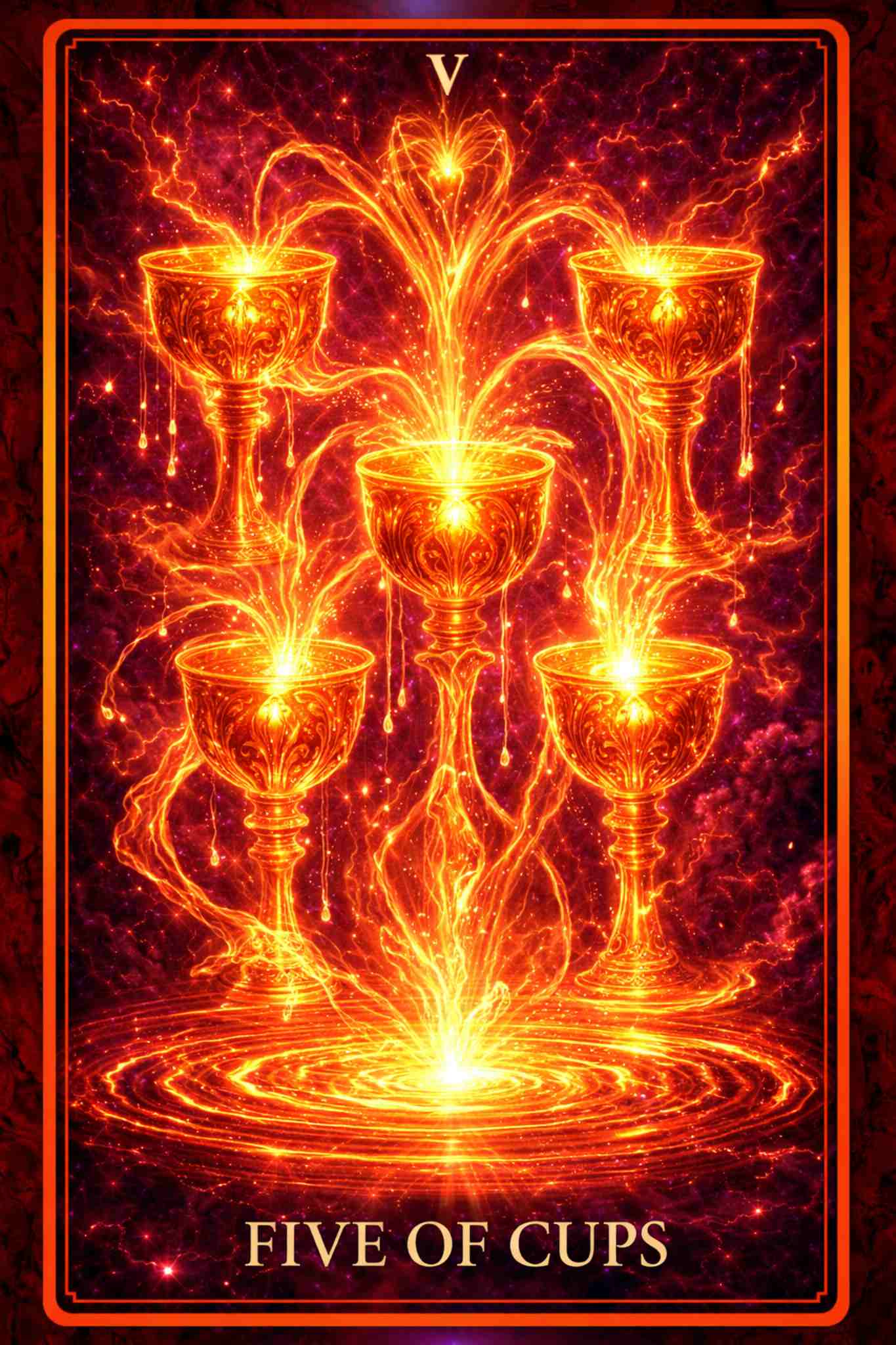
The Fool and Five of Cups Tarot Combination Meaning
Some new emotional chapters begin in bright readiness, with the heart eager to trust whatever comes next. The Fool and Five of Cups stands at a very different threshold, one shaped by sorrow that has not fully released its hold. This pair speaks of movement returning while grief is still active, of the soul feeling called toward life again while part of the heart remains turned toward what has already been lost. The Fool brings openness, forward motion, and the strange courage required to enter an unwritten future. The Five of Cups brings disappointment, mourning, emotional rupture, regret, and the deep human tendency to keep looking at what has been spilled because it mattered. Together, these cards describe a beginning that does not rise out of innocence. It rises out of lived feeling. Something in life is opening, yet the person stepping toward it may still be carrying sadness in the body, memory in the chest, and a private ache that has not finished saying what it came to say.
That is what gives this combination its emotional intelligence. The Fool here is not carefree in any shallow sense. It is the part of the self that remains willing to live after life has already disappointed it. The Five of Cups keeps the reading honest by showing that loss still has weight, and that the next step may happen while the person is still more tender than they appear from the outside. There may be real readiness here, though it is rarely loud. There may also be hesitation, because grief changes the way the nervous system responds to possibility. What once felt easy may now feel charged. What once inspired trust may now be met with caution. This pair does not ask the person to pretend they are untouched. It asks whether some genuine spark of life is still present beneath the disappointment, and whether that spark is strong enough to guide one careful, living step forward.
When life asks for movement before sorrow is finished
The Fool often appears at the edge of a new path, when something in life is beginning again from uncertain ground. In this pairing, that movement enters a landscape already marked by emotional loss. The Five of Cups shows that the inner world has been altered by something painful: a heartbreak, a failed hope, a missed chance, a broken bond, or the quiet collapse of a future that once felt meaningful. This matters because it changes the quality of the beginning. The person is no longer stepping into the unknown from a place of untested openness. They are stepping from experience, and experience has left its marks. That can make the path slower, softer, more ambivalent, and in some ways much more real.
There is a profound difference between beginning before pain and beginning after pain. Before pain, openness can be spontaneous. After pain, openness becomes an act of courage. The Fool carries that courage here. It does not erase the grief shown by the Five of Cups, and it does not try to outshine it with forced positivity. Instead, it reveals that life still contains movement even while sorrow remains present. The question becomes subtle: is the person moving because something living in them is genuinely ready to re-enter life, or are they moving because staying with grief feels unbearable? That distinction matters in every area this pair touches. One path leads toward healing that includes emotional truth. The other can become an attempt to escape pain through novelty, which usually delays the deeper repair the heart actually needs.
Grief does not cancel openness
One of the deepest teachings in this combination is that loss and openness can coexist, even when they seem emotionally incompatible at first. Many people assume that before they can begin again, they must first complete grief in some clean and perfect way. Real life rarely moves so neatly. Sometimes the invitation to live returns while sorrow is still unfolding. Sometimes the next chapter begins while tears still rise unexpectedly, while the old disappointment still has a voice, while part of the person still turns backward in quiet disbelief. The Fool and Five of Cups captures exactly that paradox. It says the heart may still hurt, and life may still be calling. Both can be true.
You may also want to go one step deeper.
The Fool + Five of Cups can open up differently inside a focused personal reading.
This is why the pair has such psychological and spiritual value. If the Fool dominates without the truth of the Five, a person may rush into a new chapter in order to outrun pain. If the Five dominates without the medicine of the Fool, a person may begin to organize their identity around disappointment and slowly lose contact with what remains alive in them. The stronger expression lives between those extremes. It allows sorrow to remain visible without giving it total authority over the future. It allows movement to begin without demanding emotional perfection. That is a very human form of resilience. It is less dramatic than forced optimism, yet far more trustworthy. It says, with quiet dignity, that something in the self is still willing to trust life a little, even after life has already proven that trust can wound.
- A new emotional step taken while grief is still active
- The heart opening again after disappointment
- Loss shaping the pace of the next beginning
- The need to distinguish healing from avoidance
- Trust returning in a quieter, more careful form
Love and relationship meaning
In love readings, The Fool and Five of Cups often reflects a heart that is trying to open again while still carrying the imprint of earlier hurt. This can describe someone entering a new connection after heartbreak, someone who wants renewal inside an existing relationship after a painful rupture, or someone who senses that emotional life is moving again even though the grief of what happened before has not fully settled. The Fool shows that the heart is not permanently closed. The Five of Cups shows that sadness, regret, or emotional caution still lives close to the surface. Together, they describe a delicate stage where love is possible, though it may arrive in the presence of vulnerability that has already been tested by disappointment.
This can create a relational rhythm that feels mixed from the inside. A person may genuinely want closeness and still become hesitant when it begins to feel real. They may feel drawn toward someone and then pull back because the body remembers what it cost to trust last time. They may experience sincere affection, though the old sorrow still colors how quickly they can receive it. None of this automatically weakens the connection. It simply means the emotional system is still reorganizing itself around a new possibility. Pressure tends to make that more difficult. Honest pacing makes it easier. The most supportive reading here does not ask the person to prove they are over the past. It asks whether they can stay truthful enough to let grief inform the pace without secretly ruling the entire bond.
This pair also raises an important relational question: is the new opening genuine, or is it partly a response to pain itself? There are times when the hunger to feel different from sorrow can make any bright connection seem larger than it is. There are also times when a very real bond arrives during grief and becomes part of the healing, even though the person still needs to move carefully. The cards do not flatten those possibilities into one answer. They ask for discernment. They ask whether the heart is stepping toward another person from living contact with itself, or from the understandable desire to escape a feeling that still needs tenderness and witness.
Timing, emotional honesty, and beginning again
Timing is central with this pair because it so often appears when a person stands between loss and renewal. The Fool indicates that movement is available now, or soon, or already beginning in small ways. The Five of Cups shows that part of the emotional body remains turned toward what is gone. That does not automatically mean the timing is wrong. It means the timing must include the truth of the grief. A beginning that honors sorrow may be wise and deeply healing. A beginning that requires emotional numbness, denial, or sudden brightness usually lacks staying power, because it asks the heart to split itself in two.
In practice, this can mean the next step comes in waves. Some days the person feels ready to trust, create, connect, or engage again. Other days the grief returns and asks for quiet. The reading becomes stronger when it allows that rhythm instead of treating it as inconsistency or failure. Healing rarely moves in a straight line, especially after real disappointment. The Fool and Five of Cups often suggests that the beginning is healthiest when it grows in dialogue with the sorrow rather than in rebellion against it. The person does not need to wait for a mythical moment of total completion. They do, however, benefit from knowing whether their next action is arising from grounded aliveness or from exhaustion with their own pain.
Career, work, and creative life
In work and creative life, this combination can describe a new direction emerging after rejection, burnout, collapse, or the painful ending of something once deeply hoped for. A project may have failed. A role may have ended badly. A dream may have lost its original shape. The Fool shows that life is still presenting a path forward, though the Five of Cups makes clear that the person does not approach that path with untouched enthusiasm. There may be hesitation, self-doubt, or a quieter relationship to ambition than before. Yet that quieter tone is not necessarily a weakness. Sometimes it is the sign that illusion has burned away and something more honest is ready to begin.
This can actually become fertile ground for more meaningful work. Many people create more truthfully after disappointment has stripped away the need to impress. The Fool in this context becomes less reckless and more courageous in a weathered, human way. The Five of Cups contributes depth, humility, and emotional substance. Together, they can point toward a new chapter built from sincerity rather than image, from lived knowledge rather than fantasy. The caution is that a new project should not be forced to carry the full burden of repairing an old wound. Work can accompany healing. It rarely replaces it. When the person allows grief and renewal to move side by side, the next path often gains stronger roots.
Psychological and spiritual meaning
Psychologically, The Fool and Five of Cups often reflects the meeting point between vitality and sorrow. The Fool loosens the future enough for life to move again. The Five of Cups fills that opening with the reality of what has been lost, missed, broken, or emotionally disrupted. A person may realize they are more wounded than they had admitted, while also discovering that some living impulse in them has survived intact. Both recognitions can arrive together. That may feel disorienting at first, though it can also be deeply healing because it breaks the false idea that grief and life-force must live in separate rooms. The self is allowed to be sad and still capable of movement.
On a spiritual level, this pairing can suggest that the soul’s next step sometimes begins while it is still carrying mourning. The Fool is the pilgrim willing to step toward mystery again. The Five of Cups is the ache of what could not be preserved. Together, they reveal a path that does not begin in triumph. It begins in humility, in tenderness, and in the quiet recognition that life is still speaking even after something cherished has ended. The deeper teaching here is not that pain disappears before the next chapter opens. It is that pain can refine openness, soften pride, deepen perception, and prepare the person for a truer form of trust than they had before.
Shadow expression and challenge
The shadow side of this combination appears when the person either rushes into the new beginning to avoid grief or becomes so organized around disappointment that every opening feels emotionally dangerous. In the first case, the Fool turns into escape dressed up as freedom. In the second, the Five of Cups hardens into an identity built around loss. Neither state allows the medicine of the pair to work fully. The real invitation is more demanding, because it asks the person to remain in contact with both the sorrow and the spark of life at the same time. That is not easy work, though it is often transformative work.
This pair can also reveal grief for the self that existed before the disappointment. Sometimes the person is mourning more than an event, relationship, or outcome. They may also be mourning the version of themselves who trusted more easily, hoped more simply, or believed the story would end another way. That layer matters. The Fool becomes powerful here because it suggests that a new self can still emerge, though it will not be the old self restored unchanged. It will be someone more aware, more tender, and perhaps more deeply rooted in reality. The path forward may feel less innocent. It may also feel more true.
FAQ
Does this combination mean heartbreak is still active?
Often, yes. The Five of Cups usually shows that disappointment, grief, or emotional regret remains present, even while The Fool suggests life is beginning to move again.
Can this pair still support a new beginning?
Yes. It often does, though the beginning tends to be healthier when sorrow is acknowledged rather than pushed aside.
Is the person ready to move on?
The cards usually suggest partial readiness. Some part of the heart is willing to step forward, while another part is still processing what has been lost.
Ready to see how this applies to your situation?
A focused tarot reading can help you explore how The Fool + Five of Cups may reflect your current situation, not just the general meaning of the cards.
Closing reflection
There is something deeply human in this pairing because it refuses simple emotional storytelling. The Fool says life is still moving, that the future has not gone silent, that some path is still opening. The Five of Cups says the heart is still carrying disappointment, and that grief deserves witness rather than dismissal. Together, they show a person standing at the edge of a beginning with sorrow still near enough to shape how they breathe.
The wisdom here is to let that complexity remain honest. A person does not need to be untouched in order to begin again. They do not need to deny what hurt in order to trust life a little more. Some openings arrive after clean endings, but others arrive while the heart is still learning how to carry what it cannot recover. The Fool and Five of Cups often appears exactly there, where loss remains real, the path still opens, and beginning again becomes an act of quiet courage rather than performance.
More combinations with The Fool
More combinations with Five of Cups
Continue with The Fool
Explore Related Guides by Topic
If you want to explore this combination through a more specific emotional lens, these tarot guides can help you follow the broader pattern behind the reading.