
The Fool + Page of Swords
Explore how these two tarot cards interact in a reading through symbolic overlap, contrast, and shared narrative. Tarot combinations often reveal meaning that neither card fully expresses on its own.

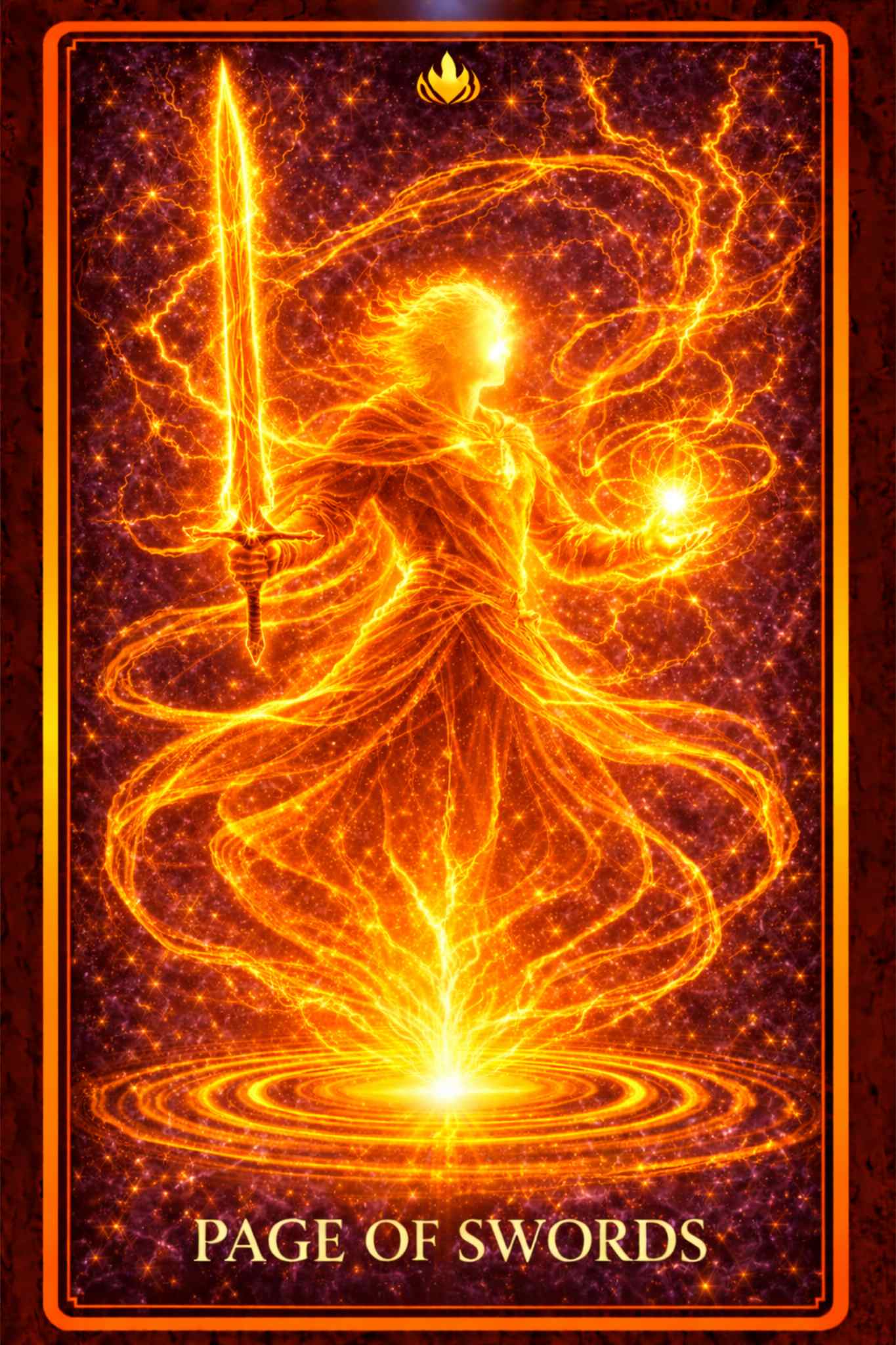
A young wind at the edge of the path
The Fool and Page of Swords begins with a question before it becomes a journey. The road may be open, but the first movement is mental: looking, listening, testing a sentence, noticing a clue, wondering what would happen if the old story were challenged. The Fool brings the threshold, the unformed possibility, the willingness to meet life before every detail has been arranged. The Page of Swords brings curiosity, alertness, watchful intelligence, and a voice that may be bright, quick, awkward, or still learning how sharp it sounds.
This combination is not the polished confidence of someone who already knows what they are doing. It is the beginning of thought in motion. A person may be entering a new field of study, watching a situation carefully, asking early questions in a relationship, researching a new direction, or trying to name an inner truth before they have the maturity to hold it elegantly. The Fool opens the gate. The Page of Swords leans forward with restless eyes and a blade too new to feel fully comfortable in the hand.
There is charm in this pair, but also a sharper risk. Curiosity can become honesty, learning, and mental bravery. It can also become suspicion, premature judgment, gossip, defensive questioning, or the kind of communication that cuts because it has not yet learned tenderness. The Fool makes the Page more open and experimental. The Page makes The Fool more observant and verbal. Together they describe the first question that might open a new road, if the person can stay curious without turning every uncertainty into a challenge.
Learning to ask without turning the question into a weapon
The Page of Swords is often mentally alive before it is emotionally seasoned. It wants to know. It watches tone, timing, words, behavior, contradiction, and small details that others might miss. With The Fool, this watchfulness appears at the beginning of something rather than after long experience. The person may be trying to learn a new language of life: how to speak more directly, how to recognize a pattern, how to test an idea, how to enter the unknown with questions instead of blind trust.
Need a little more context around this pairing?
A short reading can help you reflect on the tension, direction, or lesson this combination may be pointing toward.
The issue is not curiosity itself. Curiosity is necessary here. The Fool needs fresh perception so the new path does not become naive drift. The Page of Swords needs the openness of The Fool so its mind does not become only defensive or suspicious. When this pair is balanced, the person begins from intelligent wonder: I do not know yet, so I will observe, ask, listen, and learn. When it is strained, the person begins from mental agitation: I do not know yet, so I will interrogate, assume, chase every sign, or speak before I understand the whole room.
A useful comparison appears with The Fool and Page of Cups, where the beginning is shaped more by emotional openness, imagination, and the first tender movement of feeling. The Fool and Page of Swords is more mental, watchful, and question-led. It is the moment before the message becomes a crafted act. It is the notebook opened on the first day, the first brave question, the first attempt to think independently from the old script.
Fresh words in love, and the risk of watching too closely
In relationship questions, The Fool and Page of Swords may describe early curiosity, cautious observation, new communication, or the awkward first stage of trying to understand someone without having much certainty. There may be messages, questions, checking, thinking, noticing, and a desire to know what the other person means. Yet this pair should be handled carefully. It does not prove that someone is spying, returning, confessing, or hiding a fixed intention. It points more clearly to the mental texture of the connection: alert, curious, uncertain, and still learning how to speak.
The Page of Swords love meaning can deepen this layer because the Page often brings communication that is honest but immature, interested but guarded, observant but not always emotionally graceful. The Fool softens that energy with openness. In a relationship, the better movement may be a genuine question rather than a test, a simple message rather than a performance of indifference, or the willingness to learn another person’s language before building conclusions from fragments.
This pair can also describe someone learning to trust their own voice in love. They may have stayed silent in the past, accepted confusion, or let others define the terms of the conversation. Now something in them wants to ask more directly. Still, the first words need care. A question asked from curiosity can open a door. A question asked from fear can corner the other person and leave the asker more anxious than before. The Fool and Page of Swords invites communication that is fresh enough to be honest and humble enough to remain teachable.
The moment when observation becomes movement
Timing with this combination favors the early research stage, the first careful message, the first attempt to name what has been noticed, or the beginning of a learning process. The energy supports asking before accusing, exploring before declaring the final theory. It may be time to explore, but not yet to declare the final theory. The Page of Swords can move quickly because the mind is excited by information, while The Fool may be ready to step before all evidence is gathered. The most helpful timing is the point where curiosity becomes active without becoming reckless.
If a decision is involved, this pair may support gathering facts, asking clarifying questions, reading the situation, or testing a small first step. It is less suited to dramatic conclusions made from partial information. If a conversation is waiting, the first sentence should probably be clean and open rather than loaded. The Fool does not need a full map, but the Page of Swords needs to remember that a single clue is not the whole landscape. A fresh beginning becomes stronger when the person lets inquiry come before certainty.
For a simple reflective reading, the three-card tarot spread can suit this energy well, especially when the reader wants to separate what is known, what is assumed, and what still needs to be asked. This combination benefits from that kind of structure. It does not want blind movement, but it also does not want the mind to stay forever in observation mode. The question becomes a bridge, not a cage.
The young mind meeting the unknown
The spiritual layer of The Fool and Page of Swords is the beginner mind learning to think freely. It is the soul noticing that it does not have to inherit every explanation it was given. A person may begin to question an old belief, challenge a family story, look more honestly at a relationship pattern, or ask whether their fear has been speaking in borrowed language. The Fool opens the possibility of a new inner life. The Page of Swords gives that possibility a voice, even if the voice trembles, stumbles, or comes out too sharp at first.
This combination has a youthful edge because it is not yet wisdom in its settled form. It is inquiry. It is the first time a person realizes that asking a better question can change the path. It is the moment when the mind turns toward the unknown and says, I want to understand this for myself. That can be liberating, but it also asks for responsibility. The new thought needs to be tested. The first suspicion needs to be softened by context. The first insight needs to be given time before it becomes a conclusion.
A related contrast can be found in The Fool and Page of Wands, where the beginning is shaped more by spark, enthusiasm, and the urge to explore through action. The Fool and Page of Swords is more mental, more question-led, and more willing to learn by stepping into the world and asking. It may not yet know where the question will lead. It only knows that silence is no longer the only option.
Ready to see how this applies to your situation?
A focused tarot reading can help you explore how The Fool + Page of Swords may reflect your current situation, not just the general meaning of the cards.
The first question can be a doorway
The Fool and Page of Swords is a fresh, alert, and slightly restless combination. It may speak of early communication, learning, research, watchfulness, inquiry, or a new direction that begins through a question rather than an answer. Its gift is mental openness. Its challenge is immature sharpness: the risk of speaking too soon, assuming too quickly, or using curiosity to manage fear rather than understand reality.
The closing image is a traveler at the edge of the road, holding a notebook instead of a map. The first word has not become wisdom yet. The first question has not become certainty. Still, something important has begun. A mind that once accepted the old path without asking may now be awake enough to look at the horizon and wonder, honestly, what else could be true.
More combinations with The Fool
Continue with The Fool
Explore Related Guides by Topic
If you want to explore this combination through a more specific emotional lens, these tarot guides can help you follow the broader pattern behind the reading.