
The Fool + Six of Swords
Explore how these two tarot cards interact in a reading through symbolic overlap, contrast, and shared narrative. Tarot combinations often reveal meaning that neither card fully expresses on its own.

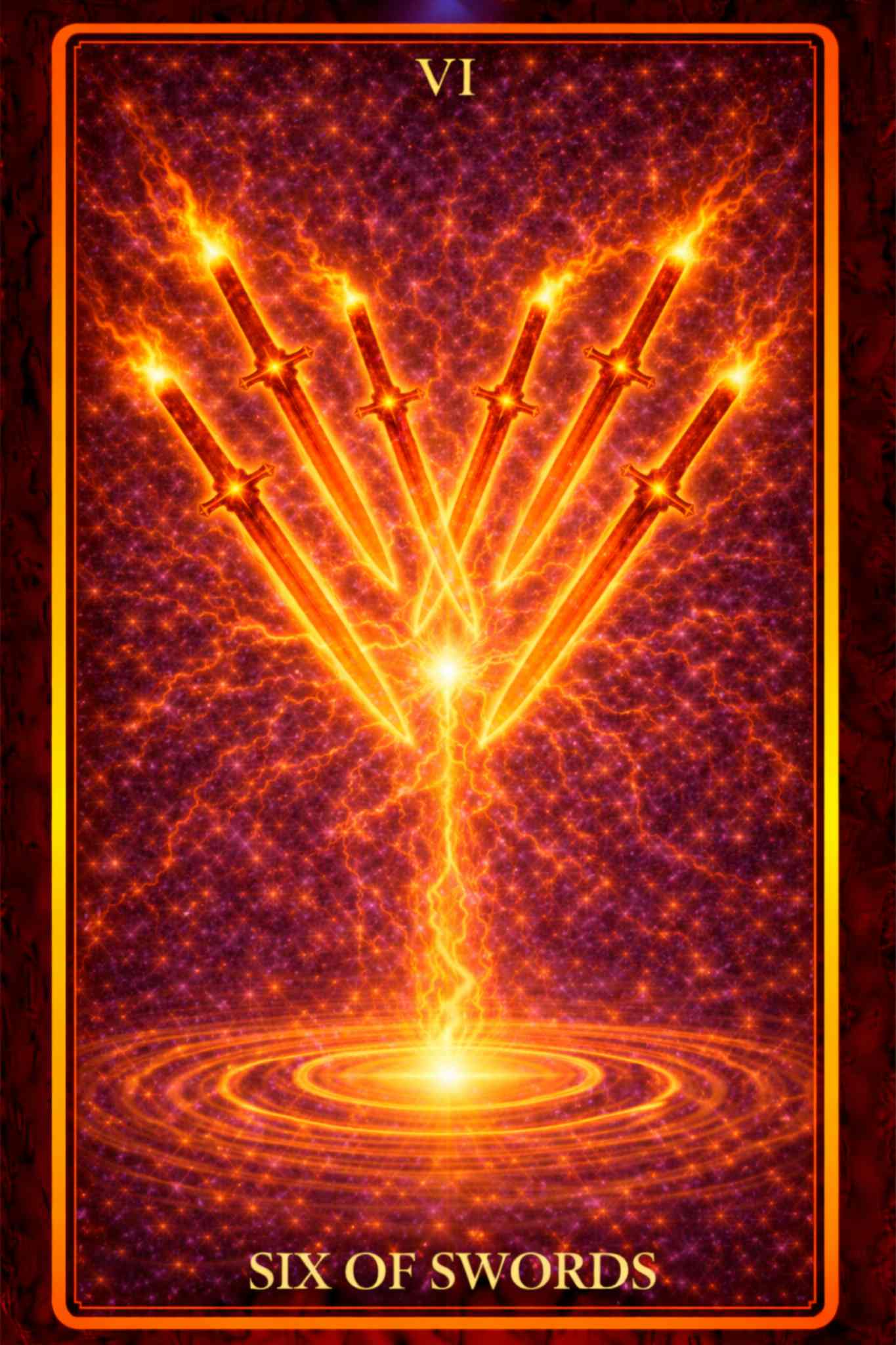
A small boat leaving the old mental weather
The Fool and Six of Swords does not feel like a leap from a cliff. It feels more like stepping into a quiet boat before dawn, carrying only what the mind still needs to understand. The beginning is real, but it moves through transition rather than sudden brightness. The Fool brings the first willingness to enter an unknown shore, while the Six of Swords gives that movement a sober, restorative direction. Something is being left behind, not always dramatically, and the person may still be close enough to the old place to hear it behind them.
This combination is about crossing into a new mental space. The person may be moving away from conflict, confusion, painful thoughts, emotional turbulence, or a situation that has taken too much from the mind. The Fool adds openness to the crossing, but the Six of Swords keeps it grounded. This is not reckless departure. It is the quiet intelligence of knowing that the same mental shore cannot keep offering the same kind of air. The road appears as water here, and the first step is a passage.
Compared with The Fool and Five of Swords, where the new path may begin after conflict and wounded words, this pair has already chosen a softer direction. The fight may still be remembered, but the focus has shifted from winning or defending toward leaving the mental battlefield. The Fool and Six of Swords is the moment when freedom becomes less noisy. It is the first breath of distance after realizing that staying in the same thought pattern would keep the soul cramped.
The unknown shore is calmer, but still unknown
The Six of Swords is not pure comfort. It often carries sadness, fatigue, and the humility of transition. The person may be moving toward something better while still grieving what had to be left. With The Fool beside it, the crossing becomes more open, but not simplistic. A new path may be calling, yet the person does not need to pretend that departure is easy. The beginning may include relief, uncertainty, tenderness, and the strange loneliness of no longer belonging to the old mental story.
In relationship questions, this can describe a movement away from confusion, a need for calmer communication, a transition after emotional strain, or the early possibility of relating from a less reactive place. It does not guarantee reconnection or separation. It frames the symbolic motion: the mind is trying to move from turbulence toward clarity. The Six of Swords spirituality meaning can deepen this layer through healing passage, inner migration, and the quiet wisdom of leaving one mental climate for another.
The Fool adds a particular vulnerability. The person may not know who they will be on the other shore. They may have built an identity around surviving the old situation, explaining it, defending against it, or endlessly analyzing it. Once movement begins, the mind can feel strangely empty. That emptiness is not failure. It may be the first sign that a new story has space to form, even if the words have not arrived yet.
When distance becomes a form of clarity
Some truths are impossible to see while standing inside the noise. The Fool and Six of Swords understands that distance can be a kind of thinking. A person may need to step back from a conversation, environment, habit, attachment, or repeating inner argument before they can know what they actually believe. The Fool supplies the courage to enter a less familiar space. The Six of Swords supplies the reason: the old mental waters have carried the person as far as they are able to go.
This combination can be especially relevant when someone is tempted to confuse healing with immediate certainty. The boat is moving, but it has not reached the shore. There may be relief in leaving, and still a need for patience. There may be a better direction, and still no full map. The person may feel steadier, calmer, or more honest once some distance is created, but the mind will likely continue processing during the crossing. The first step is not the full recovery. It is the willingness to stop remaining where the same thoughts keep reopening the same strain.
For emotional matters, the Fool feelings meaning adds the sense of unformed openness, early curiosity, and inner movement that has not become fixed. In this pairing, those feelings are carried across water. They may be gentle but uncertain, present but cautious, hopeful but still shaped by what the person is leaving. The combination is often less about dramatic declaration and more about allowing the heart and mind to enter a place where reaction no longer sets the tone.
The hour when the old shore stops answering
Timing with The Fool and Six of Swords is best understood as gradual movement after enough has been learned from the old situation. This is not the instant of rage, panic, or sudden escape. It is the quieter moment when a person recognizes that remaining in the same mental climate would be a choice, too. The first step may be modest: taking space, changing the conversation, seeking calmer surroundings, withdrawing from a circular argument, or beginning a plan for transition. The key is that movement serves healing rather than drama.
Want to explore this combination in a more personal way?
If this pairing feels important right now, a simple tarot spread can help you reflect on it with more context.
If the question involves communication, this pair may favor waiting until the conversation can move to calmer water. If the issue involves a life decision, it may suggest that the person does not need full certainty before beginning the crossing, but they do need enough clarity to know why they are leaving the old shore. A good moment to move arrives when the same thought has been examined many times and still points toward distance, recovery, or a more peaceful mental environment. A poor moment comes when the movement is only a reflex against discomfort and has no inner direction beyond away.
A spread such as the past present future tarot spread can fit this pairing when the reader wants to understand what is being left, what the crossing currently asks, and what kind of inner posture may support the next stage. The spread should still be handled reflectively rather than as a fixed forecast. The strength of this combination lies in seeing the movement of consciousness, not in forcing the future into a promise.
What the crossing asks the mind to understand
What becomes clearer in The Fool and Six of Swords?
The pair highlights the need to move into a calmer mental space. It often brings attention to what has become too heavy, repetitive, or turbulent to remain the main inner environment.
How can this combination be read in love?
It may describe emotional distance, a quieter transition, or the desire to relate from less conflict and more clarity. It does not force a specific outcome; it focuses on the movement away from old mental turbulence.
What kind of first step fits this pair?
A steady, modest step fits better than a dramatic leap. Space, calm communication, a change of environment, or a gradual transition may reflect the tone of this combination.
The quiet bravery of leaving the familiar storm
The spiritual movement of this pair is not triumphant. It is humble, almost tired, and deeply human. The Fool is usually associated with the beginning of the journey, but here the beginning comes after the mind has known enough strain to value peace. The Six of Swords carries the person across the water with the old swords still present. The wounds, lessons, words, and memories do not vanish. They are arranged differently, no longer allowed to steer the whole vessel.
That is why this combination can feel gentle and serious at the same time. It honors the person who is ready for a new story but still needs to travel with traces of the old one. It recognizes that healing often begins before confidence returns. It also respects the reality that some departures are mixed: relief and grief, hope and fatigue, openness and uncertainty. The Fool gives the crossing a future-facing quality. The Six of Swords gives it emotional intelligence and mental restraint.
Another helpful contrast appears in Death and Eight of Cups, where leaving may be tied to a deeper emotional ending, release, and the sober recognition that something once meaningful can no longer hold the next stage of the self. The Fool and Six of Swords is earlier, softer, and more exploratory. It may not yet know what the new shore will require. It only knows that the old water has become too narrow for the next version of the self.
Explore the next layer of this reading.
This combination can mean different things depending on context. A short tarot reading can help you reflect on the question behind the cards.
A beginning measured by calmer breathing
The Fool and Six of Swords is a passage into new mental air. It can speak of transition, recovery, distance, travel, emotional cooling, or the quiet decision to stop living inside the same old thought-storm. Its gift is movement without spectacle. Its challenge is allowing the crossing to be real, even when it is slow, incomplete, and emotionally mixed.
The final image is a boat moving away from a shore that once defined the whole horizon. The person may still look back. They may still feel the weight of what they are carrying. Yet the air changes little by little, and that change matters. The first step is not a shout of certainty. It is the soft sound of water under the boat, and the realization that calm can become a direction before it becomes a destination.
More combinations with The Fool
Continue with The Fool
Explore Related Guides by Topic
If you want to explore this combination through a more specific emotional lens, these tarot guides can help you follow the broader pattern behind the reading.