
Death + Ten of Wands
Explore how these two tarot cards interact in a reading through symbolic overlap, contrast, and shared narrative. Tarot combinations often reveal meaning that neither card fully expresses on its own.
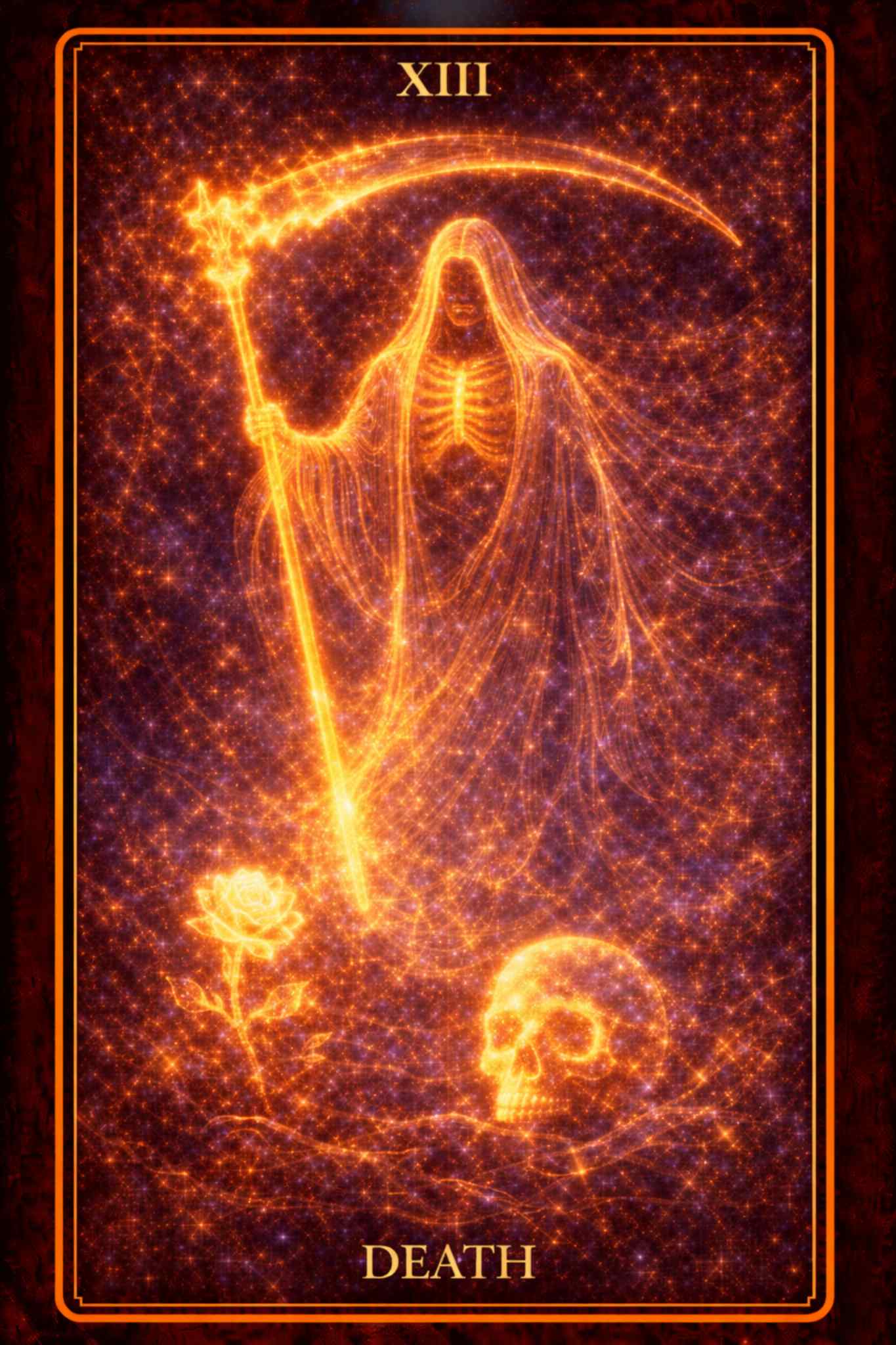
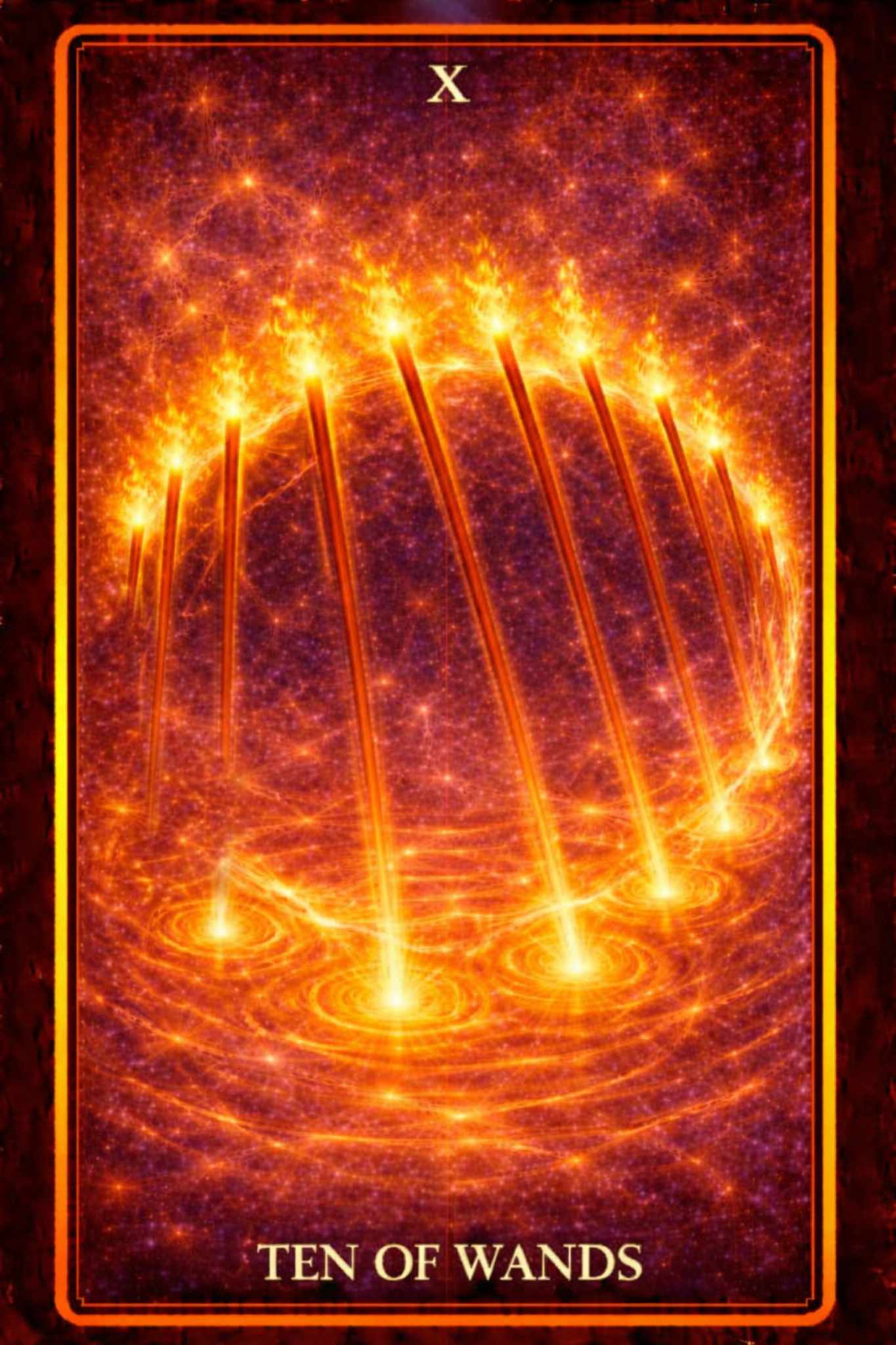
Death and Ten of Wands Tarot Combination Meaning
Death and Ten of Wands meet where transformation shows up as unsustainable weight. In this pairing, Death is less about dramatic ending and more about structural release. It exposes the point where a life-shape has become too compressed, too overloaded, too costly to keep carrying forward intact. The Ten of Wands brings the visible evidence: accumulation, strain, over-responsibility, and the weary effort of holding together more than the present form can support. Together, these cards often appear when a person has been bearing an old chapter past its natural limit. The burden is no longer incidental. It has become part of the truth.
That gives the pair a sober but clarifying tone. Death arrives here as the force that breaks the false agreement between heaviness and meaning. The Ten of Wands shows obligations, expectations, emotional labor, and structural pressure piled high enough that the person begins to mistake endurance for purpose. Yet these cards ask a sharper question: why is this still being carried in this form? Sometimes weight lingers because it still belongs to a living task. Sometimes it lingers because no one has yet admitted that the structure itself has reached completion. Death reveals the difference. It does not simply ask for relief. It asks for truth.
When heaviness becomes revelation
The Ten of Wands does not describe ordinary effort. It describes accumulation. Something has been added, retained, absorbed, or prolonged until the whole arrangement becomes difficult to carry cleanly. Beside Death, that burden often functions as revelation. A relationship may have become so labor-intensive that its current shape is telling on itself. A role may have grown so demanding that it exposes the form as outdated. A self-concept may now require constant overexertion just to remain in place. The issue is no longer simple difficulty. The issue is that the burden itself has started to describe the ending.
Need a little more context around this pairing?
A short reading can help you reflect on the tension, direction, or lesson this combination may be pointing toward.
This is why the pair can be so clarifying for strong and conscientious people. They are often capable of carrying too much for too long. Loyalty, discipline, or pride can make overload look almost noble. For a while, that may even be true. Yet Death introduces another reading: heaviness can become proof that the chapter has reached its edge. There are seasons when effort still serves growth, and there are thresholds where effort begins preserving what has already lost its vitality. These cards ask the person to stop interpreting exhaustion only as a moral challenge and start reading it as structural information.
Release and the end of over-carrying
One of the most important teachings in this combination is that release is not the same as failure. The Ten of Wands often appears where a person believes they must keep holding everything because others rely on them, because the load has become part of identity, or because setting it down would force a difficult truth into the open. Death interrupts that logic. It reveals that there are burdens which do not become wiser, holier, or more meaningful by being prolonged. They become distorting. They bind the person to a form that has already run out of room.
This does not mean every heavy responsibility should be abandoned the moment it becomes difficult. The pair is more discerning than that. It asks whether the burden still belongs to a living structure. If the answer is yes, then support, redistribution, or redesign may be needed. If the answer is no, then release becomes part of integrity. Death shows that some endings are not dramatic collapses at all. They are the moment a person stops carrying what should already have been laid down.
Love and relationship meaning
In relationship readings, Death and Ten of Wands often point toward a bond or relational pattern that has become too heavy to carry in its present form. This may involve emotional labor, one-sided maintenance, repeated repair, or the quiet exhaustion that comes from sustaining something more through duty than through shared vitality. Death brings the deeper recognition that the old arrangement has reached its limit. The Ten of Wands makes the cost visible. The relationship may still exist, yet it now requires so much effort that the effort itself becomes part of the message.
At its healthiest, this combination can bring profound honesty. A person may finally admit that they are not merely working through a difficult phase, but carrying more than the bond can truthfully support in its current shape. Or a couple may understand that a former way of relating must end if anything lighter and more alive is to remain. These cards do not automatically point toward separation. They point toward structural change. Something in the old contract has become too heavy to keep asking the heart to carry unchanged.
In more difficult expressions, the burden itself becomes part of the person’s identity in love. They may equate carrying more with loving more. They may fear that if they stop managing everything, the truth of the bond will come fully into view. Death answers that fear with unusual seriousness. Devotion still matters. But devotion alone cannot restore life to a form that has already reached completion.
Career, work, and practical life
In practical life, Death and Ten of Wands often describe a stage where work, leadership, or responsibility has become unsustainably heavy and the old arrangement is nearing its true endpoint. A person may be overfunctioning inside a role that once fit but now survives through constant compensatory effort. Administrative, emotional, strategic, and symbolic weight may have accumulated until the person is no longer carrying a meaningful load, but living inside an overburdened system. Death appears here as structural truth. It shows that the issue is larger than fatigue alone. The form itself has become too compressed.
This pairing is especially illuminating for people who are used to being the carrier, the stabilizer, the one who absorbs what others drop. The Ten of Wands names that pattern clearly. Death then asks whether the soul is still meant to organize itself around carrying at that level. Perhaps the job is ending. Perhaps the method is ending. Perhaps the identity built around managing impossible amounts is the very thing now ready to be released. The cards challenge the belief that more effort is always the honorable answer.
At its best, this combination can signal powerful simplification. The ending may feel difficult, yet it can free a tremendous amount of life-force. Once the obsolete weight is laid down, the person may realize that what seemed like permanent pressure was tied to a form already past its season. Death does not erase all responsibility. It removes what has become too heavy to remain truthful in the same shape.
Psychological and spiritual meaning
Psychologically, Death and Ten of Wands often describe a self organized around over-carrying and now being asked to transform through relinquishment rather than greater effort. This can be deeply disorienting. People who have built their worth around usefulness, reliability, or exceptional endurance can feel strangely exposed when invited to set the burden down. The load may have become part of identity. Death reaches deeper than task-management here. It asks whether the self built around carrying is itself changing.
Spiritually, the pair offers a profound lesson in the difference between sacrifice and attachment to sacrifice. Some burdens are meaningful. Others are preserved because carrying them supports a cherished self-image: the strong one, the needed one, the loyal one, the one who never stops. Death questions those stories with compassion and firmness. It asks what remains when the disproportionate weight is finally released. At first that may feel like loss. In time, it may become the beginning of a more spacious and living identity.
Shadow expression and challenge
The shadow side appears when a person keeps carrying because burden has become proof of value. The Ten of Wands can make overextension feel morally charged. The person may believe that laying the load down would betray others, waste prior effort, or expose weakness. Death reveals the hidden cost of that belief. The old chapter may already be over, yet the person keeps it standing through force of labor. The result is compression, resentment, and continued depletion.
There is also an opposite imbalance in which someone wants a dramatic ending simply because they are tired, even though part of the burden could be altered, shared, or redesigned. The cards ask for nuance. Some heavy phases call for release. Others call for reorganization. The key question is whether the form itself still contains life. If it does, the burden may need to change shape. If it does not, then release is wisdom.
Timing and the moment of laying it down
Timing in this pair often revolves around the threshold where burden stops being temporary strain and becomes evidence that a chapter is complete. A person may wonder whether to keep going a little longer, wait for a cleaner signal, or carry the weight until circumstances improve. Death suggests that the signal may already be present in the burden itself. The Ten of Wands asks how much clearer the truth needs to become before the load is allowed to change.
This does not call for impulsive decisions. It calls for accurate reading. Sometimes the old structure is done, and the kindest timing is conscious release. At other times, the chapter still lives, but only if the burden is radically redistributed. In either case, the real timing question is not whether to be strong. It is whether strength now means carrying longer or finally setting down what has ceased to belong to the future.
What this combination is really asking
Death and Ten of Wands ask: what are you still carrying that has already reached its end? That is the heart of the pair. The burden may feel familiar, even meaningful. You may have grown strong through carrying it. Yet the cards want to know whether the load still belongs to life, or whether it belongs to a chapter whose truth has already shifted. They ask whether setting it down might actually be the more faithful act.
The deeper lesson is that heaviness is not always a sign to try harder. Sometimes it is a sign that the form itself is complete. Death strips away what cannot continue. The Ten of Wands shows the accumulated weight of trying to continue anyway. Together, they create one of the clearest images in tarot of release through honest ending: not abandonment of duty, but recognition that what has become too heavy may be exactly what is ready to be laid down so life can breathe again.
Ready to see how this applies to your situation?
A focused tarot reading can help you explore how Death + Ten of Wands may reflect your current situation, not just the general meaning of the cards.
Closing reflection
There is a particular kind of suffering that comes from continuing to carry what life has already finished with. This pairing speaks directly to that threshold. It respects devotion, discipline, and responsibility. It simply asks whether those qualities are still serving something alive.
Death brings the truth of completion. The Ten of Wands brings the visible weight of postponing it. Between them is a hard but beautiful invitation: to stop measuring worth by endurance alone, to stop mistaking burden for destiny, and to allow the old load to end when its ending is the very thing that makes renewed life possible.
More combinations with Death
More combinations with Ten of Wands
Continue with Death
Explore Related Guides by Topic
If you want to explore this combination through a more specific emotional lens, these tarot guides can help you follow the broader pattern behind the reading.