
The Devil + Five of Wands
Explore how these two tarot cards interact in a reading through symbolic overlap, contrast, and shared narrative. Tarot combinations often reveal meaning that neither card fully expresses on its own.
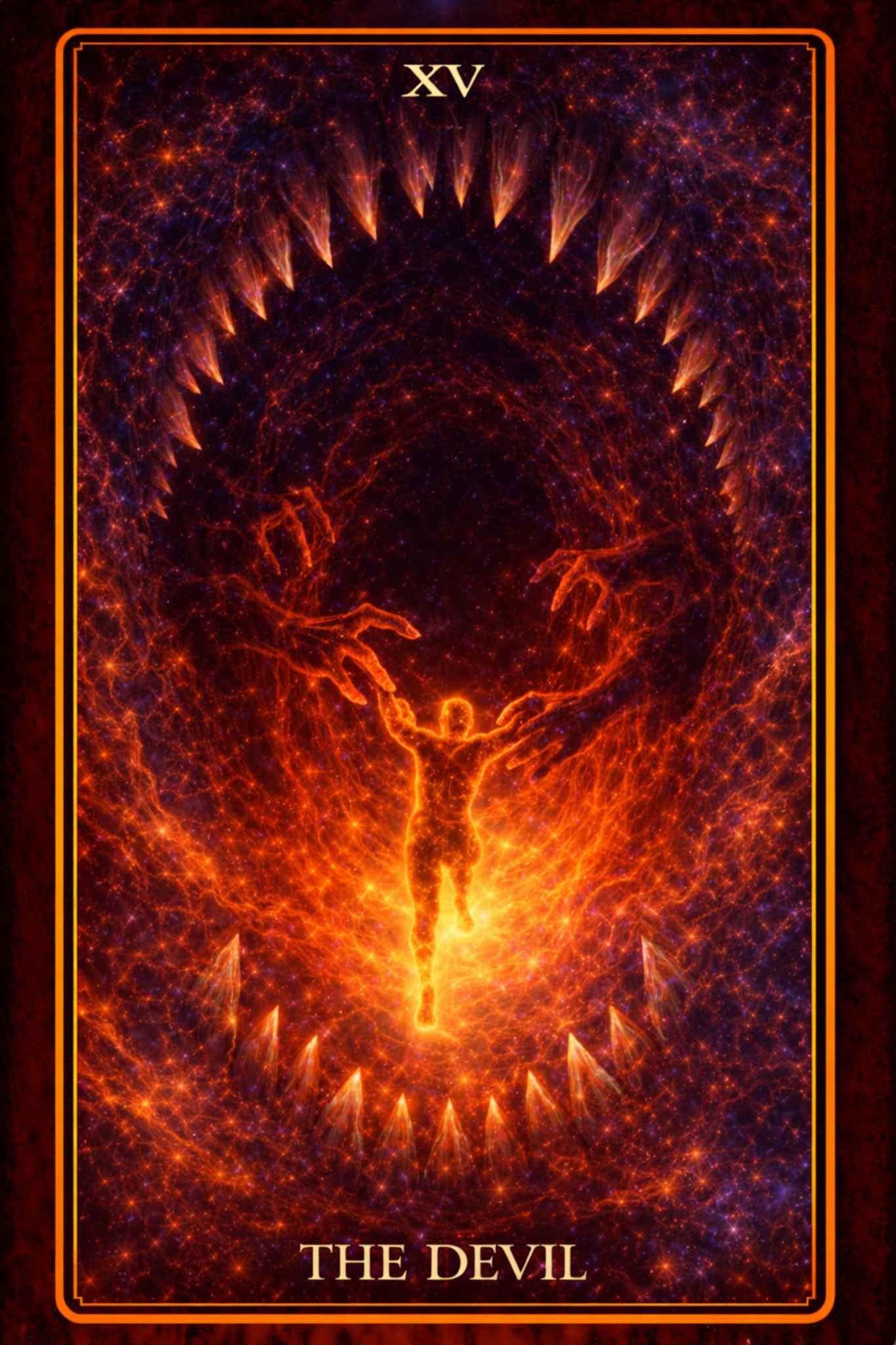

Devil and Five of Wands Tarot Combination Meaning
Some forms of conflict do more than disturb the peace. They generate heat, identity, momentum, and a strange sense of aliveness that keeps the whole pattern returning. Devil and Five of Wands often appear when friction has become more than an occasional clash. The Devil reveals the grip beneath the surface: attachment to a rivalry, a trigger, an emotional charge, a repeated power struggle, or a pattern that keeps drawing a person back into the same arena. The Five of Wands gives that grip visible form through argument, competition, ego tension, scattered fire, and clashing wills. Together, these cards describe a field where struggle keeps reproducing itself because some part of the system is still being fed by the struggle itself.
That is what makes this combination so psychologically rich. The Five of Wands on its own can point to creative friction, temporary disagreement, or the messy process of many forces trying to occupy the same space at once. With the Devil, the atmosphere deepens. The tension gains repetition, appetite, and a hidden reward. A person may say they are tired of the conflict while continuing to circle it with remarkable consistency. The conflict may drain them, frustrate them, even embarrass them, yet it may also give them something powerful: stimulation, significance, proof of strength, a reason to stay activated, or a familiar emotional climate that feels easier to inhabit than true stillness. The question is no longer only what is happening on the surface. The question is what this tension is doing for the inner life.
When friction becomes its own fuel source
The Five of Wands carries restless fire. It moves in bursts, interruptions, competing agendas, and unfinished pushes for space or recognition. There is life in it, though the life often comes through agitation rather than coherence. When the Devil enters that field, the agitation can become compelling. The person may feel most awake when there is something to resist, something to outperform, something to defend against, or someone to engage with in a heated way. Conflict then becomes more than a problem. It becomes a stimulant.
You may also want to go one step deeper.
The Devil + Five of Wands can open up differently inside a focused personal reading.
This can show itself very quietly at first. Someone may keep choosing environments where comparison dominates the atmosphere. Someone else may repeatedly enter discussions that predictably become heated. Another person may feel drawn toward relationships where chemistry and confrontation live side by side. In each case, the conscious story may focus on irritation, challenge, or the desire to resolve the issue. The deeper story often involves a nervous system that has learned how to organize energy through friction. The Devil reveals that hidden contract. The Five of Wands shows it in motion.
The repetition underneath the argument
One of the clearest lessons in this pair concerns recurrence. The Devil often points to patterns that continue long after their original purpose has faded. The Five of Wands provides the behavior through which that recurrence becomes visible: the same argument returning in a new costume, the same rivalry reigniting, the same emotional trigger catching fire, the same inner division replaying its old script. A person may tell themselves that each fresh clash is separate from the last one. The cards suggest a deeper continuity. Something beneath the surface keeps calling the scene back into being.
This can happen externally, though it can be just as strong inside the psyche. A person may keep battling themselves over the same desires, ambitions, resentments, or insecurities. They may move between drive and self-sabotage, expression and inhibition, assertion and collapse. Every cycle produces heat. Every cycle seems to promise some final victory. Yet the pattern remains alive because the conflict itself has become part of how the inner world organizes pressure. The Devil shows the chain in the basement. The Five of Wands shows the furniture shaking upstairs.
Love and relationship meaning
In relationships, Devil and Five of Wands often point to a bond where attraction and tension have become tightly intertwined. There may be strong chemistry, quick reactions, recurring disagreement, sharp competitiveness, bruised pride, or an emotional atmosphere in which peace never fully settles for long. The connection can feel vivid, charged, impossible to ignore. That intensity may be part of what keeps the relationship alive, even when both people say they want something calmer and more sustainable.
This is where confusion often enters. A person may start reading friction as proof of importance. They may assume that because the relationship feels intense, it must also be deep in the healthiest sense. Sometimes real truth is emerging through the conflict. Sometimes the bond is exposing genuine incompatibilities, unspoken needs, or ways of engaging that require maturity and repair. Yet sometimes the relationship is being held together by the repeated cycle itself: tension, release, reconnection, tension again. The Devil is especially revealing there. It shows where the couple may be feeding on the charge without fully admitting how dependent they have become on the rhythm.
At its healthiest, this combination invites brutal honesty without cruelty. It asks what the conflict is actually about and what each person receives from keeping it alive. Does the struggle sharpen understanding, or does it keep both people trapped in reaction? Does the relationship make the self larger, wiser, steadier? Or does it keep reducing both people to triggered versions of themselves, endlessly circling the same emotional ground? Those questions often reveal far more than the content of the latest argument.
Career, work, and competitive environments
In career readings, Devil and Five of Wands frequently appear in fields driven by rivalry, pressure, comparison, and constant proving. The environment may be crowded with ambition. Everyone wants space, recognition, influence, or advantage. That energy can be productive for a time. It can sharpen skill, intensify focus, and generate fast movement. Yet the Devil asks what kind of psychological relationship the person has formed with that competitive field. Do they still use the pressure consciously, or has the pressure begun using them?
Some people become highly effective in exactly these environments because they know how to metabolize conflict into performance. The cost often emerges later. The nervous system may begin needing friction in order to feel switched on. Success starts depending on opposition. Identity becomes tied to being challenged, underestimated, or in constant contest with others. In that state, the person may struggle to work from grounded purpose because battle itself has become part of the fuel supply.
This pair can also describe workplace drama that remains alive because too many people are secretly invested in it. Rivalries create hierarchy. Gossip creates stimulation. Ongoing disagreement creates emotional weather that keeps everyone alert and involved. The Five of Wands makes the field noisy. The Devil shows why the noise keeps being fed. The true challenge is less about winning the latest round and more about seeing whether the whole structure has become dependent on conflict as a source of energy and identity.
Psychological and spiritual meaning
Psychologically, Devil and Five of Wands often describe a system that learned early on to process vitality through struggle. Calm may feel flat, unfamiliar, or strangely empty. Friction may feel more natural because it produces immediate sensation and orientation. The person knows who they are when they are pushing, defending, comparing, striving, or reacting. They may be far less certain of themselves in quieter states where nothing external is demanding a response. That is why this combination deserves depth rather than simplistic advice. The pattern often has roots.
Spiritually, the cards suggest that fire can be used in more than one way. Fire can argue, compete, and scatter itself across endless small battles. Fire can also create, direct, clarify, and protect. The Five of Wands shows fire in its fragmented expression. The Devil shows what happens when that fragmentation acquires a hidden fascination and keeps returning as though it were destiny. The invitation here is to reclaim the energy without continuing to worship the conflict that currently carries it. Once that becomes possible, the same life-force can begin serving consciousness rather than repetition.
Shadow expression and challenge
The shadow side of this combination appears when a person becomes loyal to the identity they occupy within the struggle. They may feel powerful as the challenger, righteous as the defender, clever as the one who always counters, or alive as the one who keeps standing in the middle of the fire. Those roles can feel meaningful. They can also keep the pattern in place. The Devil shows how identity may become braided into the very conflict that limits growth. The more invested the person becomes in that identity, the harder it is to imagine themselves outside the battle.
Another shadow expression appears when ongoing friction protects a person from deeper contact with themselves. As long as there is someone to oppose, something to argue with, or some external drama to navigate, the quieter truths underneath can remain postponed. Conflict then becomes a shield as much as a battlefield. The Five of Wands supplies motion. The Devil ensures that the motion keeps enough emotional payoff to continue. That is why stepping back can feel far more difficult than the surface issue would suggest. The conflict may be covering grief, fear, insecurity, hunger, or the simple unfamiliarity of peace.
Timing and the point where the cycle can still be interrupted
Timing with this pair often concerns the moment before the familiar escalation completes itself again. The person may already feel the early signs: the tightening in the body, the urge to answer quickly, the need to prove, the magnetic pull toward the same charged exchange. This is the stage where real choice becomes possible. Once the pattern fully ignites, it tends to move fast and use up a great deal of energy before awareness returns. The cards therefore place enormous value on recognition in the earlier phase.
The most useful question here is less about whether conflict exists and more about how it is being entered. Is the person choosing the engagement with clean intention, or are they being pulled into a reaction they already know by heart? A pause may feel awkward at first because the system has become accustomed to movement through friction. Yet that pause is exactly where a different future begins. The Devil loses some of its glamour the moment the person experiences that they can hold the heat without immediately feeding it.
What this combination is really asking
These cards ask a difficult and illuminating question: what are you truly fighting, and what keeps making the fight feel worth returning to? The answer may involve another person, a workplace, a relationship, or a recurring external situation. It may also involve a much older inner condition that keeps finding fresh material through which to express itself. That is why the pair carries so much depth. It reveals conflict as behavior, attachment as motive, and repetition as the bridge between them.
The deeper lesson is that conflict can become a home for displaced energy. A person may pour longing, fear, ambition, pride, insecurity, and raw life-force into the same old battleground until the battleground itself starts feeling necessary. The Devil provides the grip. The Five of Wands provides the arena. Once that structure becomes visible, the person is no longer only trapped inside the pattern. They are standing at the edge of understanding it, which is the first real shift toward freedom.
Explore the next layer of this reading.
This combination can mean different things depending on context. A short tarot reading can help you reflect on the question behind the cards.
Closing reflection
Some fires warm a house. Some clear a field. Some call a forge into action so that something stronger can be shaped. And then there are fires that keep being passed from hand to hand because everyone involved has forgotten what the flame was originally for. Devil and Five of Wands belongs to that last image. It feels like a room full of people each carrying a spark, each convinced they are defending something vital, while the air itself has quietly become addicted to smoke.
That is why the wisdom here is less about silencing every disagreement and more about recovering the deeper dignity of your own energy. You do not have to spend your fire proving you can survive the same battle again. There is a life beyond perpetual reaction, a life in which intensity still exists yet no longer requires an opponent in order to feel real. The turning point comes when the struggle stops being the place where you go to feel alive, and becomes instead the place you finally understand well enough to leave without losing your strength.
More combinations with The Devil
More combinations with Five of Wands
Continue with The Devil
Explore Related Guides by Topic
If you want to explore this combination through a more specific emotional lens, these tarot guides can help you follow the broader pattern behind the reading.