
The Emperor + Five of Wands
Explore how these two tarot cards interact in a reading through symbolic overlap, contrast, and shared narrative. Tarot combinations often reveal meaning that neither card fully expresses on its own.
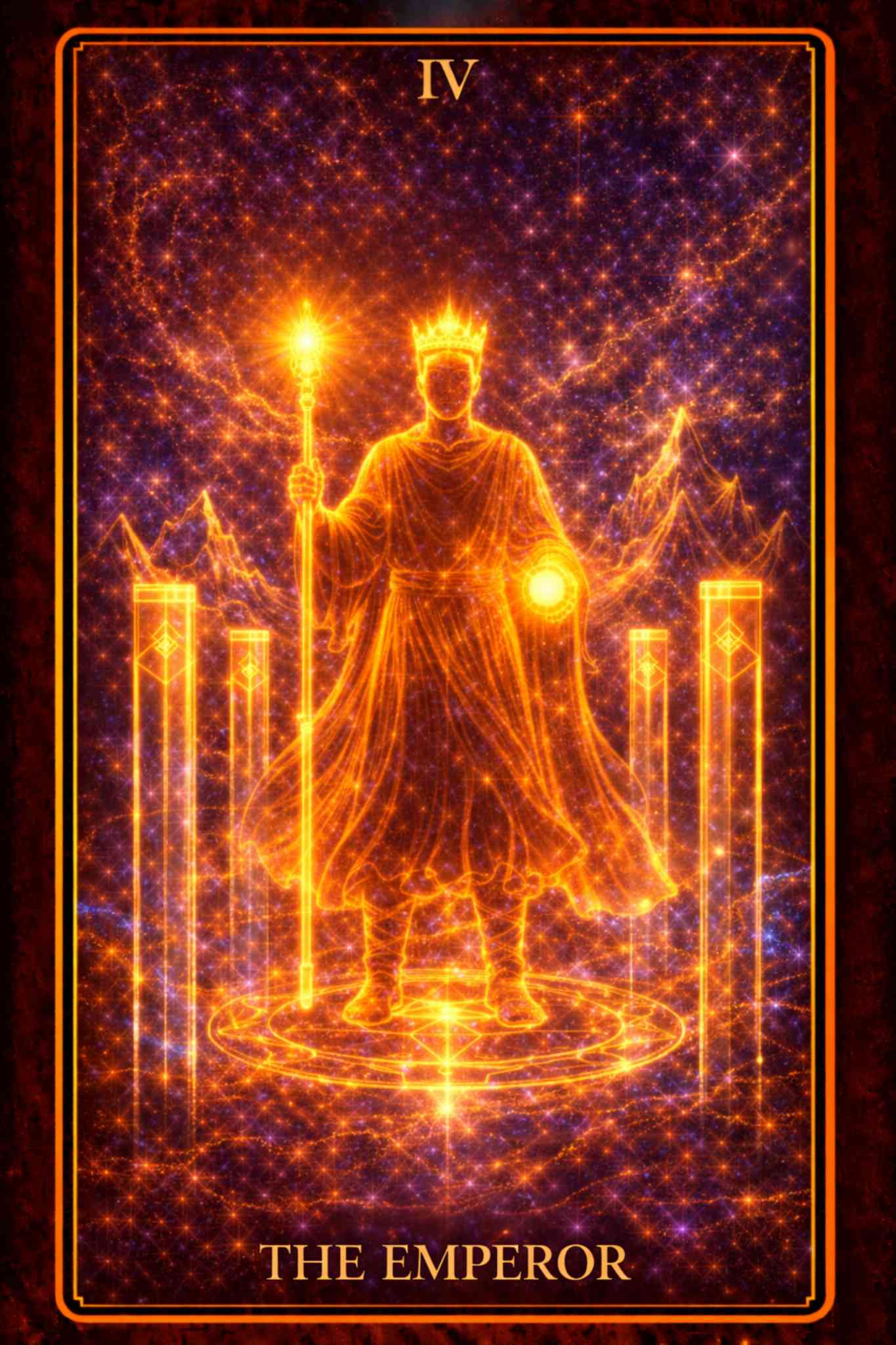

The Emperor and Five of Wands Tarot Combination Meaning
The Emperor and Five of Wands tarot combination speaks of tension inside a structure that is being forced to prove itself. The Emperor represents order, authority, hierarchy, law, responsibility, and the effort required to create terms that can actually hold. The Five of Wands brings friction, clashing wills, unstable group energy, competition, ego heat, and the kind of pressure that rises when several forces want influence at once. Together, these cards rarely describe ease. They describe a field where leadership is being tested by noise, disagreement, challenge, or competing agendas. Yet the deeper issue is not simply that conflict exists. The deeper issue is whether the structure in place is strong, fair, and flexible enough to direct that conflict without becoming consumed by it.
That is what makes this pairing more meaningful than a simple “power struggle” reading. The Five of Wands can look messy, but mess is not always meaningless. Sometimes it reveals immaturity, scattered ambition, or people fighting for space without any real center. Sometimes it reveals that the existing order is too rigid, too top-down, or too disconnected from the actual energy moving through the situation. The Emperor wants coherence. He wants a system that can hold pressure without dissolving into chaos. When these cards meet, authority is no longer theoretical. It has to function in contact with resistance.
Core meaning of The Emperor and Five of Wands
At the core of this combination is the struggle to create or maintain order while real friction is active. The Emperor brings standards, rules, structure, and the understanding that not everything can be left to improvisation forever. The Five of Wands challenges that from below, around, or within. It can appear as open disagreement, subtle rivalry, personality clashes, defensiveness, conflicting priorities, or the inner experience of being pulled by several competing drives at once. The cards together suggest that the main problem is not merely “too much tension.” The real question is whether the tension is being led well.
This is a pairing about governance under stress. It asks whether authority becomes clearer and more mature when challenged, or harsher, more reactive, and more invested in domination. It also asks whether the conflict itself is pointless, or whether it is exposing something that genuinely needs correction. The answer will not be identical in every reading. In some situations, firmer boundaries are necessary. In others, the system itself needs refinement, clearer roles, or less ego in the person trying to control it. The Emperor here is not automatically right simply because he holds authority. He has to show that his structure deserves to lead.
When pressure exposes what the system is made of
One of the most useful truths in this pairing is that pressure reveals reality. It is easy for a structure to look stable when nothing pushes against it. It is easy for a person to believe they are calm, fair, or disciplined when they are not being challenged. The Five of Wands changes the atmosphere immediately. It introduces heat. It stirs rivalry, movement, contradiction, and the refusal of easy alignment. Whatever has been weak, unclear, or merely assumed inside the system begins to show itself much more openly.
Want to explore this combination in a more personal way?
If this pairing feels important right now, a simple tarot spread can help you reflect on it with more context.
This is why the combination can feel frustrating and productive at the same time. Friction is uncomfortable, but it is often diagnostic. It shows where rules are too vague, where roles are undefined, where resentment has been building, where control has become brittle, or where people have been forced into competition without enough guidance. The Emperor then becomes the measure of response. Can leadership remain clean under strain? Can the structure adapt without becoming shapeless? Can authority distinguish between noise that should be contained and truth that should actually be heard?
Sometimes this pairing appears when the old way of managing things is no longer enough. What once kept order may now be producing unnecessary conflict. Or the opposite may be true: what was tolerated before now needs firmer terms because the field has become too scattered to govern itself. The cards do not force only one interpretation. They ask for discernment. Conflict is present, but the meaning of that conflict depends on what kind of order it is colliding with.
The Emperor and Five of Wands in love and relationships
In relationship readings, this combination often reflects friction inside a bond where questions of control, standards, ego, respect, or role are becoming difficult to avoid. The Emperor brings seriousness, boundaries, expectations, and a desire to define what the relationship is meant to be. The Five of Wands introduces tension, defensiveness, disagreement, unresolved competitiveness, or the sense that two people are not yet moving with the same rhythm. This does not automatically mean the connection is failing. It does mean that harmony cannot be faked for long. Something in the relational structure is being tested by real heat.
Sometimes this appears where both people are strong-willed and attraction exists alongside power struggle. In other cases, one person may be trying to impose order while the other resists feeling managed, interpreted, or contained. There may also be outside pressures amplifying whatever is already unstable inside the bond. The Emperor wants accountability. The Five of Wands shows where that accountability has not yet become mutual, clear, or emotionally workable.
The healthier expression of this pairing is not the absence of disagreement. It is the ability to disagree without turning every difference into a contest for dominance. That takes maturity from both cards. The Emperor must protect structure without becoming authoritarian. The Five of Wands must reveal tension without allowing that tension to become the entire relationship climate. If the bond matters, the work is not just to calm things down for a day or two. The work is to understand what kind of structure would make respect, honesty, and emotional safety possible at the same time.
The Emperor and Five of Wands in work, leadership, and group dynamics
In work and practical life, this is one of the clearest combinations for leadership under friction. It can point to teams with competing viewpoints, organizations with unclear power lines, creative environments full of strong personalities, competitive atmospheres, or management roles that now require conflict navigation rather than simple planning. The Emperor provides the need for hierarchy, process, and decision-making authority. The Five of Wands shows what happens when multiple agendas are active and not all of them naturally align.
This pairing often appears when someone must step in and establish order, but the challenge is that the field is noisy, emotionally charged, or full of people who each believe their approach should lead. A weak reading would say only that stronger control is needed. A better reading asks what kind of control. Are the roles actually clear? Are expectations defined well enough to be fair? Are people being pushed into rivalry where collaboration should have been designed? Is authority reacting from ego, or from responsibility? Those questions matter because force can suppress symptoms without resolving causes.
There is also a productive side here that should not be missed. The Five of Wands is not always useless chaos. Sometimes it reflects creative friction, honest challenge, healthy competition, or the kind of tension that reveals where a system is weak and needs refinement. In those cases, The Emperor is not being asked to eliminate the heat altogether. He is being asked to frame it properly. Good rules can turn scattered conflict into development. Clear leadership can keep strong personalities from wasting themselves against one another. A mature system knows that not all pressure is failure. Some pressure is what sharpens the work.
The deeper lesson: conflict reveals the quality of authority
One of the strongest teachings in this pairing is that authority is easiest to trust when it has already been tested. Anyone can appear composed when the room is cooperative. Anyone can seem fair when no one is pushing back. The Five of Wands removes that comfort. It exposes the points of collision. It shows where egos flare, where people resist, where structure loses clarity, and where unintegrated energy starts demanding expression. The Emperor then becomes a mirror: how do you respond when order is no longer effortless?
This is where the combination becomes especially revealing. Some people respond to tension by hardening immediately. Others avoid it and call that peace. Neither response is the highest expression here. The stronger path is disciplined engagement. That means identifying what the conflict is actually about, deciding what must be protected, clarifying what is negotiable and what is not, and refusing to let every emotional flare dictate the whole direction of the situation. The Emperor does not need to win every clash. He needs to establish terms strong enough that the structure remains both intact and fair.
That last part matters. A system can remain intact through fear, but fear is not the same as legitimacy. These cards often ask whether power is being exercised in a way that creates genuine order, or only obedience under pressure. The difference may not be visible at first glance, but under sustained friction it becomes obvious.
The Emperor and Five of Wands in personal growth
On an inner level, this combination can reflect a state of internal contention. One part of you wants order, discipline, long-range control, and cleaner priorities. Another part is noisy, reactive, ambitious, impatient, defensive, or pulled in too many directions at once. This can happen during periods of growth where your standards are rising but your older patterns have not yet accepted the new structure. The result is often inner crowding: too many impulses competing for influence, too much force without one clearly trusted center.
The cards do not suggest that you should simply crush that tension. Inner conflict often contains useful information. The Five of Wands may be showing where your drives are still fragmented, where your identity is not fully integrated, or where your ambitions exceed the structure currently available to hold them. The Emperor asks for clearer self-governance. Not harsher for the sake of harshness, but more honest. What matters most? What are you wasting energy fighting inside yourself? Which patterns keep demanding the microphone even though they no longer deserve to lead?
This can become deeply productive when used for self-organization rather than self-punishment. The goal is not to create an inner dictatorship. The goal is to become someone whose energy is directed enough that conflict no longer consumes more force than the actual work of living.
Shadow side of The Emperor and Five of Wands
The shadow side appears when authority becomes domination or when conflict becomes identity. An unbalanced Emperor may respond to resistance with force for its own sake, harshness, inflexibility, or the belief that intimidation proves legitimacy. An unbalanced Five of Wands may generate endless agitation, point-scoring, reactive behavior, petty competition, and chronic inability to align around anything stable. Together, these distortions can create an exhausting climate in which everyone is constantly defending position rather than building something meaningful.
In relationships, this may look like recurring power struggles, arguments that are really about control and respect, or an atmosphere where nobody feels safe enough to soften. In work, it can become poor management, ego-led leadership, and systems that breed conflict instead of directing it. In personal development, it may show up as over-disciplining yourself until every internal tension becomes a war. None of these are the mature form of the pairing. The stronger version does not deny conflict, but it refuses to worship conflict or be ruled by it.
The warning here is clear: order that humiliates is not wisdom, and conflict that goes nowhere is not growth.
What this combination is really asking
The Emperor and Five of Wands ask a difficult but necessary question: can you create order without being threatened by tension? Not total silence. Not perfect compliance. Real order — the kind that can survive disagreement, ego heat, contradiction, and complexity without losing its center. This is a mature question because it leaves fantasy behind. Any meaningful structure will eventually face resistance. The real issue is whether that resistance becomes destructive, or whether it is used to refine the structure and strengthen the people inside it.
There is a lot of force in this pairing, but force alone is not the lesson. The lesson is relationship to force. How do you direct it? How do you meet challenge without becoming smaller, meaner, or more brittle? How do you allow heat to reveal truth without letting it burn through the whole field? The cards do not hand out a theatrical verdict. They ask you to name the pattern cleanly. There is strain here. There are competing wills. There may be battles around standards, leadership, respect, or role. But there is also a real opportunity to build a cleaner relationship with power itself.
Explore the next layer of this reading.
This combination can mean different things depending on context. A short tarot reading can help you reflect on the question behind the cards.
Closing reflection
The Emperor and Five of Wands describe a phase where order is meeting resistance in a live and meaningful way. Something is clashing. Something is pushing back. Something in the system, relationship, or inner life is no longer willing to remain quietly unmanaged. That may feel exhausting, but it is also clarifying. It shows where the true tests are. It shows whether boundaries are functional, whether leadership is mature, and whether the structure can hold pressure without turning brittle.
The most grounded response is neither to fear conflict nor to glorify it. Study it. Direct it. Clarify the deeper issue underneath the noise. Stay responsible without becoming tyrannical. Stay open to truth without surrendering the center. When this combination is lived well, it becomes a sign of tested authority: structure that can withstand friction, leadership that can engage conflict without losing dignity, and strength that does not need chaos in order to prove itself strong.
More combinations with The Emperor
More combinations with Five of Wands
Continue with The Emperor
Explore Related Guides by Topic
If you want to explore this combination through a more specific emotional lens, these tarot guides can help you follow the broader pattern behind the reading.