
Death + Four of Cups
Explore how these two tarot cards interact in a reading through symbolic overlap, contrast, and shared narrative. Tarot combinations often reveal meaning that neither card fully expresses on its own.
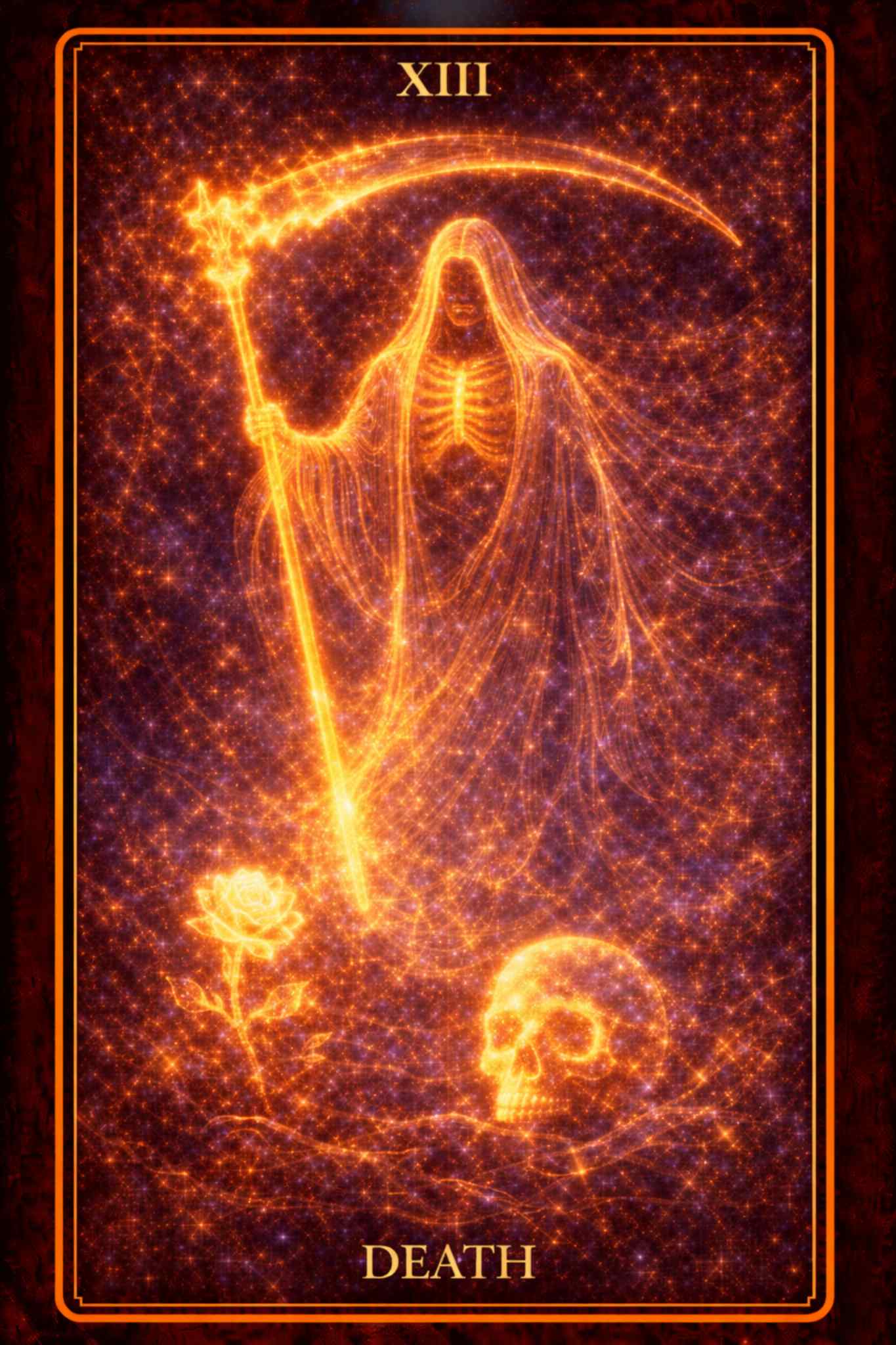
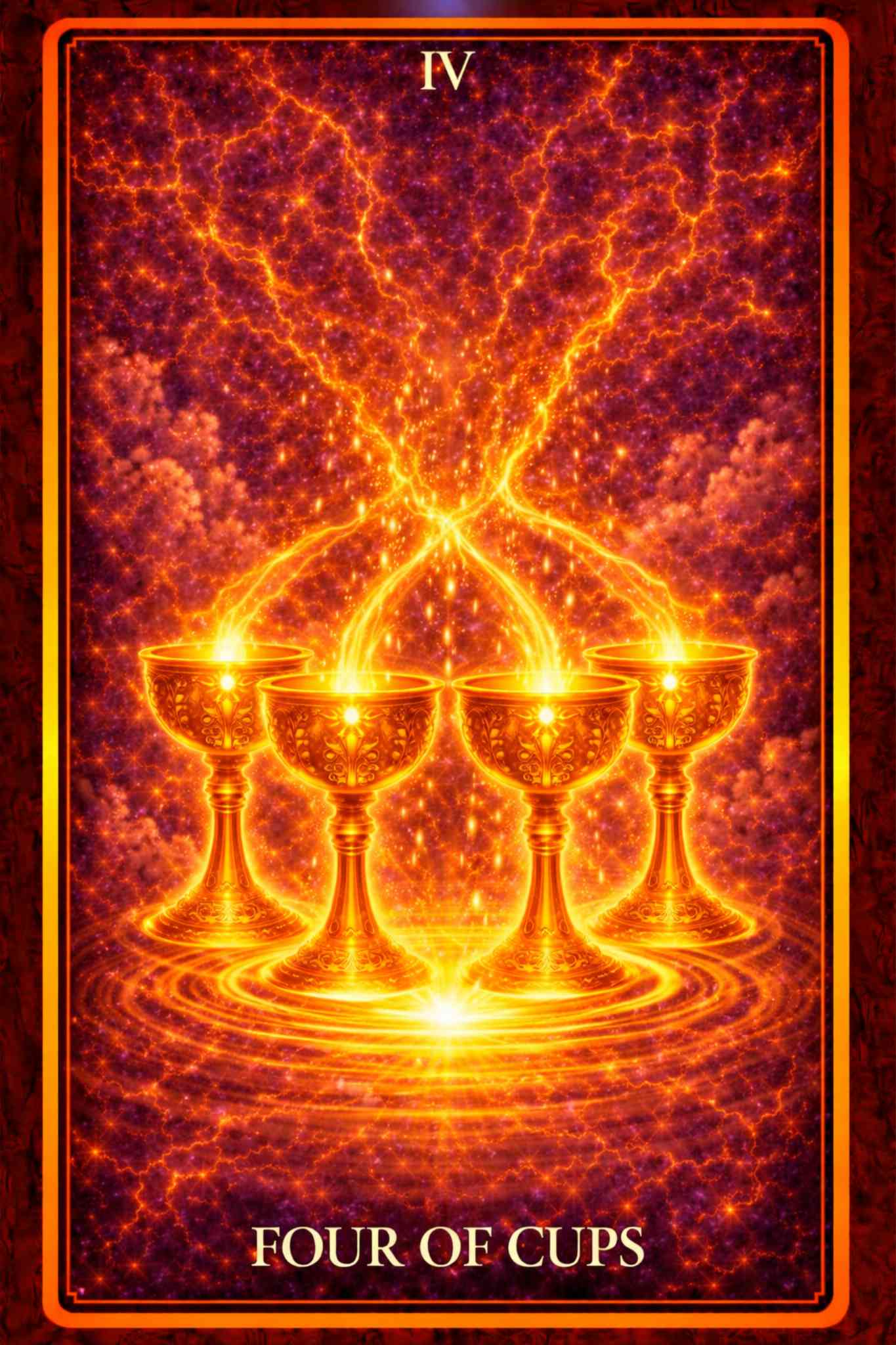
Death and Four of Cups tarot combination meaning
Sometimes the most important change happens when nothing seems to move on the surface. Death and Four of Cups reflects a deeply internal transition, where emotional withdrawal and transformation meet in a quiet but decisive way. The Four of Cups suggests introspection, detachment, or a sense of distance from what is being offered, yet this distance is not empty or passive. Death deepens the experience by revealing that the withdrawal belongs to a larger process of completion, a theme also explored in the Death love meaning when love is read through change, release, and emotional truth. Something has already shifted beneath awareness, and the visible disengagement is only the surface expression of that deeper change.
This combination often appears when emotional response itself begins to transform. What once felt engaging may now feel muted, not because the situation has lost all value, but because the inner connection to it has changed. The Four of Cups turns attention inward, creating a space where external stimuli lose their immediate influence. Death reshapes that inner space, dissolving older emotional patterns that previously defined interest, desire, or reaction. Together, they describe a moment where the absence of feeling is not a lack, but a signal that the emotional system is reorganizing itself.
The essential question in this pairing is not whether something is being missed, but whether the old way of relating has already completed its cycle. The Four of Cups may appear as hesitation or indifference from the outside, yet internally it can hold a very precise awareness: something no longer resonates in the same way. Death confirms that this shift is not temporary. The emotional landscape has changed, and the person is adjusting to that change before new clarity becomes visible.
When disengagement becomes a form of truth
There is a difference between avoidance and disengagement that comes from completion. Death and Four of Cups lives inside that distinction. Avoidance carries tension and resistance, while this kind of withdrawal carries a quieter certainty. A person may notice that they are no longer drawn into situations that once held their attention, not because they are suppressing emotion, but because the emotional charge has naturally faded. This can feel unfamiliar, especially if the identity was previously tied to strong reactions or continuous engagement.
This inner shift can be difficult to explain externally. Others may still see opportunity, value, or emotional importance in the situation, while the individual experiences a growing distance that does not easily translate into words. The Four of Cups does not argue with what is offered. It simply does not respond in the same way. Death supports this by removing the underlying attachment that once created that response. What remains is a quieter awareness that something has already finished its role, even if the outer structure is still present.
This dynamic echoes in Death and The Hermit, where inner withdrawal also meets transformation, yet the Hermit seeks understanding actively, while the Four of Cups reflects a more passive recognition. A related but more sudden internal break can appear in The Tower and Death, where change becomes visible through disruption. Here, the process remains internal, gradual, and almost invisible to others.
The quiet signals of emotional realignment
The experience of this combination can unfold through subtle but consistent signals. These signals are not dramatic, yet they carry a steady message that something within has shifted. The Four of Cups invites observation of these moments without forcing interpretation too quickly. Death ensures that the pattern behind them is meaningful, even if it is not yet fully understood.
- A reduced emotional response to situations that once felt significant
- A sense of distance during interactions that previously felt engaging
- A quiet awareness that certain desires no longer carry the same pull
- A growing preference for stillness over external stimulation
- An emerging clarity that something has already completed, even without a visible ending
These signs do not demand immediate action. They describe an internal recalibration that benefits from space and attention. The absence of urgency is part of the process. The emotional system is adjusting to a new baseline, and that adjustment cannot be forced into clarity before it is ready.
From emotional pause to deeper clarity
While the Four of Cups may appear as stagnation, Death reveals that the pause is purposeful. The emotional distance creates room for a more accurate understanding of what still holds meaning and what has quietly dissolved. This clarity does not arrive as a sudden insight. It develops gradually, often through repeated moments of recognition that something no longer fits in the same way. Over time, this recognition becomes stable enough to guide action.
In this sense, the combination supports a movement from automatic engagement toward conscious selection. A person may begin to notice that they no longer respond out of habit, expectation, or emotional reflex. Instead, engagement becomes more deliberate. What is chosen reflects current truth rather than past pattern. This shift can feel slower, yet it leads to a more precise alignment between inner state and external action.
This process connects naturally with Four of Cups feelings meaning, where emotional distance and introspection are explored in depth, and with Death spirituality meaning, where inner transformation is understood as a gradual release of outdated identity structures. Together, they show that clarity often follows a period where feeling becomes quieter rather than stronger.
The difference between silence and emptiness
One of the more subtle aspects of Death and Four of Cups is the distinction between silence and emptiness. From the outside, both can look similar. A person may appear withdrawn, less expressive, or less responsive than before. Yet internally, these states are very different. Emptiness often carries a sense of loss without direction, while the silence in this combination carries a quiet movement that is not immediately visible. Death reshapes the inner landscape in a way that reduces noise before it introduces new meaning. The Four of Cups holds that reduced state without rushing to fill it.
Need a little more context around this pairing?
A short reading can help you reflect on the tension, direction, or lesson this combination may be pointing toward.
This is why the experience can feel both calm and disorienting at the same time. The absence of familiar emotional reactions removes a kind of internal reference point. What used to signal importance, attraction, or urgency may no longer function in the same way. Without those signals, the person may question whether something has been lost or whether something is simply changing form. Death suggests that the change is structural. The old way of interpreting experience is dissolving, and the new way has not yet fully emerged. The silence is part of that transition.
In practical terms, this can affect how decisions are made and how situations are evaluated. A person may find that they are no longer guided by immediate emotional preference, but by a quieter sense of alignment that takes longer to recognize. This can slow down action, yet it also reduces impulsive choices. The Four of Cups creates space for that slower recognition, while Death ensures that the shift is meaningful rather than temporary. Over time, the silence begins to feel less like absence and more like clarity in its early form.
Letting the old emotional language dissolve
Another layer of this combination concerns the way emotional experience is interpreted. Every person develops an internal language for understanding feeling, built from past experiences, expectations, and learned responses. The Four of Cups reflects a moment when that language begins to lose its precision. Reactions that once felt automatic may now feel distant or unclear. Death deepens this by dissolving the underlying structures that supported those reactions. The person is not only stepping back from situations, but from the meaning they once assigned to them.
This can create a temporary sense of disorientation. Without the old emotional language, it becomes more difficult to label experiences quickly or to respond with certainty. Yet this uncertainty serves a purpose. It prevents the immediate reapplication of patterns that no longer reflect the present. Instead, it allows a more accurate interpretation to form over time. The Four of Cups supports this by maintaining distance, while Death removes the urgency to define everything too quickly. Together, they create a space where new meaning can emerge without being shaped by the past.
As this process unfolds, a different kind of emotional awareness begins to develop. It is less reactive, less dependent on external validation, and more attuned to internal consistency. Situations that once required strong emotional engagement may now be approached with a quieter attention. This does not reduce their importance. It changes the way importance is felt. What remains meaningful tends to feel stable rather than intense, while what has completed its cycle fades without needing dramatic closure.
Re-entry after the inner shift
Eventually, the stillness created by Death and Four of Cups begins to open toward re-engagement, though this re-entry happens differently than before. Instead of returning to previous patterns, the person begins to engage from a place that has already released those patterns. This can create a noticeable shift in behavior, communication, and decision-making. Interactions may become more selective, responses more measured, and emotional investment more intentional.
This phase does not arrive suddenly. It develops as the inner transformation stabilizes. The person may test new ways of engaging, observing how they feel in practice rather than relying on past expectations. Some situations may naturally fall away, while others may take on a new form that better reflects the current state. The Four of Cups remains present as a filter, allowing only what resonates to move forward. Death ensures that what has been released does not quietly return in its previous form.
In this sense, the combination does not end in withdrawal. It leads toward a different kind of presence. The person becomes capable of engaging without being driven by outdated emotional structures. This creates a more sustainable and aligned way of relating to both internal experience and external situations. What began as distance becomes a foundation for clearer connection, shaped by what remains true after the inner shift has completed.
Timing and the value of stillness
The timing of Death and Four of Cups emphasizes internal completion before external movement. The visible world may continue to offer options, interactions, or emotional invitations, yet the response to them remains muted until the inner process stabilizes. This can create a sense of delay, though the delay serves a purpose. Acting too quickly would reconnect the person to a pattern that is already dissolving.
This period benefits from patience and observation. Stillness becomes a form of participation rather than withdrawal. By allowing the emotional shift to complete, the individual creates a more stable foundation for future decisions. What emerges after this phase tends to carry greater clarity because it is not influenced by the residual energy of the past.
The transformation that begins with less
Death and Four of Cups ultimately describes a transformation that begins through reduction rather than expansion. Instead of adding new experiences, the process removes the emotional charge from existing ones. What remains may initially feel minimal, yet it holds a different quality: it is aligned, quiet, and free from unnecessary attachment. This creates space for a new form of engagement to develop, one that reflects the current state rather than the previous identity.
The strength of this combination lies in its subtlety. It does not demand visible change in order to be real. It works through inner adjustment, through the gradual release of outdated responses, and through the emergence of a more precise emotional awareness. Over time, this awareness supports a way of living that is less reactive and more intentional. The absence of immediate clarity is part of that movement, not a sign that something is missing.
Explore the next layer of this reading.
This combination can mean different things depending on context. A short tarot reading can help you reflect on the question behind the cards.
FAQ
Does Death and Four of Cups mean emotional numbness?
It can feel like reduced emotional intensity, yet the combination often reflects transformation rather than absence. The emotional system may be shifting away from previous patterns, creating a temporary distance that allows deeper clarity to form.
Is this a sign to withdraw from situations?
It can indicate that stepping back is part of a natural process. The withdrawal does not need to be forced. It usually arises on its own as certain experiences lose their previous emotional resonance.
Can this combination lead to clarity?
Yes, although the clarity tends to develop gradually. The initial phase may feel uncertain, yet over time it reveals what still holds meaning and what has already completed its cycle.
What is the main message of this pairing?
The central message is that emotional disengagement can be a form of transformation. What appears as distance may actually be the beginning of a more aligned and conscious way of relating to life.
More combinations with Death
More combinations with Four of Cups
Continue with Death
Explore Related Guides by Topic
If you want to explore this combination through a more specific emotional lens, these tarot guides can help you follow the broader pattern behind the reading.