
Justice + Four of Cups
Explore how these two tarot cards interact in a reading through symbolic overlap, contrast, and shared narrative. Tarot combinations often reveal meaning that neither card fully expresses on its own.
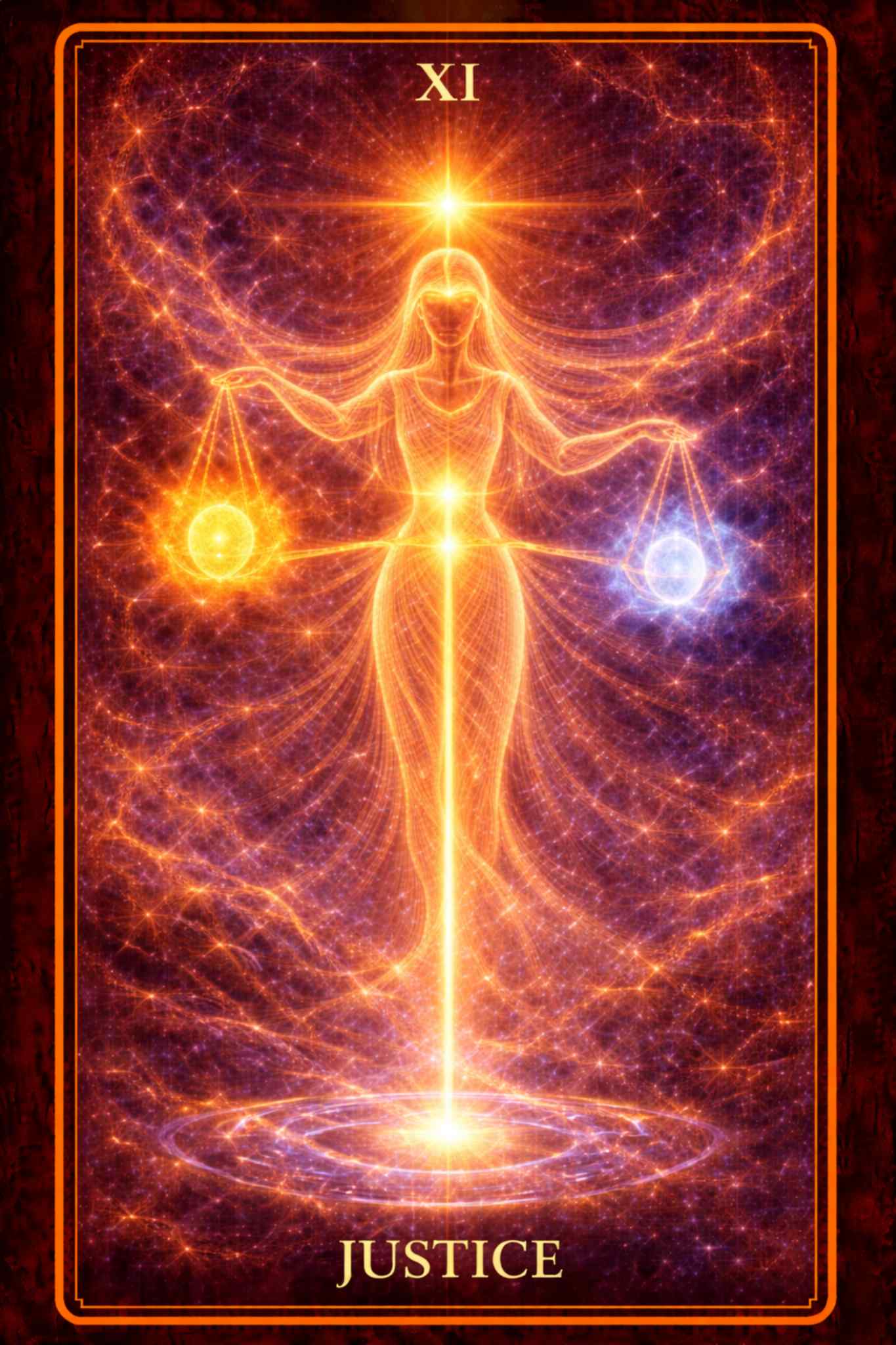

The Justice and Four of Cups tarot combination meaning
Justice and Four of Cups is a pairing about emotional distance that deserves to be understood with patience, honesty, and inner precision. The Four of Cups brings pause, inwardness, dissatisfaction, emotional reserve, and the feeling that something in front of you may be available without truly reaching the heart. Justice enters that atmosphere and asks what this withdrawal is really saying. Is the distance revealing a genuine misalignment? Is it showing emotional fatigue after too much inner strain? Is it protecting a deeper truth that has not yet been given clear language? This combination does not rush toward a dramatic conclusion. Instead, it asks for careful interpretation, because the emotional silence here often contains more meaning than it first appears to hold.
There is a sober quality in this pairing that makes it especially valuable in readings where the situation feels quiet, slow, or difficult to define. The Four of Cups often appears when enthusiasm has faded, when emotional response has become muted, or when a person is no longer willing to accept surface-level fulfillment as enough. Justice does not intensify that mood. It clarifies it. It wants to know whether the pause is wise, whether the dissatisfaction is accurate, and whether the reluctance is helping truth emerge or simply keeping life at a distance. This creates a reading that feels psychologically mature. It does not flatter every feeling, yet it does not dismiss emotional reserve either. It takes the inner state seriously and asks what it is truly communicating.
In many readings, this pair shows a moment when someone can no longer move forward through emotion alone. They need to understand what they feel before they decide what anything means. That is where Justice becomes essential. It brings proportion, discernment, and a willingness to look at the situation without exaggeration. The Four of Cups supplies the silence, the pause, and the emotional ambiguity. Justice asks which parts of that ambiguity are meaningful and which parts belong to old disappointment, temporary dullness, or a habit of staying inward. When read together, these cards often point to the kind of truth that surfaces slowly. It is not loud truth. It is not impulsive truth. It is the kind of truth that becomes visible only after emotional noise has settled enough for a person to hear themselves clearly.
When withdrawal becomes a form of discernment
The Four of Cups is often reduced to boredom, but that reading is far too thin for what this card can actually represent. It may reflect emotional saturation, disappointment, selective receptivity, spiritual dryness, uncertainty about what is being offered, or a growing awareness that outward options are failing to connect with a deeper need. Justice meets that emotional condition and asks for precision. What exactly feels absent? What feels unconvincing? What feels out of balance? These questions matter because the Four of Cups can look similar from the outside whether it is expressing wisdom, weariness, self-protection, or a valid refusal of something that lacks deeper alignment.
This is why Justice strengthens the card so effectively. It turns a vague mood into a truth-testing space. Rather than assuming that emotional withdrawal automatically means disinterest, Justice examines the structure underneath it. Sometimes the heart is stepping back because it senses a subtle imbalance that has not yet been openly named. Sometimes it is stepping back because it is tired, overfull, or reluctant to engage again before it feels safe and genuine. The combination allows both possibilities, but it asks that they be told apart. That difference is the heart of the reading.
There is also an important maturity in the way these cards work together. The pairing does not demand that a person become instantly responsive again. It respects the possibility that reserve may be intelligent. Yet it also invites responsibility. If you are emotionally distant, what is that distance helping you see? If you are dissatisfied, what is the source of that dissatisfaction? If you are hesitant, what truth is asking to be named more directly? Justice asks for cleaner inner language, because once the emotional state is named more honestly, the path forward becomes easier to recognize.
This combination can be understood more clearly when placed beside a brighter Justice pairing. In Justice and The Sun, truth tends to arrive through openness, illumination, and direct emotional visibility. Justice and Four of Cups, by contrast, works through quieter recognition. It often reveals what is true through contrast, emotional restraint, and the slow realization that surface offers and deeper needs are not always the same thing.
Love and relationship meaning
In love readings, Justice and Four of Cups often points to a relationship atmosphere where emotional hesitation has become significant. One person may be pulling back, feeling less responsive, reflecting more deeply, or questioning whether the connection is truly fulfilling on an emotional level. Justice asks whether that distance reflects a real perception of imbalance or whether it is being shaped by tiredness, fear of disappointment, or a current inability to receive what is present. This distinction changes the whole tone of the reading. The cards do not reduce the situation to a simple yes or no. They show an emotional state that needs honest examination before its meaning becomes fully clear.
Sometimes this pair appears when a connection has potential but the emotional field around it feels incomplete. Something may be present, yet something may still be missing. The Four of Cups often lives in that in-between space where a person cannot wholeheartedly accept what is being offered, though they may also feel uncertain about leaving it behind. Justice brings structure to that state. It asks what the relationship is actually giving, what the heart is actually receiving, and whether the dissatisfaction points to a real issue in the bond or to an unresolved inner condition that colors how the bond is being experienced. This makes the combination especially useful for understanding nuanced emotional dynamics that are more complex than simple attraction or simple rejection.
When reading about another person’s emotional stance, Justice and Four of Cups can suggest that they are in a reflective phase. Their feelings may be present but restrained. They may be measuring the connection carefully, trying to determine whether it is fair, meaningful, or emotionally substantial enough to invite deeper participation. That does not automatically signal coldness. It can describe someone who is looking for sincerity, proportion, and inner certainty before offering more of themselves. Even so, the combination also suggests that prolonged hesitation eventually asks for honesty. Reflection is valuable when it leads somewhere.
If you want a useful contrast with a more openly reciprocal emotional Justice pairing, Justice and Two of Cups highlights what happens when emotional balance is visible, mutual, and relationally active rather than inward and reserved. That comparison can help reveal whether the current reading leans toward contemplation, hesitation, or a bond that is still trying to define its emotional truth.
For a closer look at how this card behaves when feelings become selective, quiet, or difficult to express clearly, the Four of Cups feelings meaning can deepen the interpretation. That page explores how inwardness, emotional reserve, and reduced responsiveness shape the card on its own, while Justice in this combination adds the need for clarity, accountability, and emotional honesty.
Emotional flatness, dissatisfaction, and what they may reveal
One of the strongest themes in Justice and Four of Cups is the difference between emotional flatness as a passing condition and emotional flatness as a message. Sometimes people interpret a quieter emotional state too quickly. They assume that because they feel less moved, less excited, or less emotionally engaged, the situation itself must lack meaning. Justice slows that process down. It asks whether the current emotional tone is the whole truth or only one part of it. The Four of Cups shows the muted response; Justice asks for deeper interpretation.
At other times, dissatisfaction really is the message. A person may sense that what is being offered does not match what they need, value, or trust. The Four of Cups may then describe a valid emotional refusal, even if the reason for that refusal has not yet been spoken clearly. Justice helps the person understand that difference. It supports honest recognition of what is real instead of pushing emotional participation where deeper alignment is absent. This is one reason the combination feels so adult. It respects emotional truth without confusing every mood with final knowledge.
The challenge is to remain curious and exact. What, specifically, feels emotionally incomplete? What expectation has changed? What truth has become harder to ignore? Justice encourages direct engagement with those questions. The more clearly they are answered, the less likely a person is to stay suspended in a haze of vague dissatisfaction. The pairing wants the emotional state to become readable. Once that happens, the next step can be approached with more steadiness.
The value of stepping back before deciding
Justice and Four of Cups often appears when stepping back is part of the wisdom of the moment. In emotionally complex situations, distance can restore proportion. It allows a person to hear their own thoughts without being overwhelmed by pressure, projections, or immediate reactions. The Four of Cups creates that inward chamber. Justice gives it purpose. Together, they describe a pause that can become deeply clarifying when it is used with awareness.
Need a little more context around this pairing?
A short reading can help you reflect on the tension, direction, or lesson this combination may be pointing toward.
This is especially important when the emotional field has become cluttered or confusing. A person may have received mixed signals, felt uncertain about their own response, or reached a point where they no longer want to perform engagement they do not genuinely feel. Justice supports stepping back from that confusion in order to see more accurately. It reminds the reader that reflection is not wasted time when it leads to better understanding. In fact, some decisions become far cleaner after a period of emotional quiet.
Still, the combination also suggests that withdrawal works best when it remains alive and observant. A pause becomes meaningful when it helps something surface. Over time, Justice asks what that space has revealed. Has it shown misalignment? Has it revealed a hidden need? Has it exposed fatigue, grief, or reluctance that was being mistaken for truth? The cards support the pause, but they also ask that the pause become fruitful. Clarity is their deeper aim.
Timing, decisions, and the pace of inner truth
Timing matters greatly with this pair. Justice and Four of Cups often suggests that emotionally important conclusions benefit from a slower, more deliberate process. A person may need time to separate current feeling from lasting truth. The Four of Cups frequently appears when the heart has drawn inward and is still processing what it has experienced. Justice asks that conclusions arise from comprehension rather than from temporary emotional weather. This does not create passivity. It creates better timing.
Sometimes the cards show someone wanting a final answer while their inner state is still evolving. They may be searching for certainty before the emotional material has fully clarified. Justice softens that pressure by encouraging a more measured approach. What is already clear? What still needs reflection? Which parts of the situation belong to fact, and which belong to mood, expectation, or unspoken disappointment? These questions help the reader move toward a conclusion that feels honest and balanced rather than premature.
When a more structured process would help separate emotional reserve from deeper guidance, the Decision Tarot Spread fits this combination especially well. Justice responds naturally to readings that invite weighing, comparison, and honest evaluation, while the Four of Cups benefits from a layout that turns subtle inner reactions into something more visible and easier to interpret.
There are also times when this pairing suggests that the right decision will feel quieter than expected. Instead of arriving through sudden certainty, it may arrive through the gradual settling of emotional confusion. Justice trusts that kind of clarity. It does not need the answer to be dramatic. It only needs the answer to be true.
Shadow expression and inner challenge
The more difficult side of Justice and Four of Cups appears when discernment becomes emotional withholding without resolution. A person may remain in reserve for so long that the pause itself becomes a habit. They may keep examining their feelings without moving toward a clearer naming of what those feelings actually mean. In that case, the Four of Cups can drift into stagnation. Justice responds by pressing for greater precision. It asks for truthful interpretation rather than endless suspension.
Another challenge arises when dissatisfaction is granted too much authority without enough examination. Emotional fatigue can sometimes make every option appear unconvincing. Past disappointments can influence perception. Subtle fear can look like wisdom if it is never questioned. Justice does not invalidate emotional reluctance, but it does ask whether that reluctance is accurately reading the current situation. This can be a deeply helpful correction, especially in readings where someone is tempted to treat emotional flatness as final evidence rather than one piece of a more layered truth.
There is also a quieter shadow here involving self-protection. A person may feel safer staying uncertain than risking participation, clearer commitment, or a direct expression of what they truly need. The Four of Cups can hold that reserve beautifully for a time, because it gives the person somewhere inward to stay. Justice gently asks whether staying there is still serving clarity. This is not a harsh question. It is an honest one. Its purpose is to help the person understand whether the pause is preserving truth or postponing it.
If you want to compare this inner challenge with a more intense major-to-major pattern where truth meets attachment and psychological complexity, Justice and The Devil offers another useful lens. That combination explores where inner honesty must face deeper entanglement, while Justice and Four of Cups is often quieter, more restrained, and more emotionally muted in how the tension presents itself.
Spiritual and inner meaning
On an inner level, Justice and Four of Cups can represent a spiritually significant period of sober self-examination. This may feel less like revelation and more like quiet sorting. Emotional life may have become calmer, flatter, or more selective, and through that condition a person begins to notice what truly resonates and what no longer carries real nourishment. Justice strengthens this process by helping the person stay honest with themselves. The Four of Cups provides the inward space where that honesty can deepen.
This kind of inner phase often strips away easy emotional narratives. A person may lose interest in what once seemed compelling. They may become less available for superficial reassurance. They may start wanting something more substantial, more aligned, and more inwardly true. Justice honors that shift. It gives shape to the process by asking the person to discern clearly what has changed and why. As a result, the spiritual lesson of this pair is rarely about quick transcendence. It is about mature alignment. It is about becoming honest enough to recognize what the soul can genuinely receive and what it can no longer engage with merely out of habit.
For another angle on how Justice behaves when the inner journey turns more directly toward vocation, responsibility, and long-term purpose, the Justice career meaning can add a helpful layer. That page focuses on the card in a more external context, yet it also shows how Justice repeatedly asks for integrity, proportion, and decisions that are grounded in what is genuinely sustainable.
Where emotional distance becomes meaningful
Justice and Four of Cups ultimately describes a pause that asks to be used well. Emotional distance, dissatisfaction, reserve, and inwardness may all be present, yet the deeper meaning of the combination depends on what those states are revealing. If the withdrawal is showing that something lacks integrity or emotional substance, the cards support recognizing that clearly. If it is showing exhaustion, self-protection, or a heart that needs time to trust its own response again, the cards support seeing that honestly too. Either way, the purpose of the pause is understanding.
This is what makes the pairing so quietly powerful. It does not force brightness onto a muted emotional season, and it does not treat every hesitation as a problem to be solved immediately. Instead, it asks whether the inner state is being read with fairness, depth, and truth. The Four of Cups provides the silence. Justice asks what in that silence can actually stand. Once the answer begins to form, the next step often becomes much cleaner. What seemed like simple withdrawal can reveal itself as wise discernment, a necessary correction, or a quieter path toward emotional authenticity.
In that sense, Justice and Four of Cups teaches a mature lesson. Emotional responsiveness is valuable, but so is emotional honesty. Pause is valuable, but so is clarity. Distance is meaningful when it helps a person recognize what is true, what is fading, and what still deserves their energy. That is the deeper gift of this combination: it shows that stepping back can become a form of insight when it is used to understand the heart rather than escape it.
Ready to see how this applies to your situation?
A focused tarot reading can help you explore how Justice + Four of Cups may reflect your current situation, not just the general meaning of the cards.
FAQ
Does Justice and Four of Cups mean emotional distance?
It often points to emotional reserve, hesitation, or a quieter inner state, while also asking what that distance is truly revealing.
Is this combination difficult for love readings?
It can reflect uncertainty or dissatisfaction, yet it also helps reveal whether the connection is emotionally aligned and honestly understood.
What is the central lesson of Justice and Four of Cups?
To use pause and emotional distance as tools for deeper clarity, so that understanding can guide the next step with greater balance.
More combinations with Justice
More combinations with Four of Cups
Continue with Justice
Explore Related Guides by Topic
If you want to explore this combination through a more specific emotional lens, these tarot guides can help you follow the broader pattern behind the reading.