
The Fool + Eight of Swords
Explore how these two tarot cards interact in a reading through symbolic overlap, contrast, and shared narrative. Tarot combinations often reveal meaning that neither card fully expresses on its own.
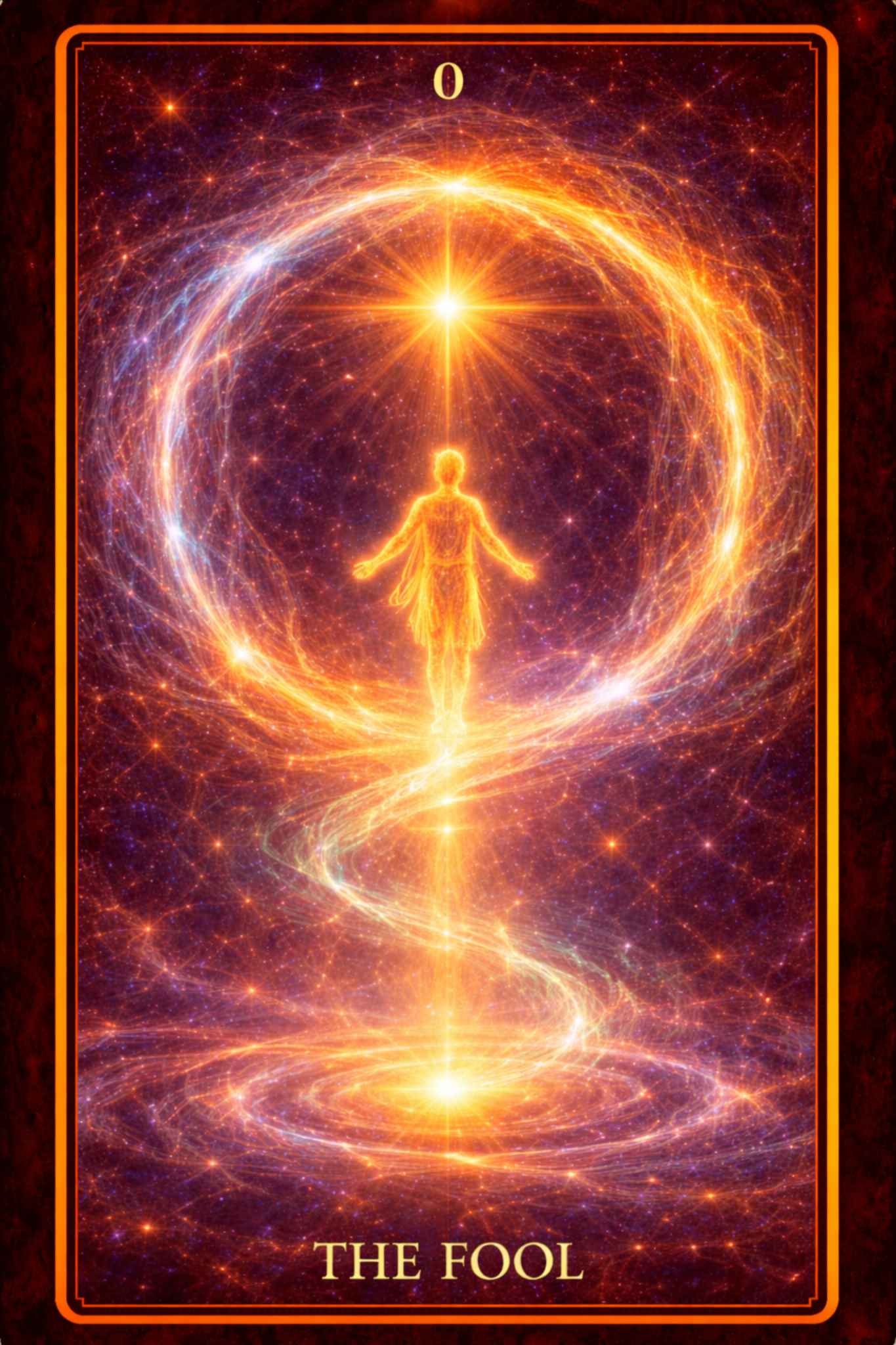
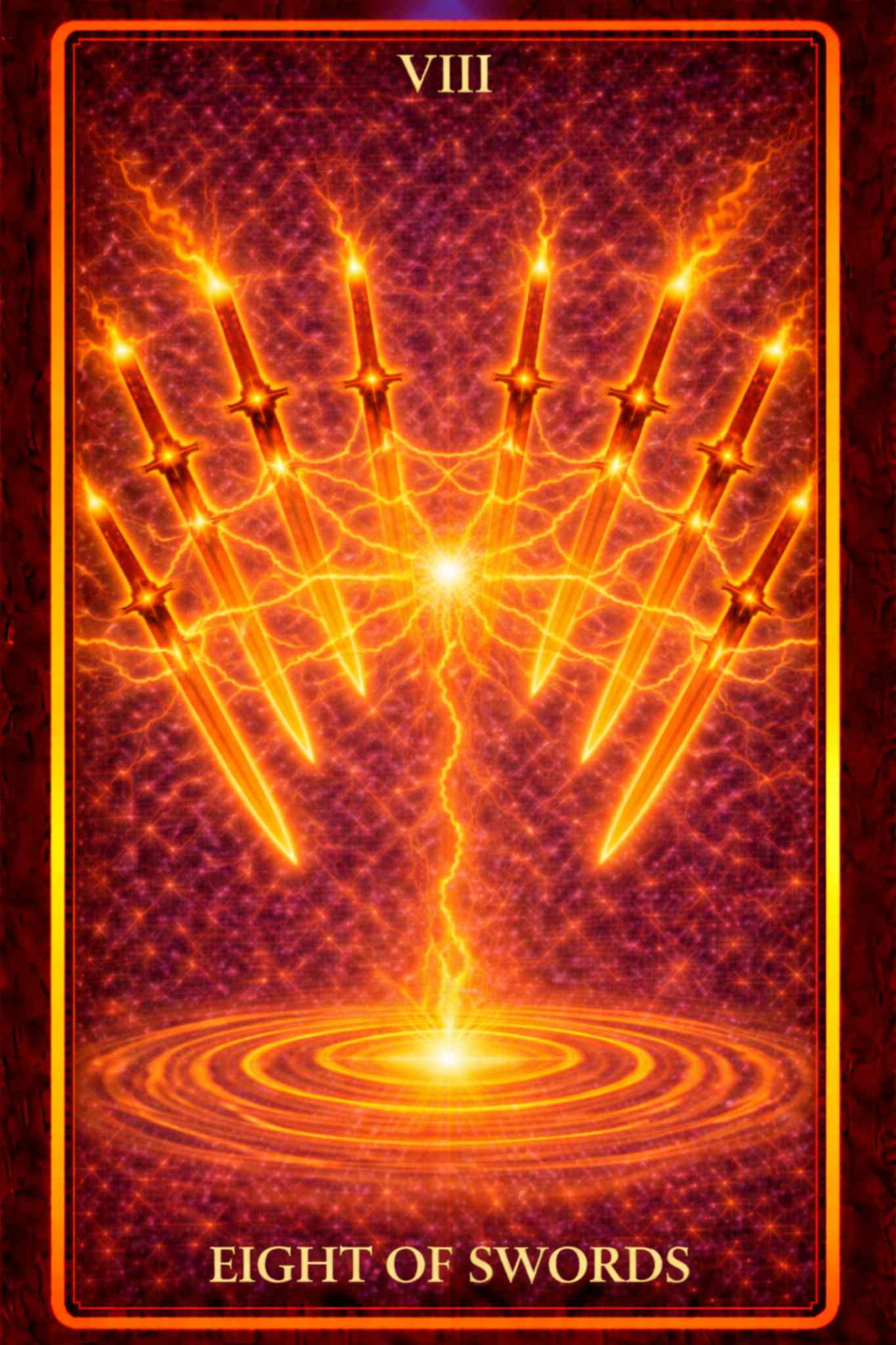
The road is visible, but the mind feels tied
The Fool and Eight of Swords has one of the most poignant tensions in the Swords sequence. The road is near, the threshold is real, and some part of the person may already sense that life is asking for movement. Yet the mind feels wrapped in its own restrictions. The Fool brings the possibility of a first step into new air. The Eight of Swords surrounds that step with fear, self-doubt, limiting thoughts, imagined consequences, and the painful belief that there may be no bearable way to move.
This is not a simple story of weakness. The Eight of Swords often appears where the mind has learned to protect itself by narrowing the field of possibility. A person may have been criticized, overwhelmed, conditioned, pressured, or repeatedly taught that movement brings danger. They may now stand before a real opening and still feel trapped inside the old mental architecture. The Fool does not mock that fear. It brings a small current of freshness into the locked room and asks whether every wall is truly as solid as it feels.
The emotional atmosphere is tender because the person may want freedom while fearing the act of choosing it. They may overthink every message, rehearse every possible failure, imagine every criticism, or freeze before a decision that another part of them quietly longs to make. The Eight of Swords can make the unknown feel like proof of danger. The Fool reminds the reader that unknown territory is not automatically hostile. It may simply be unpracticed, and the first step may need to be smaller, gentler, and more conscious than a dramatic leap.
A cage made of thoughts still feels like a cage
The strongest layer of this combination is mental restriction at the edge of possibility. The person may be physically able to move, speak, ask, leave, begin, apply, create, or choose, yet inwardly they feel held by thoughts that repeat the same warning. What if I fail. What if I am wrong. What if I look foolish. What if the old story was right about me. The Fool does not answer those fears with shallow positivity. It brings attention back to the present threshold: what is actually here, and what has the mind added from past pain?
Compared with The Fool and The Devil, where the open road may meet attachment, temptation, shadow patterns, or a familiar chain that still has emotional pull, the Eight of Swords feels more inwardly mental and enclosed. The restriction is less about desire binding the person to an old pattern, and more about the belief that movement itself may be unavailable. The Fool changes this by introducing the possibility of motion before total confidence. A person may not be ready to run, but they may be able to shift one thought, loosen one inner binding, ask one question, or take one grounded step toward the edge of the circle.
The Eight of Swords yes or no meaning can help when the issue has become mentally cramped around a single answer. This pair often suggests that the deeper issue is the frame of the question itself. Sometimes the mind asks yes or no because it wants relief from complexity, while the true movement begins by noticing the assumptions that make both answers feel frightening. The Fool adds fresh perspective, but that perspective needs room to breathe.
The first step may be smaller than the fear imagines
When the Eight of Swords surrounds The Fool, the idea of beginning can become exaggerated. The mind may turn one message into a life-altering risk, one application into a verdict on self-worth, one honest sentence into the collapse of a relationship, or one boundary into total abandonment. The Fool softens that exaggeration by returning the beginning to scale. A first step does not always need to be a public leap. It may be a private admission, a short conversation, a draft, a question, a walk, a small act of research, or the decision to stop calling fear the only intelligent voice in the room.
Need a little more context around this pairing?
A short reading can help you reflect on the tension, direction, or lesson this combination may be pointing toward.
This combination is especially useful for understanding the difference between caution and captivity. Caution gathers information, checks reality, and respects limits. Captivity repeats fear until no amount of information feels enough. The Fool needs caution because new paths deserve awareness. The Eight of Swords needs the Fool because awareness can turn into paralysis when the mind tries to control every possible outcome. Together they form a difficult but hopeful image: the person does not need to tear through every sword at once. They need to notice where one opening may already exist.
In spiritual or self-reflective work, the Fool spirituality meaning adds the sense of returning to experience before the mind has over-defined it. With the Eight of Swords, that return may feel almost radical. The person is invited to meet one small part of life directly rather than through the full machinery of fear. This does not erase deeper fear, difficult history, or real-world constraints. It simply offers a symbolic image for reclaiming one inch of inner movement.
Love, fear, and the story the mind keeps rehearsing
In relationship readings, The Fool and Eight of Swords can describe a person who is curious, emotionally open, or drawn toward a new relational space while feeling trapped by fear. They may want to reach out but feel unable. They may long for trust, while another part of them keeps searching the situation for signs of risk. They may feel the possibility of a new chapter but become bound by older experiences, past disappointments, shame, or the belief that choosing will lead to loss. The cards do not confirm what another person feels or plans. They illuminate the mental enclosure around the possibility of connection.
This can also appear when someone is afraid to leave a painful pattern because the unknown feels more frightening than the familiar discomfort. The Fool brings the sense that another path exists, yet the Eight of Swords shows how the mind can make even a door look like a threat. If the question involves feelings, the Eight of Swords feelings meaning gives more detail around emotional inhibition, fear-based interpretation, and the difficulty of acting while mentally overwhelmed. The pair asks for compassion without turning fear into the final authority.
A person under this combination may need patience from themselves and clarity from the situation. If communication is possible, it may need to be simple and non-cornering. If a boundary is needed, it may need to be framed in a way that protects reality rather than amplifying panic. If the connection is unsafe or coercive in practical terms, tarot reflection should not replace trusted support, real-world help, or careful planning. In ordinary emotional uncertainty, however, the pair asks whether the mind is reading the present moment or replaying an older room.
When the first opening appears inside the thought
The timing of this combination rarely favors dramatic movement from a place of panic. The Eight of Swords needs enough calm to recognize that fear is speaking, while The Fool needs enough courage to avoid waiting for perfect confidence. A more grounded moment begins when the person can name one specific fear instead of feeling trapped by a cloud of unnamed dread. Once the fear has a shape, the first step can become more realistic. It may still feel uncomfortable, but it no longer looks infinite.
This pair often supports gradual action after a shift in perception. That shift may be subtle: realizing that a thought is inherited, noticing that a worst-case scenario is not the same as intuition, admitting that no one has demanded perfection except the inner critic, or recognizing that staying frozen is also a choice with consequences. The Fool does not need certainty before moving. It needs enough presence to begin without surrendering leadership to fear. The Eight of Swords does not need to disappear before the path opens. It needs to lose its claim to being the whole truth.
If a reading needs structure around the mental knot, a problem solution tarot spread can be useful in a reflective way. The problem may not be the outside situation alone. It may be the way the mind has framed the situation so tightly that no humane movement seems possible. The solution may not be instant courage. It may be a smaller, cleaner relationship with the thought that says there is no way forward.
Ready to see how this applies to your situation?
A focused tarot reading can help you explore how The Fool + Eight of Swords may reflect your current situation, not just the general meaning of the cards.
The open road waits for the mind to loosen
The Fool and Eight of Swords is a compassionate combination for the person who wants to begin but feels mentally bound. It speaks of possibility held inside fear, fresh movement surrounded by old thought patterns, and the difficult first step toward inner freedom. Its gift is the reminder that the cage may contain real feelings, real history, and real stress, while still not being the whole landscape. Its challenge is to begin gently enough that the frightened mind can come along.
The final image is not a fearless leap. It is a person standing in a ring of swords, hearing the road beyond them before they can fully see it. One binding loosens. One breath returns. One thought becomes less absolute. The Fool does not demand that the person become brave in a single moment. It offers something quieter and perhaps more lasting: the possibility that freedom can begin as a small correction inside the mind, long before the feet take their visible step.
More combinations with The Fool
Continue with The Fool
Explore Related Guides by Topic
If you want to explore this combination through a more specific emotional lens, these tarot guides can help you follow the broader pattern behind the reading.