
Eight of Swords Intentions Meaning
Card: Eight of Swords
Meaning type: Intentions Meaning
Introduction
Eight of Swords as intentions often reflects a state where someone may want to engage, yet feels limited by fear, uncertainty, pressure, or inner conflict. This card rarely points to clear, confident intentions moving freely. More often, it suggests that a person's intentions are constrained by how trapped, overwhelmed, or mentally burdened they feel within the situation.
In many readings, this card indicates hesitation more than direction. The person may be thinking intensely about the connection, yet struggle to translate that into steady action. Their intentions can feel narrowed by self-protection, overthinking, or the sense that any move could create consequences they do not feel ready to handle.
This does not automatically mean there is no interest or no care. It often means the person is operating from a restricted emotional and mental position. They may intend to hold back, stay cautious, avoid complexity, or protect themselves until they feel more clarity. In some cases, they may genuinely feel unable to move with openness, even if part of them would like to.
The Eight of Swords invites a careful reading of capacity as much as intent. The person may have internal motives, feelings, or wishes, yet their ability to carry them forward may be reduced by fear, confusion, or the belief that they have fewer options than they actually do.
Arvethis Lens: Eight of Swords as intentions reflects hesitation, inner restriction, and intentions shaped more by fear, uncertainty, or self-protection than by free and open movement.
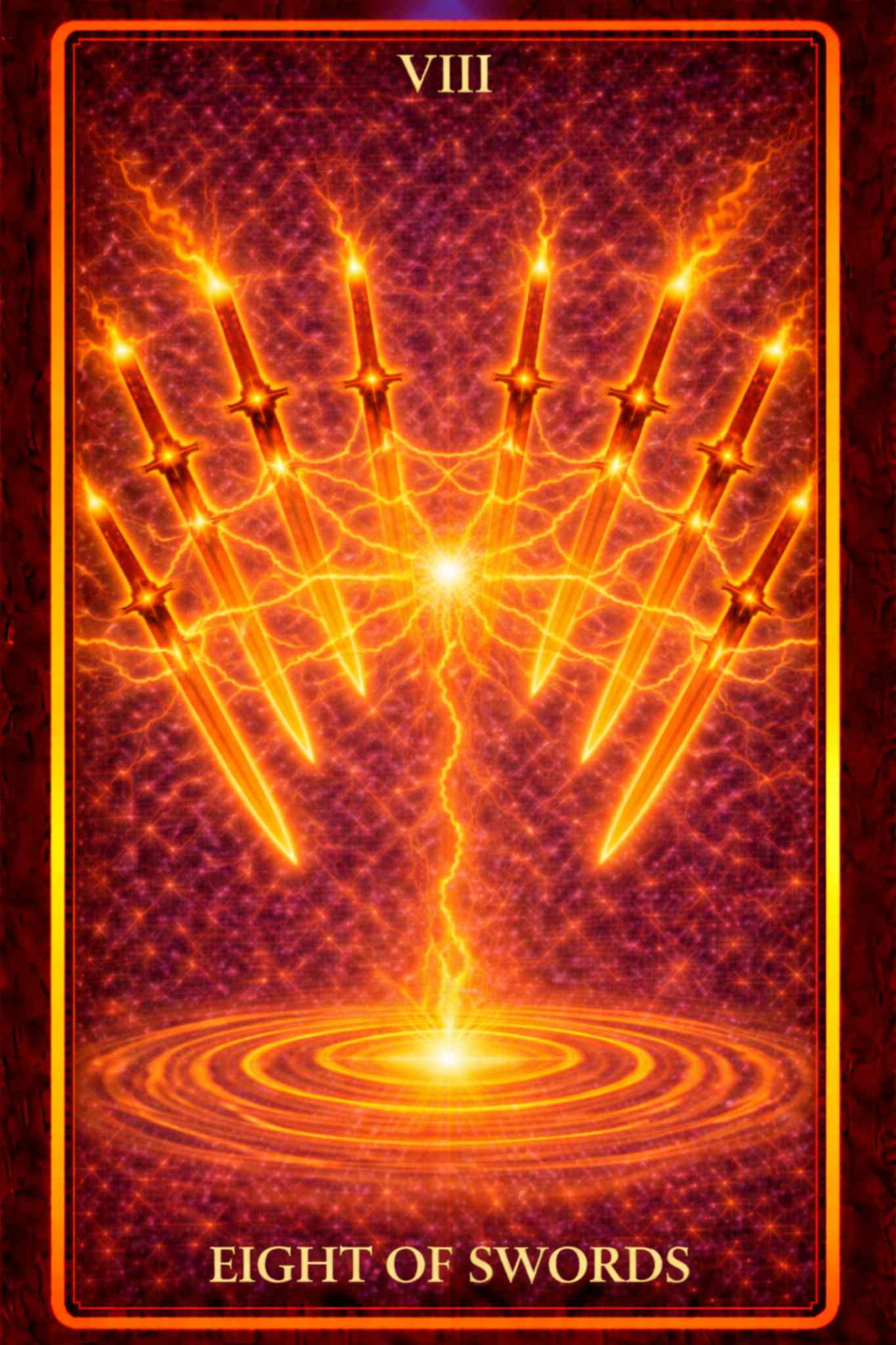
Eight of Swords Upright in Intentions
Upright, Eight of Swords shows the healthier expression of the archetype. The central themes here are restriction, fear, overthinking, paralysis, self-limiting perception, and pressure created by the mind’s own enclosure. In Arvethis work, upright Swords energy is not read as sterile rationality. It is read as discernment that has enough coherence to become useful. The truth is not necessarily comfortable, but it is more likely to be honest, readable, and capable of supporting wise action.
With this card, the upright form often reveals restriction, mental entrapment, fear, learned helplessness, and the narrow perception that makes freedom feel unreachable. In practical life, that may show up as cleaner communication, sharper judgment, stronger boundaries, more honest self-observation, or a willingness to face what is difficult without immediately collapsing into drama or denial. The mind is moving in a way that can clarify rather than merely intensify.
Still, upright does not mean automatic perfection. Even a strong Swords card can be mishandled if people confuse bluntness with maturity or assume that seeing the truth is the same as using it wisely. Arvethis always asks the next grounded question: is the clarity being supported by timing, behavior, and ethics? When the answer is yes, upright Swords energy can become one of the clearest signs of real alignment in a reading.
Because the upright current is usually more coherent, the situation often becomes easier to interpret. You can sense where the truth is crystallizing, where the decision point is forming, and where the lesson of discernment is becoming visible. That precision is one reason Swords cards can feel so powerful when read well: they help name what has already been structuring the story beneath the noise.
Eight of Swords Reversed in Intentions
Reversed, Eight of Swords shows that the mental current is not moving in a fully clean or simple way. The reversed themes here are release, wider perspective, self-liberation, but also panic, destabilization, or difficulty trusting new freedom. In Arvethis interpretation, this does not mean the truth disappears. It means the truth is blocked, distorted, delayed, weaponized, fragmented, hidden, or difficult to trust at face value.
The shadow of this card often involves believing the prison is absolute when part of the confinement is maintained by thought, habit, or fear. That is why reversed Swords can be so nuanced. There may still be intelligence, awareness, motive, or insight present — but the mental energy does not yet have a healthy enough container to express itself clearly. Something about the way the truth is being held is complicating the picture.
Reversed air often reveals the difference between thought and wisdom. A person may see accurately but communicate badly. A situation may contain truth but also too much fear. A boundary may be necessary and yet be expressed harshly. A strategy may be clever and still fail ethically. The reversal helps show where the clear perception exists, and where its expression is still under strain.
In Arvethis work, reversals are diagnostic rather than punitive. Reversed Eight of Swords says: slow down, name what is mentally unclear, and let reality test the story. That approach protects the reading from false certainty while still honoring the symbolic depth of the card.
What intentions pages are best for
Intentions readings are strongest when they focus on direction and follow-through. Ask what the card suggests about motive, readiness, avoidance, sincerity, and whether desire is likely to become consistent action.
What This Suggests About Intentions
The Eight of Swords is a card of restriction, and in an intentions reading it often suggests that someone's approach is being limited by their own mental or emotional state. This does not usually describe a person moving with confidence, clarity, or emotional freedom. Instead, it points toward someone whose intentions are constrained, cautious, or difficult to act on because they feel trapped within their own thoughts or fears.
In relational questions, this can create a confusing atmosphere. A person may seem inactive, inconsistent, withdrawn, or overly careful, even when the connection matters to them on some level. The card often shows that their intentions are being filtered through anxiety, uncertainty, or the need to avoid risk.
Hesitation Instead of Clear Forward Movement
One of the clearest themes of this card is hesitation. A person may intend to wait, pause, hold back, or avoid making the situation more complicated than it already feels. Their focus may be on managing pressure rather than building momentum. Because of that, their intentions can feel passive even if their inner world is active.
This passivity is often linked to mental overload. They may be considering too many possibilities, fearing the wrong move, or feeling unable to see a path that feels emotionally safe. The result is often delay rather than decision.
Self-Protection and Restricted Capacity
The Eight of Swords often suggests that self-protection plays a strong role in the person's intentions. They may be trying to protect themselves from vulnerability, conflict, rejection, embarrassment, or emotional complexity. That protective instinct can shape the entire way they approach the connection.
In practice, this may mean they intend to remain careful, emotionally guarded, or difficult to read. They may avoid direct conversation, avoid defining the connection, or avoid taking visible steps because those actions feel too exposing from where they currently stand.
If You Are Asking About Romantic Intentions
In romantic readings, this card often suggests that the person's intentions are limited by fear or emotional restriction. They may be interested, yet too hesitant to move clearly toward the connection. They may want to protect themselves, avoid emotional risk, or stay in a space that feels mentally manageable rather than emotionally open.
This can create a situation where the connection feels stalled. The person may not be acting from clean indifference, but they may still be unable to bring enough clarity or freedom into their intentions for the relationship to move naturally.
If You Are Asking About Someone New
With someone new, the Eight of Swords can indicate that the person intends to proceed very cautiously, if at all. They may feel uncertain about what they want, unsure how to read the situation, or overly focused on what could go wrong. This can make their intentions feel guarded and slow to develop outwardly.
The connection may still matter to them, but the card suggests that their internal restrictions are shaping how much room they allow themselves to engage.
If You Are Asking About an Existing Relationship
Within an established relationship, the Eight of Swords can reflect intentions shaped by emotional fatigue, feeling trapped, or uncertainty about how to handle the next stage of the bond. A person may intend to avoid conflict, avoid difficult decisions, or stay within familiar patterns because they do not yet see a freer way forward.
In this context, the card can indicate that the relationship is being approached through pressure rather than clarity. The person may feel emotionally boxed in, and their intentions may reflect that burden more than their deeper desires.
The Difference Between Intention and Ability
This card strongly highlights the difference between what someone may inwardly want and what they are actually able to carry into action. A person may have emotional motives, curiosity, or even care, yet still feel too constrained to act with openness. Their intention may therefore be defensive, delayed, or indirect even if deeper feeling exists underneath it.
This distinction matters because the Eight of Swords often shows a person whose capacity is reduced by fear, overthinking, or a sense of entrapment. Understanding that can explain why the connection feels limited without forcing the reading into a simple category.
The Shadow Side of Eight of Swords as Intentions
The shadow side of this card can appear as avoidance, paralysis, mixed signals, or the repeated choice to remain in a mentally safe but emotionally restrictive position. A person may tell themselves they have no options when in reality they are unable to trust any option enough to take it. This can create stuck patterns that affect the connection over time.
There can also be moments where the person's intentions revolve around maintaining control through distance. Rather than risk exposure, they may intend to keep the situation limited, unclear, or emotionally contained.
Reading This Card with Clarity
When the Eight of Swords appears in an intentions reading, it is often useful to ask what is constraining the person. Are they afraid of vulnerability? Are they overwhelmed by the complexity of the situation? Do they feel trapped by other circumstances, or by their own internal narrative? These questions often bring more insight than trying to force the card into a simple yes-or-no statement about seriousness.
The card tends to describe restricted intention rather than free intention. That can mean the person is protecting themselves, delaying action, or struggling to see how to move without creating more discomfort.
The Arvethis Perspective on Eight of Swords as Intentions
From this perspective, the Eight of Swords reflects intentions narrowed by fear, caution, confusion, or self-imposed limits. It often suggests that the person is not approaching the connection from a fully open place. Their inner world may be crowded, tense, or overly controlled, which shapes what they feel able to do.
This does not automatically remove emotional significance from the connection. It does suggest that intention alone may not be enough if the person lacks the inner freedom to act on it well. That is why this card is often more revealing about current capacity than about ideal desire.
The invitation is to read the limitation honestly. There may be something here, but it is moving through a restricted channel. Clarity comes from recognizing both the presence of intention and the pressures that may be containing it.
Guidance Around Intentions
If this card appears as your advice card, begin by asking how the mental current wants to be handled more consciously. Swords advice is rarely about suppressing thought. It is more often about telling the truth about thought while refusing to let fear, defensiveness, or cleverness become the only authority in the room.
Helpful: work with the healthier side of the card — restriction, fear, overthinking, paralysis, self-limiting perception, and pressure created by the mind’s own enclosure. Let the truth become cleaner, steadier, and more ethical. Respect reason, but test it. Respect boundaries, but support them with real maturity, context, and communication.
Less helpful: ignore the shadow — release, wider perspective, self-liberation, but also panic, destabilization, or difficulty trusting new freedom. If the pattern includes projection, mental aggression, hidden agenda, fixation, avoidance, or instability, the card is asking for greater precision, not for pressure or superiority to take over.
A strong Arvethis reading always returns to one practical question: what is the next truthful step? With Eight of Swords, that step is usually the one that honors clarity without surrendering compassion, and honors discernment without abandoning reality.
Continue the guidance
Subscribe to the Arvethis newsletter for daily tarot guidance, intuitive reflections, and gentle spiritual reminders delivered with calm clarity.
Sometimes a single card offers a starting point, but personal guidance can help you explore your situation in more depth.
This link may be an affiliate link. We may earn a small commission at no extra cost to you.
Eight of Swords in related combinations
Eight of Swords can take on a broader archetypal tone in combinations such as Eight of Swords and The Fool, where the focus often shifts toward change, development, and the larger structure of the journey.
Explore More Eight of Swords Meanings
If you want to explore this card from other angles, continue with Eight of Swords — Love Meaning, Eight of Swords — Career Meaning, Eight of Swords — Yes / No Meaning, Eight of Swords — Feelings Meaning, and Eight of Swords — Spiritual Meaning. These pages help place Eight of Swords into different emotional and interpretive contexts while keeping the symbolism grounded in the kind of question you are actually asking.
Related Intentions and Tarot Resources
Intentions FAQ
What does Eight of Swords mean as intentions?
As intentions, Eight of Swords often reveals restriction, mental entrapment, fear, learned helplessness, and the narrow perception that makes freedom feel unreachable at the level of motive, mental stance, communication style, and likely follow-through.
Is Eight of Swords a sign of serious intentions?
It can be, but seriousness is shown through behavior, consistency, integrity, and the way truth is handled in real life.
What does Eight of Swords reversed mean for someone’s intentions?
Reversed, it may point to release, wider perspective, self-liberation, but also panic, destabilization, or difficulty trusting new freedom, which can translate into mixed motives, avoidance, pressure, self-protection, or poor follow-through.
Can Eight of Swords show mixed or unclear intentions?
Yes. Especially in reversed form, strategy may be present while clarity, honesty, or maturity are still lacking.