
The Fool + Seven of Swords
Explore how these two tarot cards interact in a reading through symbolic overlap, contrast, and shared narrative. Tarot combinations often reveal meaning that neither card fully expresses on its own.

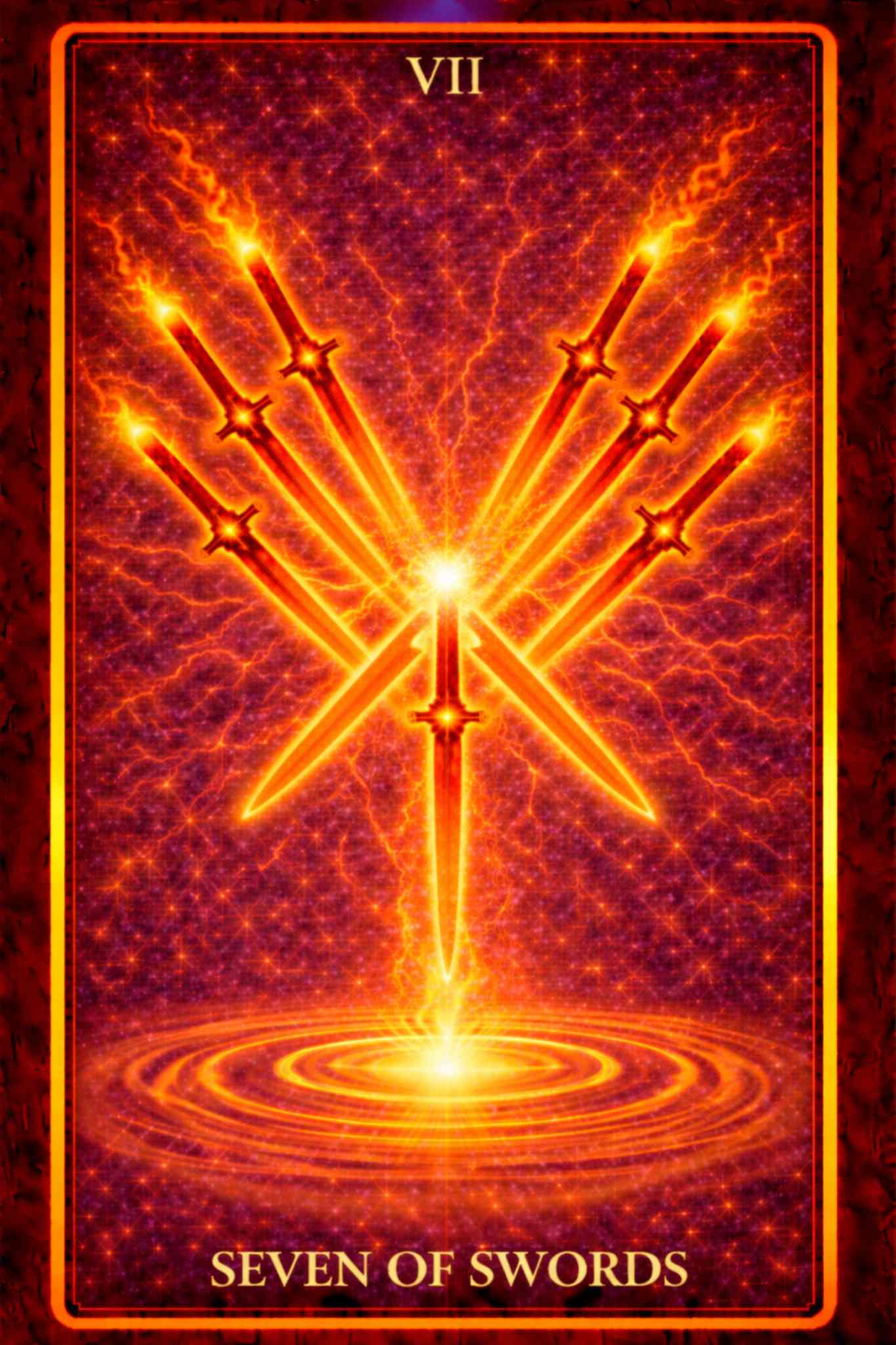
The side door before the honest road
The Fool and Seven of Swords begins with a traveler near the threshold, but the door they notice first may be the side door, not the front one. There is a wish for freedom here, a desire to slip out of an old pattern, situation, conversation, or identity before everything has been fully named. The Fool brings the pull toward fresh air and unclaimed possibility. The Seven of Swords adds strategy, privacy, avoidance, cleverness, and the uneasy awareness that the chosen route may reveal something about the motive behind the movement.
This pairing is not automatically about deception in a literal sense, and it should not be used to accuse another person without grounded evidence. Its symbolic weight is more subtle. It asks why the new path needs to be entered indirectly. A person may be protecting something tender, avoiding confrontation, hiding uncertainty, planning carefully, or trying to leave a situation without facing the full emotional or ethical cost. The Fool wants to begin. The Seven of Swords asks whether the beginning is clean, concealed, necessary, evasive, or some uneasy mixture of all four.
The inner scene can feel almost quiet: someone packing a bag mentally before anyone knows they are leaving, drafting a message and deleting half of it, making a private plan, withholding a thought, or telling themselves that silence is simpler than explanation. Sometimes privacy is wise. Sometimes secrecy becomes a way to avoid responsibility. The combination becomes most useful when it does not flatten that distinction. The open road may be calling, but the mind still needs to ask what kind of path is being created by the way the person chooses to leave.
Strategy can protect the beginning, or distort it
The Seven of Swords has an intelligence that can be useful when direct force would create unnecessary damage. It can describe discretion, observation, careful timing, and the ability to move without exposing every fragile part of a plan too early. With The Fool, that intelligence may help a new beginning survive its earliest stage. A person may need privacy while they gather courage, research options, prepare a transition, or separate their own thoughts from the pressure of other voices. A seed does not always need an audience before it has roots.
The difficulty comes when strategy becomes self-avoidance. The person may tell themselves they are being careful while actually refusing a needed conversation. They may claim freedom while leaving confusion behind for others to manage. They may call the new path authentic while shaping it from half-truths, hidden resentment, or fear of being seen clearly. This is where the pairing becomes sharp. The Fool wants a clean horizon. The Seven of Swords warns that a hidden exit can carry the old room into the new life if the motive is never examined.
A useful contrast appears with The Magician and Seven of Cups, where possibility, desire, imagination, and choice become more consciously shaped by intention. The Fool and Seven of Swords feels earlier, more guarded, and more uncertain. It is less about arranging many visions into a deliberate path and more about the instinctive maneuver before the person fully admits what they are doing. The road may be real, but the first step needs a clearer relationship with honesty.
What is being protected, and what is being avoided
In relationship questions, this combination often gathers around unspoken motives, indirect communication, or the wish to leave a confusing emotional space without a direct confrontation. Someone may be curious about a new beginning but hesitant to reveal it. They may be emotionally stepping away before saying anything aloud. They may be testing the air, observing, withholding, or trying to keep options open while avoiding the discomfort of a clear statement. None of this proves betrayal or hidden malice. It does suggest that the reading should pay close attention to what remains unsaid.
The Seven of Swords intentions meaning can be especially relevant when the question revolves around motive, strategy, privacy, or the blurry line between self-protection and evasion. The Fool adds the wish for openness and movement, yet the Seven of Swords makes the first step emotionally and ethically complicated. Is someone protecting a vulnerable beginning from premature judgment, or are they avoiding the mature honesty that would make the beginning cleaner?
In love, this pairing may also describe the person who wants freedom from an old relational role but has not found the courage to say it simply. They may want to begin again, meet someone differently, or approach a conversation from a new angle. The risk lies in using cleverness where vulnerability is needed. If the matter is romantic, the Fool love meaning can frame the early openness and uncertainty, while the Seven of Swords asks whether that openness is being handled with enough respect for truth.
Signs inside the reading that deserve a slower look
The Fool and Seven of Swords works best when interpreted through careful distinctions rather than quick suspicion. It may speak of legitimate privacy, but it may also show avoidance. It may show tactical movement, but it may also reveal a fear of directness. It may describe the first step out of an unhealthy situation, while still asking whether the person is leaving with awareness or simply disappearing from the difficult part of the story. The following reflections can help keep the reading grounded, careful, and fair.
- Privacy is not the same as deception. A person may need space to think, plan, or protect a new beginning before sharing it with others.
- Indirect movement still has consequences. A hidden exit can reduce conflict in the moment while creating confusion later if nothing is clarified.
- Strategy needs an honest motive. The mind may be clever, but cleverness becomes unstable when it is used to avoid responsibility.
- The first step should not require a false self. The Fool seeks a new path, and that path becomes stronger when it does not depend on pretending.
These points do not turn the cards into proof of what another person is doing. They are symbolic mirrors for the quality of movement, communication, and self-protection inside the situation. If real-world safety is involved, privacy and careful planning may be genuinely important, and trusted practical support matters. In ordinary relational or personal contexts, however, the pair invites a more nuanced question: what would change if the beginning could be protected without being hidden from the truth?
The moment before the secret becomes a pattern
Timing with this combination is delicate because the Seven of Swords often prefers movement before explanation. The Fool may feel ready to go, but the mind may be choosing a route that avoids exposure. This can be wise when the beginning is too fragile for noise, criticism, or premature interference. It becomes more troubling when the person delays honesty until the delay itself becomes the structure of the new path. The timing is healthier when strategy serves clarity rather than replaces it.
Need a little more context around this pairing?
A short reading can help you reflect on the tension, direction, or lesson this combination may be pointing toward.
If a conversation is needed, it may help to wait until the person can speak without over-explaining or hiding behind vague language. If a decision needs privacy, that privacy should have a purpose and a limit. If someone is leaving a role, relationship, project, or mental pattern, the first step may be quiet, but eventually the mind may need to face what it was trying to avoid. The Fool and Seven of Swords suggests that the path becomes cleaner when the person can distinguish between necessary discretion and fear-driven concealment.
For questions involving choices, uncertainty, or a need to compare routes, a decision tarot spread can fit this combination if it is used reflectively. The purpose is not to force an outcome, but to look at motive, risk, timing, and the cost of each option. The Seven of Swords benefits from being brought into the light gently. The Fool benefits from knowing which doorway it is actually choosing.
The soul does not need a disguise to begin
There is a spiritual layer in this pair that has little to do with perfection and much to do with inner honesty. The Fool wants to meet life without the heavy costume of an old identity. The Seven of Swords may reveal that the person has learned to survive by concealing motives, softening truths, hiding plans, or moving around direct conflict. Some of those habits may have once protected them. Some may now keep them from entering the new path as their real self.
That is the quiet challenge. A beginning can be private without being false. A person can protect their tenderness without turning every conversation into a strategy. They can move carefully without treating everyone else as an obstacle. This combination asks for freedom that does not need to sneak away from conscience. It asks for a mind clever enough to be safe, but honest enough to avoid becoming trapped in its own methods.
Another useful comparison is The Fool and The Moon, where the open road is surrounded by uncertainty, fear, projection, and partial light. The Fool and Seven of Swords is less dreamlike and more strategic. The Moon may show a person who cannot yet see the path clearly, while the Seven of Swords asks what happens when the person sees enough to move, but chooses a hidden route. If the side door becomes the only way they know how to begin, freedom may start to resemble another form of captivity.
Explore the next layer of this reading.
This combination can mean different things depending on context. A short tarot reading can help you reflect on the question behind the cards.
A cleaner path than the one that slips away
The Fool and Seven of Swords is a tense, intelligent, and morally subtle combination. It speaks of a first step that may need discretion, but also of the danger of beginning from avoidance. It may describe strategy, privacy, quiet planning, or the wish to leave a situation without making a scene. It may also show where the mind is trying to outsmart a truth that would become simpler if it were faced directly.
The final image is not a thief condemned by the cards, nor a hero escaping all limits. It is a person near the edge of a new road, carrying more swords than they can comfortably hold, wondering whether the hidden route is protection or fear. The beginning becomes more trustworthy when the person can put down at least one blade and ask: what am I trying to save by staying unseen, and what part of me is ready to walk forward without a disguise?
More combinations with The Fool
Continue with The Fool
Explore Related Guides by Topic
If you want to explore this combination through a more specific emotional lens, these tarot guides can help you follow the broader pattern behind the reading.