
The Devil + Two of Cups
Explore how these two tarot cards interact in a reading through symbolic overlap, contrast, and shared narrative. Tarot combinations often reveal meaning that neither card fully expresses on its own.

The Devil and Two of Cups Tarot Combination Meaning
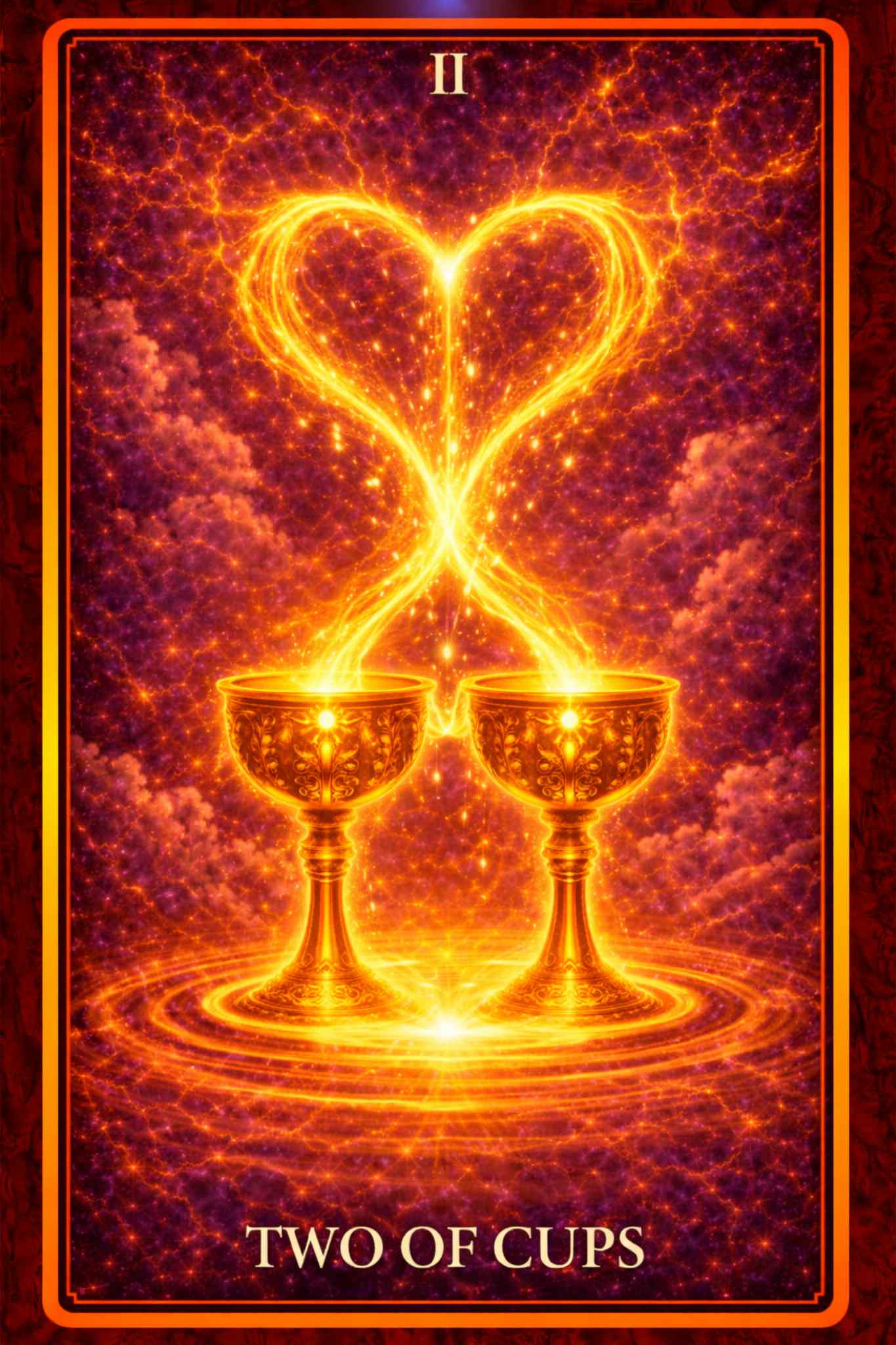
Two people can look into the same cup and still bring different hungers to the water. The Two of Cups speaks of meeting, reciprocity, affection, emotional exchange, and the mirror of relationship. The Devil brings desire, attachment, compulsion, control, craving, and the shadow that forms when closeness begins to narrow the inner world. Together, The Devil and Two of Cups explores the charged space where intimacy and dependency can begin to resemble each other. It does not label the bond as bad. It asks whether the connection leaves both hearts more honest and free, or whether the longing between them has begun to decide too much.
This pair is especially strong in relationship readings because the Two of Cups gives The Devil somewhere very human to work. The chain may appear through possessiveness, anxious longing, emotional bargaining, jealousy, fantasy, sexual magnetism, fear of abandonment, or the need to be mirrored by the other person. Yet the cards also leave room for tenderness. A connection may be genuine and still carry shadow. Two people may care for each other and still activate old wounds. Attraction may be mutual and still need boundaries. The reading becomes more useful when it avoids moral judgment and turns toward the quality of the bond: where does love create openness, and where does need begin to close the hand?
The Two of Cups on its own often carries a gentler meaning of emotional meeting and mutual recognition. The Two of Cups feelings meaning can help clarify that softer layer: affection, warmth, resonance, and the wish to meet heart to heart. With The Devil, the same meeting may become more charged. The other person may feel like a mirror, but also like a source of emotional proof. The bond may awaken beauty and insecurity together. The cup may be shared, yet someone may quietly fear losing their place beside it.
Where intimacy turns into emotional leverage
The unique tension of The Devil and Two of Cups is mutual attachment under pressure. Unlike The Devil and Ace of Cups, where the story begins with a new emotional opening, this pair has another person clearly in the field. There is exchange, response, chemistry, and the possibility of shared feeling. That is why the shadow can become more subtle. Dependency may hide behind devotion. Control may hide behind care. A request for reassurance may sound like love while carrying the weight of fear. A bond may feel powerful because both people are feeding the same emotional loop.
In some readings, the connection may be intense because each person activates a need in the other. One may want to feel chosen; the other may want to feel needed. One may fear distance; the other may fear losing control. One may give too much to keep the bond warm; the other may lean on that giving because it feels safe. The Devil does not make either person the villain. It reveals the pattern that can form between them when desire, fear, and longing begin to negotiate in the background. If someone feels unsafe, pressured, or trapped in a real-life situation, trusted support outside the reading matters more than symbolic interpretation.
A useful comparison appears in The Devil and The Empress, where desire, pleasure, attachment, self-worth, and the need to feel cherished can become difficult to separate. The Devil and Two of Cups is more intimate and immediate. It studies the emotional exchange itself: the messages, glances, promises, silences, needs, and subtle contracts that form when two hearts begin to depend on a shared current. The question is less “Is this love?” and more “What does this bond ask each person to give up inside themselves?”
The mirror that flatters and reveals
There is a reason this combination can feel seductive. The Two of Cups offers recognition. The Devil intensifies the need for that recognition. To be seen by another person can feel sacred when the heart has carried loneliness. To be desired can feel healing when self-worth has been fragile. To feel chosen can soothe an old place of rejection. Yet the same beauty can become binding when the mirror becomes the only place where the self feels real. The person may begin to adjust, perform, pursue, or surrender parts of themselves to keep the reflection alive.
This is where The Devil asks for a brave kind of honesty. What do you become in the presence of this bond? Do you feel more yourself, or more managed by fear? Is affection being offered freely, or traded for reassurance? Is there room for separate rhythms, separate needs, separate truths? The strongest relationships can hold desire without turning it into ownership. They can hold longing without making it a command. The Devil and Two of Cups invites the reader to notice whether the connection supports that kind of freedom, or whether love has become tangled with proof, power, and emotional survival.
For a wider look at the Devil card in relational and inner dynamics, the Devil love meaning may be useful because it treats desire as a symbolic field rather than a simple accusation. This matters here. The bond may contain attraction, care, sensuality, memory, and tenderness. It may also contain a pattern that asks to be named. The more honestly the pattern is seen, the less power it has to operate from the shadows.
When to slow the exchange
Timing with The Devil and Two of Cups often centers on the moment when emotional exchange becomes reactive. A conversation may repeat the same circle. A message may be sent mainly to ease anxiety. A promise may be requested before trust has had time to become stable. A reunion may feel tempting because the chemistry is alive, while the underlying dynamic remains unclear. The cards suggest that a slower pace can protect the truth of the bond. Slowness here is not punishment. It is a way of seeing what remains when urgency stops steering the connection.
The relationship tarot spread can fit this kind of question when the aim is to examine the pattern between two people rather than force a single yes-or-no answer. A helpful reading may explore what each person brings, what the bond feeds, what it asks for, and where clearer boundaries would make the emotional exchange cleaner. The Devil is especially revealing when the questions are precise: where does closeness become pressure? Where does care become control? Where does desire begin to replace self-respect? Where does the relationship need truth rather than more intensity?
Another related doorway appears through The Devil and Six of Cups, especially when the bond feels familiar, nostalgic, or tied to an older emotional imprint. The Two of Cups may be present now, but The Devil often asks what history is being carried into the present exchange. Sometimes the other person is partly themselves and partly a symbol of someone, something, or some lost emotional safety the heart has been trying to recover.
What a freer bond would feel like
A freer bond does not have to be colder. This is one of the deeper teachings of The Devil and Two of Cups. Many people fear that loosening the grip means losing the feeling, reducing passion, or becoming less devoted. Yet genuine intimacy often becomes more alive when it has air around it. Love can breathe when it is no longer forced to prove worth every hour. Desire can remain warm when it is no longer used to control the distance between two people. The cup can be shared without becoming a contract of emotional possession.
Want to explore this combination in a more personal way?
If this pairing feels important right now, a simple tarot spread can help you reflect on it with more context.
Spiritually, this pair asks both honesty and compassion. The shadow inside attachment often grew from a place that once needed protection. The fear of being left, the hunger to be chosen, the impulse to control, the ache for constant reassurance, the difficulty of trusting space — these patterns rarely appear from nowhere. They are signals. They point toward places where the self may need care, rebuilding, and a more stable relationship with its own value. The reading becomes healing when the person can say, “This is what the bond awakens in me,” without turning the statement into shame.
Explore the next layer of this reading.
This combination can mean different things depending on context. A short tarot reading can help you reflect on the question behind the cards.
Small questions for a charged connection
When The Devil and Two of Cups appears, the clearest questions are often simple and uncomfortable in a useful way. They bring the reading back from fantasy into lived experience. They also keep the interpretation grounded in self-awareness rather than prediction.
- Where does this connection make me feel more alive? This names the genuine gift without dismissing the shadow.
- Where do I begin to lose my own rhythm? This reveals the point where attachment may be narrowing choice.
- What am I trying to receive from the other person that I also need to rebuild within myself? This turns longing into inner work.
- Which parts of the bond feel mutual, and which parts feel like emotional leverage? This helps separate intimacy from dependency.
- What boundary would make the cup cleaner? This frames boundaries as clarity rather than rejection.
The Devil and Two of Cups is ultimately a mirror for the place where love, need, desire, and fear meet between two people. It does not deny the sweetness of the cup. It asks whether the sweetness is being mixed with compulsion. It does not condemn longing. It asks what longing has been carrying. The deepest invitation is to let intimacy become conscious: to love with eyes open, to desire without surrendering self-respect, and to keep enough inner freedom that the shared cup remains a meeting place rather than a chain.
More combinations with The Devil
More combinations with Two of Cups
Continue with The Devil
Explore Related Guides by Topic
If you want to explore this combination through a more specific emotional lens, these tarot guides can help you follow the broader pattern behind the reading.