
The Devil + Seven of Cups
Explore how these two tarot cards interact in a reading through symbolic overlap, contrast, and shared narrative. Tarot combinations often reveal meaning that neither card fully expresses on its own.
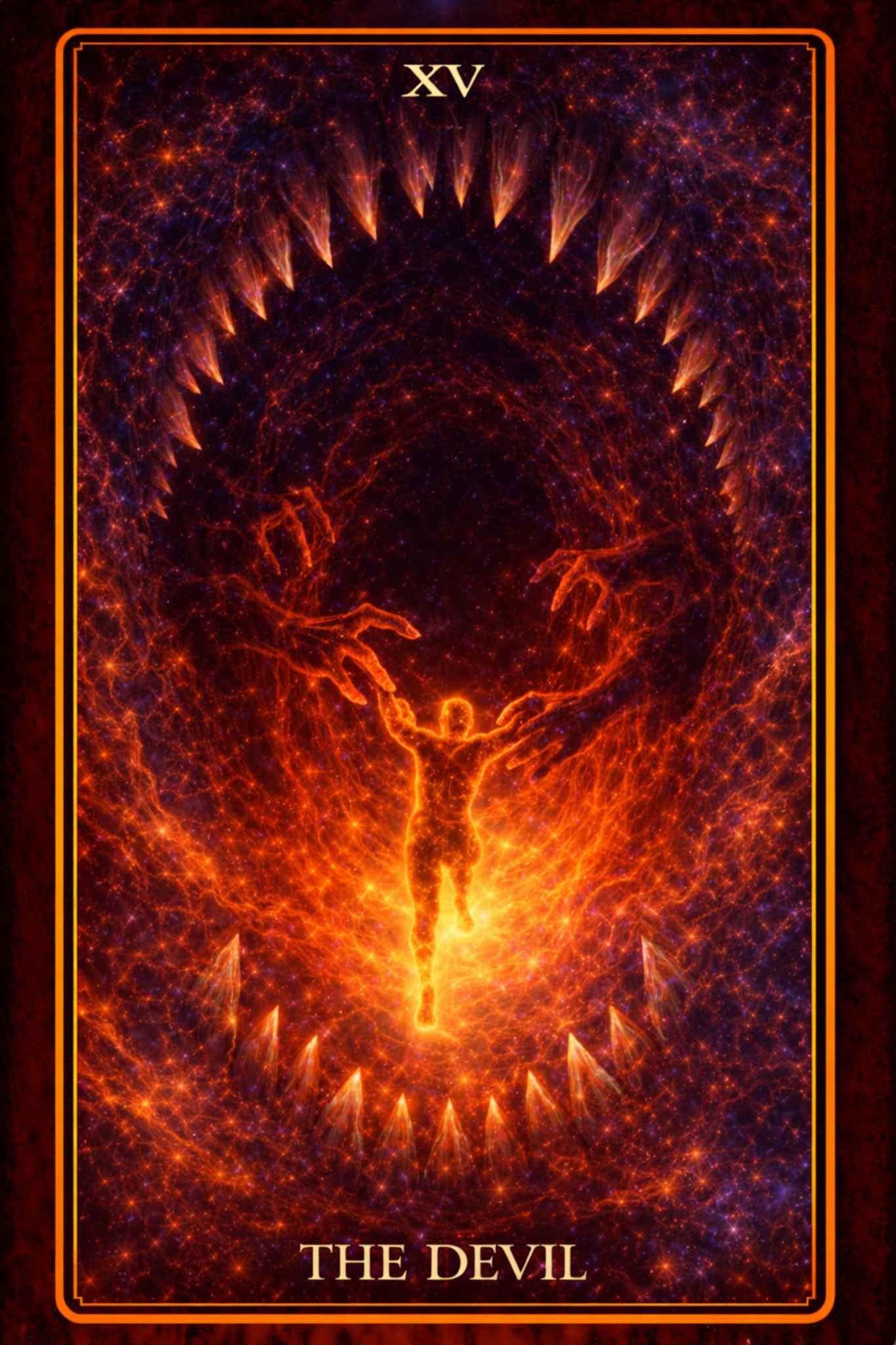
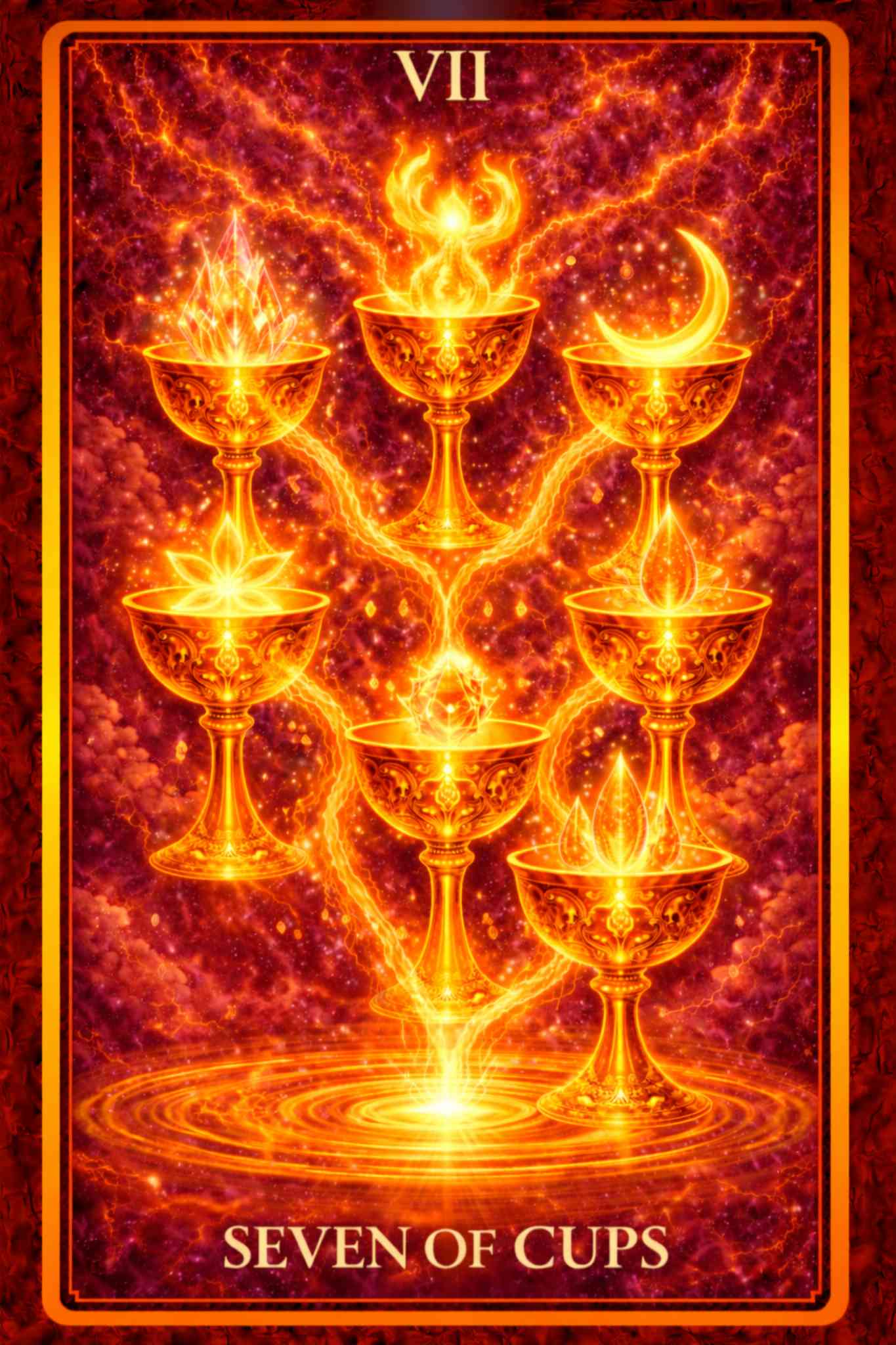
The Devil and Seven of Cups Tarot Combination Meaning
Desire becomes difficult to read when every cup begins to glow. The Devil and Seven of Cups brings craving into the realm of fantasy, projection, emotional fog, imagined possibilities, and seductive inner pictures. The Seven of Cups speaks of choice, dream, temptation, confusion, wishful thinking, and the strange beauty of things that may or may not have substance. The Devil adds attachment, compulsion, fixation, longing, and the moment when a fantasy begins to hold more power than the truth beneath it. Together, these cards ask what the heart is reaching for when it reaches beyond reality.
This pair does not condemn fantasy. Imagination can protect, inspire, soften, and reveal hidden desire. The issue appears when fantasy becomes the place where the person loses choice. A connection may be more imagined than lived. A possibility may feel more intoxicating than grounded. A person may become attached to a version of someone, a romantic scenario, a future outcome, or an emotional high that exists mainly inside the mind. The Devil beside the Seven of Cups asks whether the dream is opening the heart, or quietly binding it to something that cannot truly answer back.
The Seven of Cups by itself can describe many emotional options, unclear desire, and the need to separate vision from illusion. The Seven of Cups intentions meaning helps clarify that reflective layer: mixed motives, imagined possibilities, and the difference between a real direction and a tempting inner picture. With The Devil, the question becomes sharper: which cup has become a fixation? Which image keeps pulling the heart even when it creates confusion? Which fantasy feels so powerful because it carries an old need for escape, validation, rescue, intensity, or emotional proof?
The cup that looks like escape
The unique tension of The Devil and Seven of Cups is not simply confusion. It is desire inside confusion. The person may know that the situation is unclear, but the uncertainty itself may become part of the attraction. Ambiguity can leave room for projection. Silence can be filled with meaning. A distant person can become a screen for longing. An unavailable path can seem more magical because it has not been tested by ordinary reality. The Devil holds the gaze there, making the imagined cup feel more alive than the real cups within reach.
In love readings, this may appear as fascination with a person who is partly known and partly invented by the heart. The attraction may be genuine, yet the inner image may become larger than the actual relationship. Someone may replay messages, interpret signs, build emotional stories from small gestures, or become attached to a future that has not been mutually shaped. The cards do not say the feeling is false. They ask how much of the feeling belongs to the person in front of you, and how much belongs to the need that person has awakened.
This is close in spirit to The Devil and Ace of Cups, where a new emotional opening may carry too much hunger too quickly. With The Devil and Seven of Cups, the emotional pull spreads into several imagined directions at once. Here, the desire may spread into many versions: what could happen, what might be felt, who someone might become, how life might change if the fantasy were finally chosen. The heart may feel surrounded by cups, yet the body may sense that only one of them has become charged with compulsion.
Projection, longing, and the need behind the image
The Devil and Seven of Cups often asks the reader to look behind the image rather than argue with it. A fantasy usually carries information. It may reveal a need for romance, sensuality, power, creative escape, emotional safety, recognition, spiritual depth, or a life that feels less constrained. The problem begins when the image is treated as the only doorway to that need. A person may believe that only one relationship, one outcome, one choice, or one idealized future can make them feel complete. That belief is where the chain begins to close.
You may also want to go one step deeper.
The Devil + Seven of Cups can open up differently inside a focused personal reading.
The Devil intentions meaning can deepen this reading because it explores the motives underneath desire. In this combination, intention may be mixed with longing and self-protection. A person may want love, but also escape. They may want truth, but also prefer the intoxication of possibility. They may want freedom, but still choose the cup that keeps them emotionally busy. The reading becomes more honest when it asks: what does this fantasy let me avoid feeling directly?
There may also be a shadow of shame around wanting too much. The Seven of Cups can hold private dreams that feel excessive or unrealistic. The Devil may bind the person to those dreams through secrecy, guilt, or the belief that desire itself is dangerous. A more compassionate view recognizes that desire is rarely the enemy. Desire becomes difficult when it removes proportion, when it turns uncertainty into fixation, or when it asks the person to give up present clarity for an imagined emotional reward.
This combination can also speak to the emotional comfort of keeping desire untested. A fantasy does not answer back, disappoint, delay, disagree, or reveal ordinary limits. It can remain perfect because it does not have to become real. That is part of its seduction. The Seven of Cups allows the heart to imagine many versions of fulfillment, while The Devil may quietly attach the person to the version that feels most intoxicating and least accountable to reality. In a relationship question, this may appear when someone is more attached to the imagined bond than to the actual exchange. In a creative or personal question, it may appear when a dream gives relief, but the real step toward it feels frightening, dull, or exposing. The fantasy may become a private theater where the person can feel chosen, powerful, desired, admired, rescued, or transformed without having to risk the vulnerability of a living situation.
The deeper question is not whether the fantasy is “wrong.” It is whether the fantasy still leaves the person free. Some inner images are useful because they reveal what the heart has been missing. Others become circular because they give emotional intensity without movement. The Devil and Seven of Cups asks the reader to notice the difference. Does the dream return the person to themselves with more clarity, or does it leave them more restless, secretive, distracted, and hungry? Does it inspire one honest step, or does it replace the step entirely? When the image becomes a substitute for contact, choice, or action, the cup has become less like a vision and more like a chain. Seeing this clearly can be uncomfortable, but it is also liberating. The person does not have to destroy imagination. They only have to stop letting imagination become the only place where desire is allowed to live.
When choices become a mirror of craving
Timing with The Devil and Seven of Cups often calls for slowing down before choosing from a charged emotional fog. This is not the best inner climate for decisions made from fantasy, envy, urgency, or the need to escape discomfort. The person may be tempted to chase the most glittering cup because it creates the strongest feeling. Yet strong feeling is not always the same as clear truth. Sometimes the cup that glows brightest is reflecting the heat of an old hunger.
A decision tarot spread can fit this combination when there are several tempting options and the reader needs to separate emotional pull from grounded choice. Useful questions might include: what am I idealizing, what am I avoiding, what desire is honest, what desire is compulsive, and which option gives me more freedom rather than only more intensity? This keeps the reading practical without turning tarot into a prediction machine.
A related major-arcana pattern can be seen in The Devil and The Magician, where desire, will, control, attraction, and the wish to shape reality can become difficult to separate. The Devil and Seven of Cups is different because the fantasy is less focused and more misted. The person may feel captured by one image, one temptation, one romantic possibility, or one imagined escape. The Magician may try to direct desire into form; the Seven of Cups shows how desire can multiply into beautiful possibilities before truth has become clear.
Want to place this combination into a wider reading?
If this pairing feels close to something you are experiencing, a simple spread can help you reflect on the surrounding energy with more clarity.
What becomes clearer when the fantasy is questioned gently
This combination benefits from questions that do not shame the dream. Harshness can drive fantasy deeper into secrecy. Gentle precision is stronger. What does this image give me emotionally? What part of me feels fed by imagining it? What would I have to face if I stopped returning to it? Is this desire connected to a living truth, or has it become a beautiful room where I hide from a harder need?
- Which cup feels magnetic, and what does it promise?
- Where am I confusing possibility with emotional certainty?
- What need is hidden inside this fantasy?
- Does this desire expand my choices or reduce them?
- What real step would remain if the dream became simpler?
Spiritually, The Devil and Seven of Cups asks for a clean relationship with imagination. The soul may speak through images, but the shadow can also use images to avoid embodiment. A fantasy may show the direction of a need, yet the person still has to meet that need in a grounded way. Love has to become relational. Creativity has to become practice. Desire has to meet consequence. Freedom has to return to the body, the present, and the choices that can actually be lived.
The Devil and Seven of Cups ultimately describes a powerful emotional fog where desire has become attached to an image. It is not here to punish the dreamer. It is here to ask what the dream is doing. Is it revealing a truth, hiding a wound, intensifying a craving, or keeping the heart busy with possibilities that never require full honesty? When the fantasy is seen clearly, it may still contain wisdom. The difference is that the person can stop serving the image and begin listening to the need beneath it.
More combinations with The Devil
More combinations with Seven of Cups
Continue with The Devil
Explore Related Guides by Topic
If you want to explore this combination through a more specific emotional lens, these tarot guides can help you follow the broader pattern behind the reading.