
Death + Three of Cups
Explore how these two tarot cards interact in a reading through symbolic overlap, contrast, and shared narrative. Tarot combinations often reveal meaning that neither card fully expresses on its own.
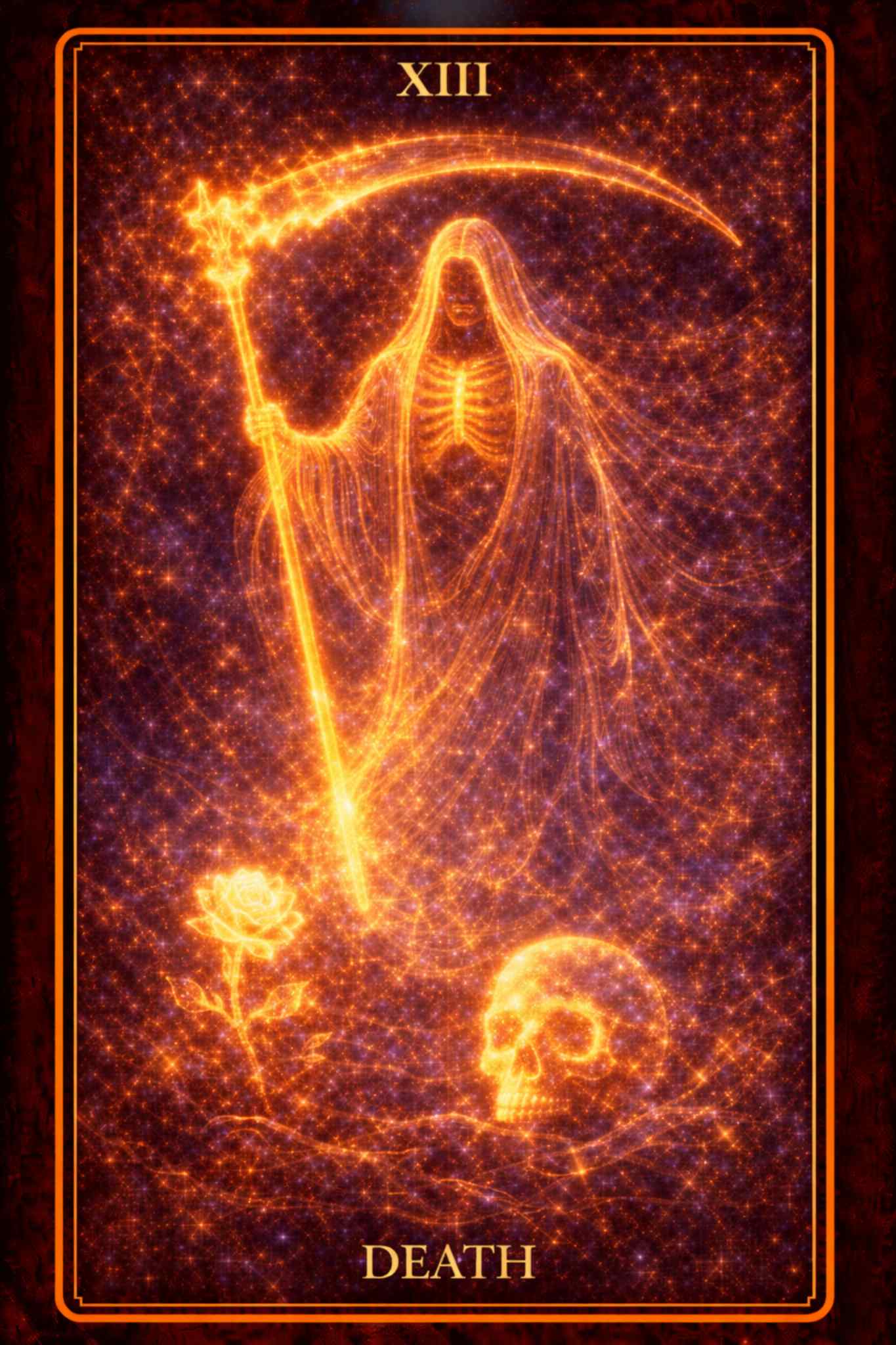
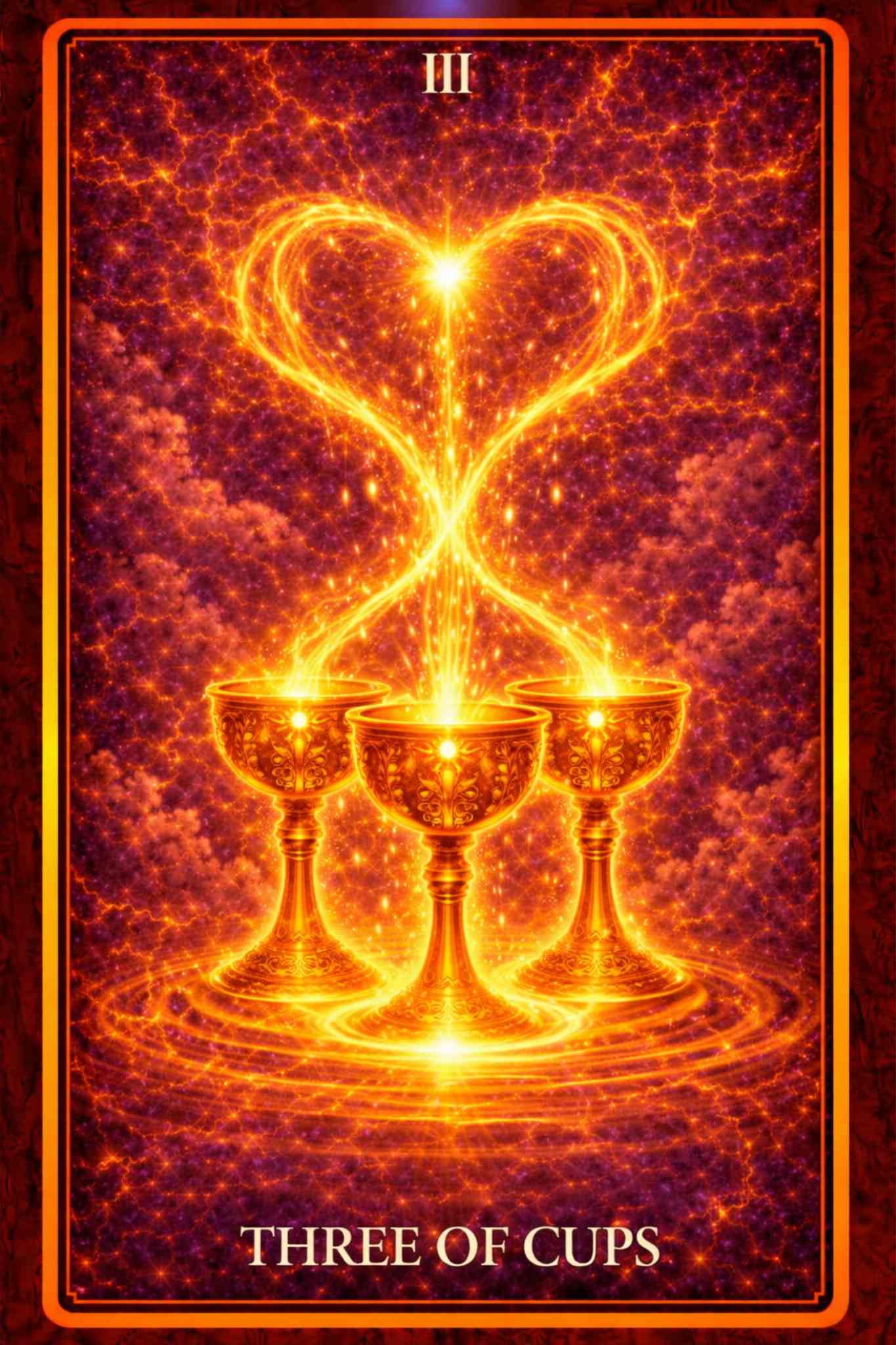
Death and Three of Cups tarot combination meaning
There are moments when shared joy no longer feels the same, even if the people are still there. Death and Three of Cups explores that subtle, often unspoken shift. The Three of Cups brings connection, friendship, celebration, and emotional resonance between people. Death does not take that away abruptly. Instead, it reveals that the form of connection is changing, sometimes quietly, sometimes undeniably. The laughter may still exist, the memories may still be warm, but something deeper has moved, a transition not unlike the quiet threshold described in the The Fool and Death, where an ending does not close life but opens it into a different direction. The emotional truth has evolved beyond the old shape of the bond.
This combination often appears when a social circle, friendship, or emotional environment is transitioning. It can describe drifting apart, growing into different emotional needs, or recognizing that what once felt aligned no longer fully reflects the present. This is not necessarily a dramatic ending. It is more like realizing that the same conversation no longer nourishes, the same dynamic no longer feels alive, or the same group energy no longer supports the inner direction of the individual. What changes here is not only the connection itself, but the meaning of participation within it.
At its core, Death and Three of Cups asks a more nuanced question than simple loss: what part of this shared joy is still alive, and what part is being sustained by familiarity? The Three of Cups celebrates emotional exchange, but Death introduces honesty into that exchange. A space can remain active while losing its depth. A bond can remain friendly while losing its alignment. The invitation is not to reject connection, but to recognize when connection has shifted into a different emotional truth that requires acknowledgment rather than repetition.
When belonging becomes a question instead of a certainty
The central tension of this pairing is not between people, but between belonging and authenticity. The Three of Cups carries the feeling of being part of something shared, something mutual, something emotionally synchronized. Death introduces the moment when that synchronization begins to dissolve. A person may still be included, still welcomed, still appreciated, yet feel that their inner rhythm no longer matches the outer environment. This creates a quiet dissonance: belonging remains, but resonance weakens.
You may also want to go one step deeper.
Death + Three of Cups can open up differently inside a focused personal reading.
This shift is rarely loud. It often appears through subtle signals: a sense of distance during conversations, a reduced emotional response to situations that once felt meaningful, or the realization that one’s attention is moving elsewhere even when physically present. Death does not force exclusion. It reveals misalignment. And in that revelation, the person is asked to consider whether staying in the same emotional space continues to reflect their truth, or whether it maintains a version of identity that has already begun to change.
This dynamic resonates with Death and Six of Cups, where emotional memory and past connection meet transformation. Yet the Three of Cups is more immediate. It is not about what once was, but about what is currently being shared. The question becomes less about nostalgia and more about present alignment: is the connection still alive now, or is it echoing something that has already completed its cycle?
Shared joy and emotional surface
The Three of Cups can sometimes carry joy that remains on the surface while deeper layers shift underneath. This does not make the joy false. It simply makes it partial. A group can still laugh together while avoiding more complex emotional truths. A friendship can still function while no longer evolving. Death brings awareness to this difference. It does not reject joy, but it refines it by asking whether it reflects the full emotional reality or only a comfortable portion of it.
In this way, the combination can describe a movement toward deeper emotional standards. A person may begin to notice that lightness alone is no longer enough, that shared experience needs to carry authenticity as well as enjoyment. This can lead to a natural distancing from interactions that remain pleasant but no longer meaningful. The change may not be expressed immediately. It often begins internally, as a quiet shift in attention, interest, and emotional investment.
This recalibration is supported by Three of Cups yes or no meaning, where alignment and shared intention are explored. With Death, that alignment becomes more selective. Not every shared space needs to continue in the same way to remain respectful of what it once was.
The evolution of social identity
Another layer of Death and Three of Cups concerns identity within a group. The Three of Cups often reflects not only connection, but the role a person plays within that connection. Someone may be the organizer, the supporter, the listener, the one who brings energy, or the one who maintains harmony. Death introduces the possibility that this role has reached its natural limit. What once felt natural may begin to feel restrictive. What once felt expressive may begin to feel performative.
This is not a rejection of others, but a redefinition of self. The person may begin to ask whether they are still showing up authentically, or whether they are continuing to embody a version of themselves that no longer reflects their inner state. When this awareness grows, the group dynamic may shift in response. Some connections adapt. Others remain as they were, creating a gentle but undeniable separation between past identity and present truth.
In this sense, Death does not remove the Three of Cups. It transforms the way it is lived. The person may still value connection, but seek it in a different form, with different depth, or in a different environment altogether. The external structure may change, but the need for shared emotional experience remains, only expressed through a more aligned channel.
Timing and the quiet completion of shared cycles
The timing of this combination is rarely immediate. It unfolds gradually, often without a single defining moment. A person may continue to participate in the same social space while internally recognizing that the connection has already begun to complete. This creates a transitional period where presence and detachment coexist. The outer interaction continues, but the inner investment shifts.
Death marks the point where this inner recognition becomes too clear to ignore. The individual may begin to step back, not necessarily through confrontation, but through reduced engagement, changed priorities, or a natural redirection of energy. This is not avoidance. It is alignment. The Three of Cups does not demand abrupt endings. It allows space for the emotional cycle to close in a way that respects both the past and the present.
The three card tarot spread can help clarify this process by showing what is fading, what remains active, and what is beginning to emerge. This perspective supports understanding the transition without forcing it into a fixed conclusion before it has fully revealed itself.
Letting connection change without losing meaning
Death and Three of Cups carries a quiet but important reassurance: connection does not lose its value when it changes. A shared space that no longer feels aligned is not invalidated by that change. It simply belongs to a different phase of life. The laughter, support, and presence that once existed remain part of the emotional landscape, even if they no longer define the present.
The deeper movement of this combination is toward honest participation. Staying connected is meaningful when the connection is alive. Letting it shift is meaningful when the emotional current has moved elsewhere. Neither path is inherently better. What matters is whether the choice reflects truth rather than habit. In that sense, Death and Three of Cups is not about losing connection, but about allowing connection to evolve into forms that remain genuine rather than maintained.
The image is not of something breaking, but of something gently completing. And in that completion, space opens for new forms of shared experience to arise, shaped not by memory alone, but by present alignment.
Want to place this combination into a wider reading?
If this pairing feels close to something you are experiencing, a simple spread can help you reflect on the surrounding energy with more clarity.
FAQ
Does Death and Three of Cups always mean friendships end?
Not necessarily. This combination often points to change rather than absolute endings. A friendship or group dynamic may evolve, shift in intensity, or take on a different form. In some cases, distance naturally appears. In others, the connection remains but becomes more selective or more honest.
Can this combination indicate growing apart from a social circle?
It can reflect that experience, especially when personal development leads in a different direction than the group dynamic. The shift may happen gradually and without conflict. The cards suggest observing whether the connection still feels aligned rather than forcing it to remain unchanged.
Is there still value in a connection that is changing?
Yes. The Three of Cups emphasizes that shared experiences, support, and joy remain meaningful even when their form evolves. Death does not erase that value. It highlights that the emotional reality has changed and invites a more honest relationship to that change.
How should someone approach this energy?
The approach is usually reflective rather than reactive. It can be helpful to notice where connection feels alive and where it feels maintained. Allowing space for change without immediate judgment often reveals whether the bond wants to adapt or naturally complete its cycle.
More combinations with Death
More combinations with Three of Cups
Continue with Death
Explore Related Guides by Topic
If you want to explore this combination through a more specific emotional lens, these tarot guides can help you follow the broader pattern behind the reading.