
Death + Five of Wands
Explore how these two tarot cards interact in a reading through symbolic overlap, contrast, and shared narrative. Tarot combinations often reveal meaning that neither card fully expresses on its own.
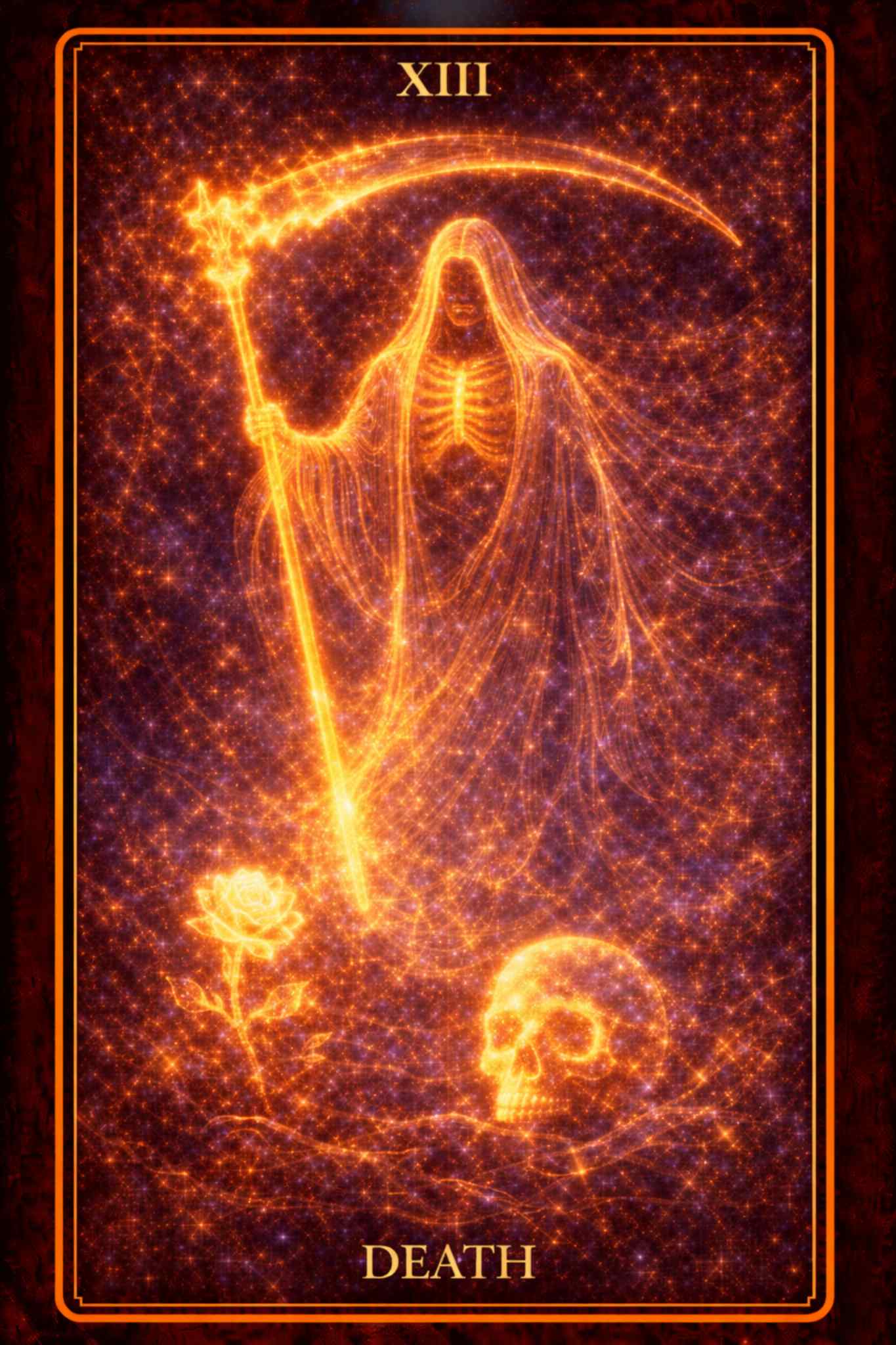
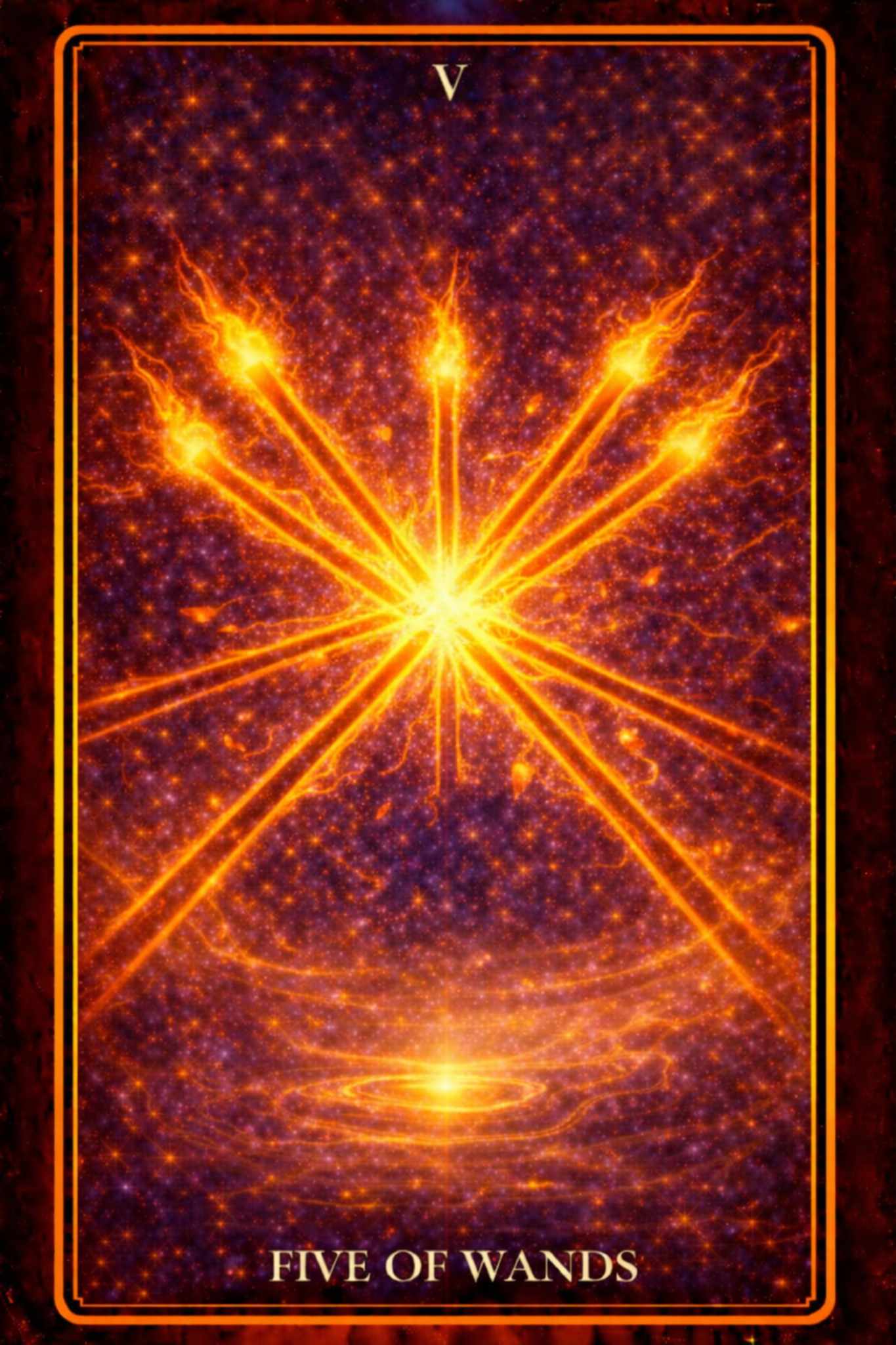
Death and Five of Wands Tarot Combination Meaning
Death and Five of Wands meet where change is no longer quiet and inner or outer friction begins to expose what cannot continue. This is rarely a soft transition. Death already signals that a form of life has reached completion, that an old pattern, identity, attachment, or dynamic can no longer move forward in the same way. The Five of Wands brings heat, agitation, scattered effort, competing impulses, and the restless pressure of forces colliding in the same space. Together, these cards often appear when transformation is underway, yet the surrounding energy has not settled into acceptance. Something in the system is resisting, accelerating, dramatizing, or complicating the ending. The experience can feel messy and emotionally charged, but it is rarely empty of meaning. Very often, the friction itself reveals where the old structure is still being defended even though its life has already run its course.
This is what gives the pair its depth. Death does not only describe external endings. It marks the point where continuation loses its truth. The Five of Wands shows what happens when fire enters that threshold without direction. Different impulses, fears, agendas, and reactions may all compete for control. One part of the person may recognize that a chapter has ended, while another part tries to prove, preserve, restart, or outmaneuver the change. In outer life, multiple people may respond to the same transformation from very different positions of tension or self-interest. The cards therefore ask a precise question: is this struggle helping truth come into form, or is it the turbulence that appears when something finished is still being pushed to behave as if it were alive?
Conflict as evidence of transition
The Five of Wands does not always point to destruction. It can reflect friction that reveals differences, brings hidden tension to the surface, and shows where energy is trying to reorganize. Beside Death, that friction often carries more weight. It may indicate that a change has become unavoidable and the system can no longer hold its previous arrangement together. What used to coexist through compromise now clashes openly. What used to remain unspoken now rises through tension. Death has already withdrawn life from the old form, and the Five of Wands shows the turbulence created as that truth begins to move outward.
In this sense, conflict becomes informative. It highlights where attachment still lives, where identity is being defended, and where impatience is trying to outrun deeper surrender. The point is not to glorify struggle, but to read it clearly. Sometimes the noise is simply noise. Other times it is the exact expression of a transformation that has not yet been accepted. The task is to recognize which one you are standing in.
When fire resists what must end
A central theme in this combination is how fire can resist ending by turning it into a contest. The Five of Wands thrives on movement, engagement, and intensity. That energy can be useful when change has been avoided for too long. Yet beside Death, it can become reactive. A person may argue with reality, push against what is already clear, or become caught in cycles of proving, defending, or escalating. The focus shifts from transformation to winning, even though the situation is no longer truly about victory.
This is where exhaustion often appears. The struggle may feel urgent, yet its direction becomes scattered. The deeper question is whether the friction is clarifying the transition or dispersing energy around it. Are you engaging with what is still alive, or reacting to the discomfort of letting something go? Death asks for direct honesty here. It asks whether the fire is serving life or delaying the acceptance of what has already reached its end.
Love and relationship meaning
In relationships, Death and Five of Wands often point toward a field where tension is rising because an old dynamic can no longer hold. This may appear as recurring arguments, ego clashes, emotional volatility, or a sense that every interaction carries more friction than before. Sometimes the relationship itself is shifting or ending. At other times, a pattern within the relationship is dissolving, and both people are reacting to that loss through defensiveness, intensity, or competing needs for control.
You may also want to go one step deeper.
Death + Five of Wands can open up differently inside a focused personal reading.
At its clearest, this combination helps reveal what has to change. Conflict becomes informative rather than purely painful. A couple may begin to see that the issue is not a series of isolated disagreements, but a deeper transformation that is already underway. Old roles may no longer fit. Old expectations may have lost their ground. The Five of Wands becomes the heat through which that truth becomes impossible to ignore.
In more difficult expressions, conflict itself becomes the avoidance. Instead of acknowledging that something has ended, energy is spent arguing over details that orbit the real issue. The fire becomes circular. Death reminds us that no amount of friction can restore life to what has already completed itself. The work is to see what the conflict is pointing toward, not only to remain inside it.
Career, work, and shifting structures
In professional life, Death and Five of Wands often appear when a structure is changing and tension is rising around it. A team, project, leadership pattern, or strategic direction may be reaching its limit, and the resulting environment can feel crowded with competing agendas. People may push for position, defend territory, or attempt to assert relevance inside a system that is already transforming. Death shows that the old arrangement cannot continue. The Five of Wands shows how individuals react when that reality becomes visible.
This can explain why certain environments grow more chaotic just before a major shift. Energy increases, but coherence decreases. Sometimes this leads to innovation. Other times it produces noise and unnecessary rivalry. The key question is whether the struggle is helping shape something new or simply amplifying discomfort with what is ending. For an individual, this may also reflect internal conflict: continuing to fight for a role or direction that has already lost its deeper meaning. In such cases, transformation begins when energy is withdrawn from battles that no longer belong to the future.
Psychological and spiritual meaning
Psychologically, this pairing often reflects the experience of inner conflict during transformation. Multiple parts of the self may activate at once — the one that wants to fight, the one that wants to hold on, the one that fears loss, the one that tries to stay in control. The Five of Wands gives form to that internal crowding. Death reveals that beneath all this activity, something simpler is taking place: an old form of self is ending.
Spiritually, the combination can act as a form of purification through friction. Tension reveals attachment, identity investment, and the places where the self is still trying to protect what has already changed. The purpose is not to eliminate fire, but to let it serve clarity rather than resistance. When that shift happens, the same energy that once fueled conflict begins to illuminate truth.
Shadow expression and challenge
The shadow appears when struggle becomes a substitute for transformation. A person may remain in conflict because it feels more active than surrender. Argument replaces grief. Friction replaces stillness. The Five of Wands can create the illusion of movement, while the deeper process remains untouched. Death exposes this pattern by asking whether anything is truly changing beneath the surface activity.
There is also an opposite tendency where all friction is suppressed in the name of acceptance. Yet real transformation often stirs the field before it settles it. The task is to distinguish between clarifying tension and repetitive conflict. One reveals truth. The other delays it.
Timing and the pressure point of change
This combination often appears when energy is building faster than integration. The field feels heated. Reactions multiply. Small tensions become amplified. Death suggests that the necessary ending has reached a point where it can no longer remain contained. What was once hidden now becomes visible through pressure.
At the same time, not every surge of intensity requires action. The urge to react, prove, or accelerate may come from discomfort rather than clarity. Sometimes the most useful step is to pause long enough to see what the conflict is truly circling. Once that becomes visible, the transformation can move with far more direction and far less wasted force.
FAQ — Death and Five of Wands
Is this combination always negative? It can be intense, but it often reveals necessary truth through friction rather than representing harm on its own.
Can it point to arguments in relationships? Yes, especially when recurring conflict signals that a deeper change is already underway.
Does the Five of Wands block Death? It can delay clarity through noise, but it also shows where attachment still exists.
Can this be internal struggle? Very often. It can reflect competing impulses within the self during transformation.
What is the core lesson? Some conflicts reveal what must end. The key is knowing which struggles deserve energy and which do not.
What this combination is really asking
Death and Five of Wands ask whether the energy being expressed is serving truth or resisting it. The tension may be real, yet the deeper question is what it reveals. Is the fire clarifying the transformation, or is it scattering attention away from it? The answer shapes how the change unfolds.
The deeper lesson is that transformation often becomes visible through friction before it becomes peaceful. Death removes what has completed itself. The Five of Wands reveals the turbulence that may surround that shift. Together, they show change under pressure — and the possibility of allowing that pressure to become clarity rather than repetition.
Explore the next layer of this reading.
This combination can mean different things depending on context. A short tarot reading can help you reflect on the question behind the cards.
Closing reflection
Some transitions arrive with heat. The field becomes active, reactive, and difficult to ignore. This pairing belongs to those moments, where friction signals that something deeper is already changing.
Death brings the underlying truth. The Five of Wands brings the visible unrest around it. When the energy is read clearly, conflict stops being a distraction and becomes a form of revelation. In that shift, fire begins to serve transformation rather than delay it.
More combinations with Death
More combinations with Five of Wands
Continue with Death
Explore Related Guides by Topic
If you want to explore this combination through a more specific emotional lens, these tarot guides can help you follow the broader pattern behind the reading.