
Temperance + Five of Wands
Explore how these two tarot cards interact in a reading through symbolic overlap, contrast, and shared narrative. Tarot combinations often reveal meaning that neither card fully expresses on its own.
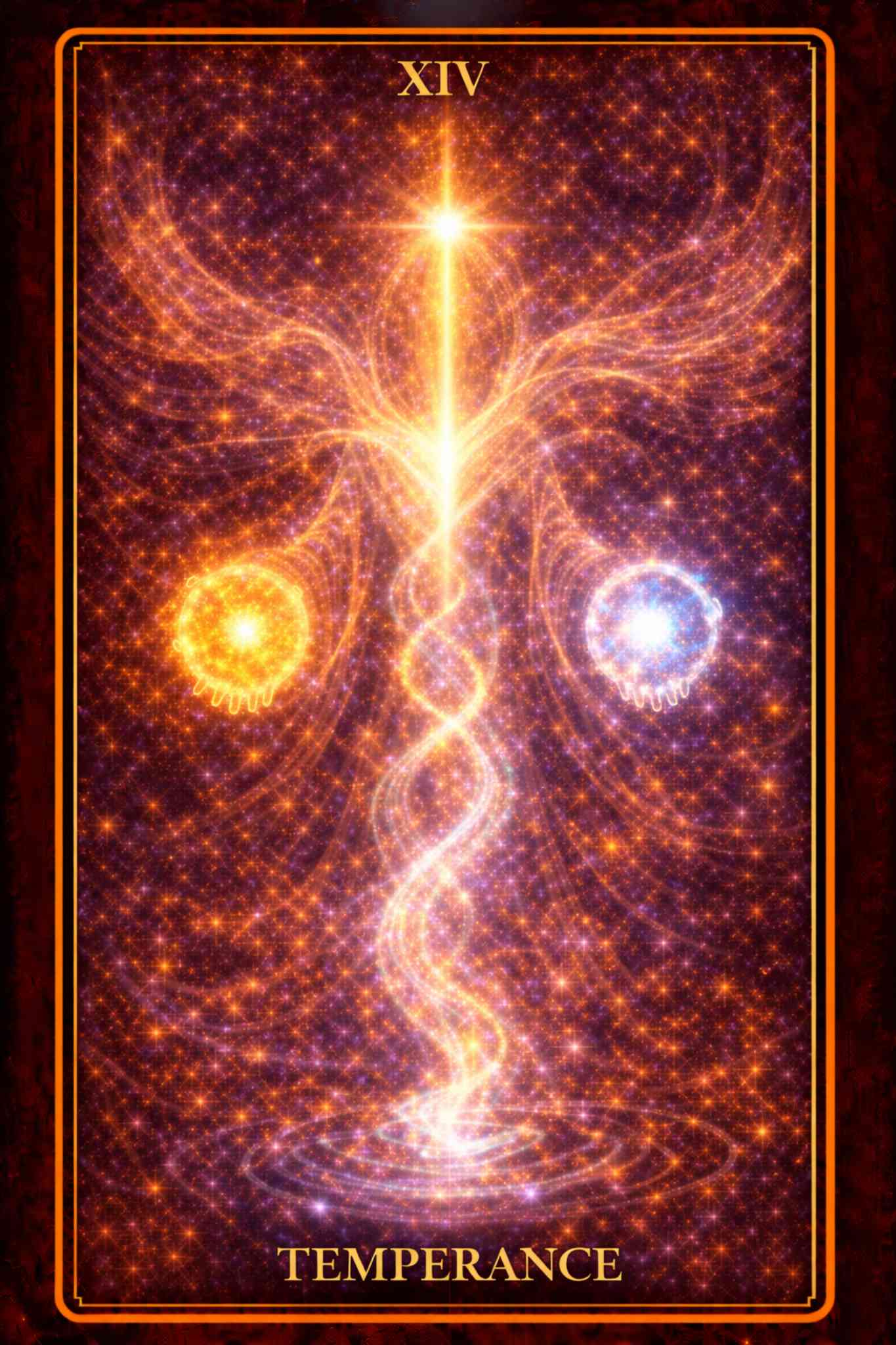

Temperance and Five of Wands Tarot Combination Meaning
Temperance and Five of Wands meet where friction is already in the room, yet the deeper task is learning how to work with that heat without letting it take over the whole field. This is a far more interesting pairing than a simple contrast between peace and conflict. Temperance does not arrive here as a soft refusal of tension. It arrives as regulation, proportion, intelligent blending, and the capacity to keep several active forces from tearing the moment apart. The Five of Wands brings clashing agendas, scattered effort, irritation, rivalry, strong opinions, mixed motives, and the kind of agitation that reveals where coordination is missing. Together, these cards often appear when the real issue is less about ending conflict entirely and more about turning raw struggle into something that can actually teach, clarify, and reorganize life.
That is why this pair can be so useful in serious readings. The Five of Wands is often messy, but it is rarely meaningless. It shows where energies are alive yet poorly arranged. Several desires may be competing at once. Several people may want influence, space, recognition, or movement in different directions. A person may even be fighting themselves through contradictory impulses, inconsistent priorities, and a nervous system that is carrying too much stimulation. Temperance does not erase the noise. It asks whether the noise can be read with more precision. What exactly is colliding here, and what would happen if the aim shifted from winning the moment to understanding the pattern?
When conflict stops being random
One of the most valuable things about this combination is that it often reveals tension as structure rather than accident. The Five of Wands can feel chaotic on the surface. Arguments flare, plans tangle, timing slips, people talk past each other, and effort spreads in too many directions at once. Yet beside Temperance, the same scene begins to look more legible. The friction may be showing where pacing is wrong, where expectations are mismatched, where several active parts of life are all demanding equal space, or where the container is too weak for the amount of fire moving through it. In that sense, the conflict is not only an interruption. It becomes information.
You may also want to go one step deeper.
Temperance + Five of Wands can open up differently inside a focused personal reading.
This shift in perspective matters. Many people respond to friction by either intensifying it or escaping it. They argue harder, shut down, overexplain, appease, or mentally leave before they have really understood what the heat is saying. Temperance offers another way. It slows the reflex to react and replaces it with discernment. Which part of this tension is productive? Which part comes from overload? Which part is exposing something real that needs to be addressed directly? Which part is only echoing habit, ego, insecurity, or accumulated strain? The Five of Wands supplies the sparks. Temperance asks where the sparks are landing and what kind of fire they are truly creating.
Heat that can be used rather than feared
This pairing is especially important for people who have a complicated relationship with intensity. Some fear conflict so much that any friction feels like failure. Others come alive in friction and become sharper, louder, or more forceful whenever resistance appears. Temperance offers a more mature path than either extreme. It does not ask a person to become passive, vague, or endlessly agreeable. It asks them to become exact. How much force is actually needed here? What tone serves the moment? Where is a boundary necessary? Where is patience more powerful than pressure? Where does the situation need a cooler response so that the deeper issue can finally be seen?
The Five of Wands is useful precisely because it shows that living energy is present. There is investment here. There is desire, effort, charge, and often genuine care beneath the agitation. The problem is not lack of vitality. The problem is that vitality is colliding with other vitality without enough rhythm or order. Temperance helps create that order. It teaches that regulated fire remains fire. It can still be passionate, assertive, ambitious, and alive. The difference is that it stops spraying itself everywhere and begins moving with greater coherence.
- Temperance brings proportion, integration, healing, and active regulation of intensity.
- Five of Wands brings friction, competition, clashing agendas, scattered heat, and developmental struggle.
- Together they suggest that tension can become clarifying when it is handled with skill.
- The caution lies in letting conflict become identity, habit, or constant overstimulation.
- The gift is learning how to hold difference without turning every difference into a battle.
Love and relationship meaning
In relationship readings, Temperance and Five of Wands often point toward a bond where chemistry, emotional style, timing, or personal needs are rubbing against each other in ways that demand maturity. This can show arguments, defensiveness, mixed signals, competing desires, or the exhausting experience of two sincere people trying to love each other while still lacking shared rhythm. The Five of Wands brings the heat of interaction. Temperance asks whether that heat can become better understanding rather than ongoing noise. In many cases, the pair does not say the connection is wrong. It says the connection is active, charged, and under-coordinated.
At its healthiest, this combination can be surprisingly constructive. Tension in love does not automatically mean emotional failure. Sometimes it means that two strong natures are still learning how to share space without turning every contrast into a test of control, value, or safety. Temperance becomes deeply important where one person escalates quickly and the other absorbs too much, or where both partners want connection yet keep approaching closeness through different speeds and instincts. The cards suggest that real progress becomes possible when each person regulates their own fire well enough to hear what the relationship is actually struggling with beneath the surface reactions.
In more difficult expressions, the Five of Wands can become chronic irritation, ego contest, or a relationship that stays energized through conflict because genuine softness still feels harder to sustain. Then arguments themselves start carrying the intensity that intimacy cannot yet hold. Temperance asks a decisive question in those situations: can the bond modulate, or does it keep returning to friction as its dominant language? The answer matters a great deal. A relationship can survive difference. It struggles far more when difference becomes constant emotional static.
Career, work, and collaborative strain
In work and professional life, Temperance and Five of Wands often describe a highly energized environment that lacks coordination. There may be overlapping priorities, unclear roles, competitive personalities, clashing leadership styles, or a culture where everyone brings strong fire yet very little shared timing. The Five of Wands can look like brainstorming that tips into ego struggle, ambition that becomes territorial, or a fast-moving setting where too many active currents are crossing at once. Temperance enters as process intelligence. It asks what needs sequencing, simplifying, clarifying, or cooling so that the collective energy becomes useful rather than draining.
This can also describe a private work struggle rather than an external one. A person may have several ambitions pulling at them simultaneously. They may feel full of ideas, hunger, plans, and urgency, yet unable to bring those forces into a workable order. In that case, the conflict is internal but just as real. Too many active goals are competing for one pool of attention. Temperance becomes essential through pacing, prioritization, and the disciplined choice to stop feeding every spark equally. The purpose is not to reduce passion. The purpose is to stop turning passion into internal crossfire.
At its best, this pair can be excellent for dynamic and creative environments because it does not demand lifeless order. It asks for skilled coordination. Strong voices may still exist. Difference may still exist. The field may remain lively, ambitious, and full of movement. What changes is the quality of the container. Temperance helps make the container strong enough that the fire produces output instead of exhaustion.
Psychological and spiritual meaning
Psychologically, Temperance and Five of Wands often describe a person in the middle of internal contradiction. Several parts of the self may be active at once, each insisting on its own urgency. One part wants rest while another wants achievement. One wants closeness while another wants distance. One wants healing while another still trusts old patterns of defense, speed, or self-protection. The Five of Wands shows that these forces are alive and pressing against each other. Temperance offers a path beyond simple suppression. It teaches the art of letting different inner voices come into relationship without allowing one of them to seize the entire system.
Spiritually, this pair can be read as the sacred labor of harmonizing living difference. Real integration is rarely tidy in its early stages. When growth deepens, conflict often becomes more visible because old fusions begin to loosen. Hidden tensions rise into awareness. Desires that once stayed buried begin speaking. Ambitions, fears, instincts, and unhealed responses stop blending unconsciously and start showing their edges. Temperance does not ask the person to return to numbness or forced peace. It asks them to become an alchemist of tension. The Five of Wands supplies the raw materials: heat, resistance, appetite, comparison, agitation, challenge. Temperance teaches how to refine those materials into something more conscious and workable.
Shadow expression and challenge
The shadow side of this pairing appears when friction becomes the atmosphere rather than the signal. A person may become so accustomed to conflict, debate, competitiveness, or emotional charge that calmer forms of engagement start feeling flat by comparison. Then the Five of Wands begins shaping identity. The person becomes reactive, easily provoked, argumentative, or subtly dependent on the stimulation of contest. Temperance can feel frustrating in those moments because regulation asks for less drama and more awareness. Yet without that regulation, the system overheats and clarity disappears.
There is another distortion as well. Temperance can be misused as a way of avoiding necessary friction. A person may become so invested in staying composed, agreeable, or “above the conflict” that they fail to engage the real differences present. Then the peace is only cosmetic. The Five of Wands corrects that by insisting that the heat already exists and needs to be worked with honestly. The deeper challenge of this pair is to avoid both traps: conflict everywhere, or false harmony laid over unresolved strain.
Timing and the management of heated phases
Timing matters greatly with this combination because not every heated period means collapse. Sometimes a rise in tension marks growth, clearer contact, and the first honest appearance of differences that were previously hidden under politeness or confusion. At other times, it signals an ongoing imbalance that will continue unless the pattern itself changes. Temperance helps distinguish between those possibilities. It asks whether the present heat is becoming more workable through conscious adjustment, or whether it is cycling because no one is taking real responsibility for tone, proportion, and rhythm.
The best timing here often involves intervention before escalation hardens into habit. A small correction made early can prevent a much larger rupture later. Sometimes that correction is internal: pacing energy differently, reducing overload, clarifying priorities, or refusing to feed every irritation. Sometimes it is relational: speaking more clearly, setting a cleaner boundary, slowing the tempo of an argument, or redesigning collaboration before strain becomes identity. The Five of Wands shows that the fire is active now. Temperance asks how wisely it can be met before it burns more than it needs to.
FAQ — Temperance and Five of Wands
Is this a negative combination? Not necessarily. It often points to tension, but that tension can be developmental and useful when handled with maturity, regulation, and honest awareness.
What does it mean in relationships? It often suggests friction, arguments, mixed signals, or clashing needs that require skillful communication and better pacing rather than immediate hopelessness or reactive escalation.
Can it apply to work? Very much so. It can reflect competition, collaborative strain, scattered priorities, or a high-energy environment that needs stronger coordination to remain healthy.
Does Temperance calm the Five of Wands? Yes, though not by denying the conflict. It refines the heat so that tension becomes more constructive, purposeful, and far less likely to spiral into wasteful escalation.
What is the core lesson here? Friction is not always the enemy. Sometimes the deeper task is learning how to regulate competing forces so they create growth rather than chaos.
What this combination is really asking
Temperance and Five of Wands ask whether you can remain skillful inside heat instead of letting heat decide the whole tone of your life. That is the heart of the pair. The conflict may be real. The irritation may be real. The clash of energies may be entirely genuine. Yet the cards want to know whether you can meet that friction with enough proportion, self-awareness, and maturity that it becomes informative rather than destructive. They ask whether your fire can be coordinated, not merely expressed.
The deeper lesson is that healing often includes the management of difference rather than the disappearance of difference. Temperance brings the art of blending what does not naturally blend easily. The Five of Wands brings the raw fact of forces competing for space, voice, and direction. Together, they form a highly sophisticated image of growth through regulated friction: a life in which tension becomes less about drama and more about the creation of stronger, clearer, and more integrated movement.
Explore the next layer of this reading.
This combination can mean different things depending on context. A short tarot reading can help you reflect on the question behind the cards.
Closing reflection
Some imbalances arrive as emptiness. Others arrive as too much motion in too many directions at once. This pairing belongs to the second kind. It suggests that the problem may not be lack of fire at all, but the absence of a wiser relationship to the fire already present. Something needs sorting, blending, cooling, and redirecting so the heat can become useful again.
Temperance holds the art of proportion. The Five of Wands brings the clash that reveals where proportion is missing. Between them is a demanding but valuable lesson: harmony is not the absence of energy, difference, or strain. It is the skill of working with those forces in a way that allows life to become more coherent, more honest, and more genuinely alive.
More combinations with Temperance
More combinations with Five of Wands
Continue with Temperance
Explore Related Guides by Topic
If you want to explore this combination through a more specific emotional lens, these tarot guides can help you follow the broader pattern behind the reading.