
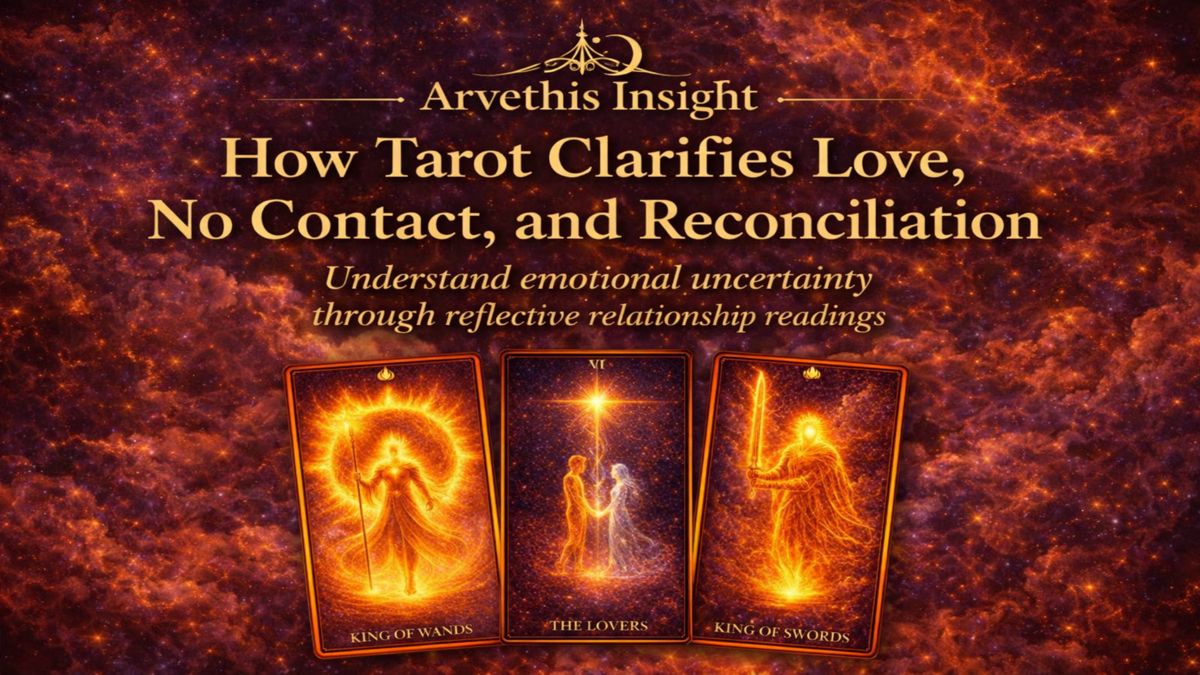
Why relationship questions feel different in tarot
Some tarot questions are easier to hold than others. A question about direction, a personal crossroads, or a general emotional theme can often be approached with a certain amount of calm. Relationship questions usually arrive differently. They tend to come with emotional charge already attached to them. There may be hope, confusion, tenderness, disappointment, longing, mixed signals, unfinished conversations, or the simple ache of not knowing where you stand. Even before the cards are laid down, the question already has weight.
This is part of what makes relationship tarot so compelling. It does not enter a neutral space. It enters a living emotional field. Someone may ask whether a person still cares, whether silence means absence, whether feelings remain hidden beneath distance, or whether a broken connection still carries a path toward repair. These questions are rarely abstract. They rise from real attachment, and that is why they return so often. The emotional mind keeps circling back because it wants orientation. It wants a shape. It wants to understand what is happening beneath what can currently be seen.
Tarot becomes useful here because it slows the rush toward assumption. It offers symbols where the mind would otherwise fill empty space with fear or fantasy. It provides structure without forcing emotional life into something artificial. That is one of its quiet strengths. It does not remove complexity. It helps you look at complexity more clearly.
If you are still refining the quality of the questions you bring into a reading, it can help to revisit how to ask a tarot question. Relationship readings become much stronger when the question itself creates room for depth rather than only urgency.
Why love readings become emotionally foggy so quickly
Love is one of the hardest things to read cleanly because the heart does not observe from a distance. It participates. It remembers tone, absence, small changes, old tenderness, and unspoken possibility. It can recognize meaning in a glance and build a story from a delay. It can hold on to a moment long after the outer situation has shifted. That does not make love irrational. It makes it layered. And layered subjects are exactly where tarot can either become very helpful or very distorted, depending on how it is approached.
One of the main reasons love readings become foggy is that emotion can begin interpreting before the cards do. A hopeful mind may soften difficult cards too quickly. A fearful mind may read distance into every symbol. Someone who misses another person may look for proof instead of pattern. Someone who has been hurt may look for protection instead of truth. These are human tendencies, and they are especially strong when the question touches a vulnerable part of the heart.
This is why steadiness matters so much in relationship tarot. The goal is not to become cold. The goal is to become clear. A reading deepens when you stop asking the cards to rescue you from uncertainty and begin allowing them to describe the emotional structure of the situation as it is. That shift may sound small, though it changes everything. It moves the reading away from immediate comfort and toward grounded perception.
If this pattern feels familiar, tarot projection vs intuition and why your tarot reading feels confusing both support a more honest way of working with emotionally charged questions.
What tarot actually reveals in emotional situations
Tarot does not usually give its most meaningful insight through blunt statements. Its strength lies in showing tone, movement, contrast, and emotional logic. A card can describe affection, hesitation, withdrawal, vulnerability, sincerity, or transition, but what matters most is how those energies are behaving in the situation you are asking about. In relationship readings, this is often more useful than a flat answer because emotional reality is rarely flat.
A person may care and still pull back. They may feel deeply and still stay silent. They may miss what existed and still be uncertain how to re-enter it. They may carry tenderness together with fear, guilt, pride, exhaustion, or inner conflict. Tarot can reveal this layered emotional structure more naturally than ordinary reasoning can, because it allows contradiction to exist without needing to erase one side of it.
This is one reason the cards remain so valuable in love-related questions. They help make room for complexity without collapsing it into confusion. Over time, this creates a more mature reading style. Instead of asking the cards to reduce the connection to one sentence, you begin asking what kind of emotional atmosphere is present, what is moving internally, what remains unresolved, and what deeper dynamic is shaping the present moment.
That is also why learning to read beyond isolated keywords matters. If you want to strengthen that side of your practice, how to interpret a tarot reading offers a useful foundation.
Love questions often hide a deeper need underneath them
Many relationship readings appear to be asking one thing while actually asking another. A person may ask whether someone still loves them, though underneath that question sits a more private need: to know whether the bond mattered, whether the silence is meaningful, whether what was shared was real, or whether the emotional connection still lives somewhere beyond what is being shown outwardly. This is why relationship tarot deserves more respect than quick-answer culture often gives it. The visible question is only part of the story.
When that deeper layer is acknowledged, the reading immediately becomes stronger. It becomes easier to see why a simple yes-or-no often feels insufficient. Love is not only about the presence or absence of feeling. It is also about the quality of that feeling, the maturity of it, the expression of it, and the way it lives inside time, communication, fear, and choice. Tarot can explore those layers far more effectively than it can force a narrow promise.
This is where a guide like does he love me becomes valuable inside the site structure. It answers a strong emotional search intent, though it also opens the deeper interpretive work behind that intent. A reader may arrive wanting certainty, yet stay because the question has been expanded into something more truthful and more useful.
For broader emotional context around romance and attachment, what tarot cards say about love can also support the reader journey without flattening the subject.
Why hidden feelings matter more than surface behavior in some readings
There are moments in love where behavior tells only part of the truth. Someone may say very little and still be emotionally full. They may appear calm while feeling conflicted, detached while quietly watching, distant while still carrying memory and emotional weight. This does not mean behavior should be ignored. It means human beings are capable of inner experiences that do not immediately move into expression. Tarot often becomes most valuable in exactly that space.
Questions around hidden feelings are really questions about the emotional life of the connection beneath the visible layer. They ask whether something remains active below the silence, whether emotion exists where it is not being named, and whether the bond is being felt in a way that current behavior does not fully reveal. These are delicate questions. They require care because it is easy to turn them into projection if the reader begins filling in the blanks with desire instead of observation.
A more grounded approach is to let the cards describe the inner atmosphere without demanding they validate a preferred outcome. That way, the reading can reveal emotional pressure, restraint, hesitation, tenderness, regret, sentiment, or unresolved attachment without immediately converting those things into a promise. This is usually where the real clarity begins.
For readers who want to go deeper into that territory, hidden feelings tarot guidance is a strong internal destination because it focuses directly on this gap between inner experience and outward expression.
Silence is rarely empty in tarot
Few relational conditions create as much inner noise as silence. When communication stops or becomes uncertain, the mind often rushes to interpret what the silence means. Sometimes it reads distance as finality. Sometimes it reads it as hidden longing. Sometimes it moves restlessly between those two poles. This is why no contact readings have become such a strong part of tarot culture. Silence may look like nothing from the outside, but emotionally it is often one of the loudest states a connection can enter.
Tarot reads silence in an especially interesting way because it does not treat it as a blank. It treats it as a condition. That condition may contain reflection, avoidance, emotional overwhelm, protection, unfinished feeling, or simple uncertainty about how to proceed. The cards can show whether the silence is cooling the bond, preserving it, exposing deeper truths, or holding a process that is still changing under the surface. This helps prevent the reading from becoming reactive.
Instead of asking the silence to explain itself all at once, tarot can help you notice what kind of silence it is. That alone can bring relief. The question shifts from panic to perception. What is happening in the silence? What emotional state is shaping it? What remains active even where nothing is being said?
If the reader is standing specifically in this territory, a deep link such as is he thinking about me provides a natural next step because it follows the actual emotional direction many no contact readings take.
Thinking about someone is not the same as moving toward them
This is one of the most important distinctions in relationship tarot, and one of the easiest to miss when emotion is strong. A person can think about someone often without being ready to communicate. They can feel nostalgia without clarity. They can miss what existed without knowing how to rebuild it. They can remain emotionally affected by a connection while still doing nothing outwardly to change the current distance. Tarot often reveals this difference with surprising subtlety.
The question of whether someone is thinking about you is therefore more meaningful than it may first appear, but only when it is held with enough maturity. It is not merely about curiosity. It is about emotional presence. It asks whether the bond still exists in the other person's inner world, whether memory is active, and whether silence truly reflects emptiness or something more complicated. Tarot can illuminate this, though it does so best when the reading remains descriptive rather than possessive.
When held well, this kind of question can become a doorway into deeper emotional understanding. It may reveal that the connection remains alive internally even if the outer movement is slow. It may reveal that thought is present but tangled. It may also reveal that the emotional focus is shifting into a more private or transitional form. All of these possibilities are more nuanced than the question first appears to ask, which is exactly why tarot is suited to it.
Contact is usually the outer sign of an inner shift
When someone asks whether another person will reach out, the surface focus is on communication, but the deeper subject is usually readiness. Reaching out is not only an action. It is often the result of an internal change that has already been building for some time. Reflection becomes more conscious. Silence becomes harder to maintain. Emotional pressure, curiosity, longing, or unfinished feeling begins asking for expression. Tarot can sometimes detect this inner movement before the outer event appears, which is why these readings can feel so compelling.
Still, communication questions need to be approached with care. The cards may show movement without showing speed. They may show desire without showing courage. They may show thought without showing follow-through. This does not make the reading weak. It makes it accurate to emotional life. Human beings do not move in straight lines when vulnerability is involved.
This is why a page like will he contact me fits naturally inside a content cluster like this one. It speaks to a powerful and specific user need, while still allowing the site to present the question in a grounded, non-sensational way.
For readers who want more general interpretive depth before narrowing into communication questions, how to trust your tarot reading can also support better pacing and clearer self-awareness.
Breaking no contact is a different emotional event
No contact is not always just the absence of messaging. Sometimes it becomes part of the emotional structure of the connection itself. It can act like a boundary, a recovery space, a defensive pause, or a pattern that both people remain inside for different reasons. Because of this, breaking no contact is not merely a smaller version of reaching out. It usually reflects a more meaningful internal shift. Something about the emotional arrangement that has been holding the silence in place begins to change.
That shift can happen for many reasons. Missing the connection may become more conscious. Emotional avoidance may lose some of its strength. Reflection may lead to a different understanding of the bond. Pride may soften. Curiosity may return. Regret may rise to the surface. Tarot helps here because it can reveal the condition of that inner threshold before it becomes visible through action.
A guide such as will he break no contact deserves its own internal support because it speaks to a distinct relational stage. Someone who searches this is often farther inside the emotional complexity of silence than someone simply asking about casual contact. The wording carries more history. The reading should reflect that.
Reconciliation is about change, not just return
Reconciliation is one of the most emotionally powerful themes in tarot because it brings together memory, hope, grief, and possibility in a single question. But reconciliation is rarely about returning to what once was in its original form. Even when reconnection is possible, it usually requires change. Something in the emotional pattern, in the perspective of one or both people, or in the way the bond is held must shift. Otherwise the idea of reconciliation becomes only a longing for repetition.
This is why reconciliation readings ask for maturity from the reader. They ask whether repair is truly supported by the emotional landscape, whether the connection is evolving into something more conscious, and whether the conditions that once caused pain are being transformed or merely revisited. Tarot is very capable of holding these questions, though it tends to do so through process rather than fantasy. It can show openness, remembrance, softness, mutual pull, or the possibility of return, but it often shows these alongside deeper conditions that must also be acknowledged.
That is what makes will we reconcile such a valuable deep page inside the cluster. It stands at the point where emotional search intent becomes deeper interpretive work, and it connects naturally with love, hidden feelings, silence, and communication without collapsing into any one of them.
Combinations still matter when the article is not built like a combinations page
A blog post should not move like a combinations page. Its rhythm is broader. It explores a subject across emotional, symbolic, and interpretive levels rather than focusing on one pair of cards at a time. Still, combinations remain useful inside authority content because they show how tarot meaning becomes more precise in practice. A concept such as emotional maturity, hidden feeling, or gentle openness becomes easier to understand when it is tied to an actual interaction between cards.
For example, The Lovers and King of Cups can illustrate a bond where affection is paired with emotional regulation, steadiness, and depth that may be felt more strongly than it is displayed. Likewise, Strength and Ace of Cups can support a discussion of quiet emotional opening, where feeling emerges through gentleness, balance, and inner composure rather than dramatic exposure.
Used sparingly and naturally, examples like these enrich a blog article rather than making it feel like a list of pairings. They help connect the broader emotional discussion to the site's deeper interpretive resources, which is exactly what good internal linking should do.
If a reader wants to understand that principle more directly, tarot cards change meaning together is a strong related blog path.
Authority in relationship tarot content comes from emotional accuracy
There is a difference between content that sounds intense and content that is genuinely trustworthy. Relationship tarot can easily slip into dramatic language because the topics themselves are emotionally charged. But real authority usually feels steadier than that. It does not need exaggerated certainty to hold attention. It earns trust by describing emotional reality accurately, by allowing nuance to remain visible, and by guiding the reader toward understanding rather than dependence.
This matters for both the reader experience and the overall strength of the site. A strong authority article does more than target a phrase. It becomes a bridge. Someone may arrive because they are distressed by silence, confused by mixed signals, or pulled toward the hope of reconnection. If the article meets that emotional state honestly, it can then guide the reader deeper into the most relevant part of the site without forcing the journey. That is where internal linking becomes genuinely powerful. It stops being a technical layer and starts becoming part of the reading path itself.
A user may enter through a broad emotional article like this one and naturally move into a more specific page such as will he come back once the emotional framework has become clearer. That movement feels natural because the content has already prepared the deeper question instead of dropping it in abruptly.
How to get clearer readings for yourself
If you are reading for your own emotional situation, one of the most helpful changes you can make is to stop treating urgency as insight. Urgency wants resolution now. Insight usually arrives more quietly. It asks for observation, honesty, and enough stillness to let the symbols speak before the emotional mind rushes in to finish the story. This is not always easy, especially when the situation matters deeply, but it changes the quality of the reading almost immediately.
It also helps to ask better questions. Ask what emotional dynamic is active right now. Ask what the silence is revealing. Ask what is shaping the distance. Ask what needs to be understood about the bond in its current form. Ask what you may be sensing clearly and where you may be interpreting through fear, hope, or memory. These kinds of questions usually create richer, more stable readings than repeated demands for certainty.
If you want additional support in building that reading style, is tarot accurate and tarot and decision-making both help place tarot inside a more grounded and thoughtful framework.
Final perspective: what tarot is really offering in love, silence, and reconnection
At its best, tarot does not turn relationship uncertainty into a simplistic answer. It does something more useful than that. It reveals pattern, tone, emotional movement, and inner truth with enough clarity that the situation begins to feel less shapeless. The silence may still exist. The longing may still exist. The unanswered questions may still remain for a time. But they begin to live inside a clearer emotional map.
That map matters. It can show that love is present in a quieter or more conflicted form than expected. It can show that hidden feelings exist without yet moving into expression. It can show that no contact is emotionally active rather than empty. It can show that reconciliation belongs to a deeper process of change rather than a quick return to the past. Most importantly, it can help the reader step out of the cycle of reacting to every shift and into a more grounded relationship with what the connection is actually revealing.
In that sense, tarot is not only helping you understand another person. It is helping you understand the emotional field you are standing in, and the way your own hope, fear, memory, intuition, and perception move within it. That is often where the deepest clarity begins. Once that clarity is present, the right next question tends to reveal itself naturally, and from there the site can guide the reader more specifically into love, feelings, no contact, reconciliation, or card interaction without losing the broader human truth that brought them here in the first place.
Tarot works best here as a reflective tool for emotional clarity, pattern recognition, and deeper perspective within complex relationship dynamics.