
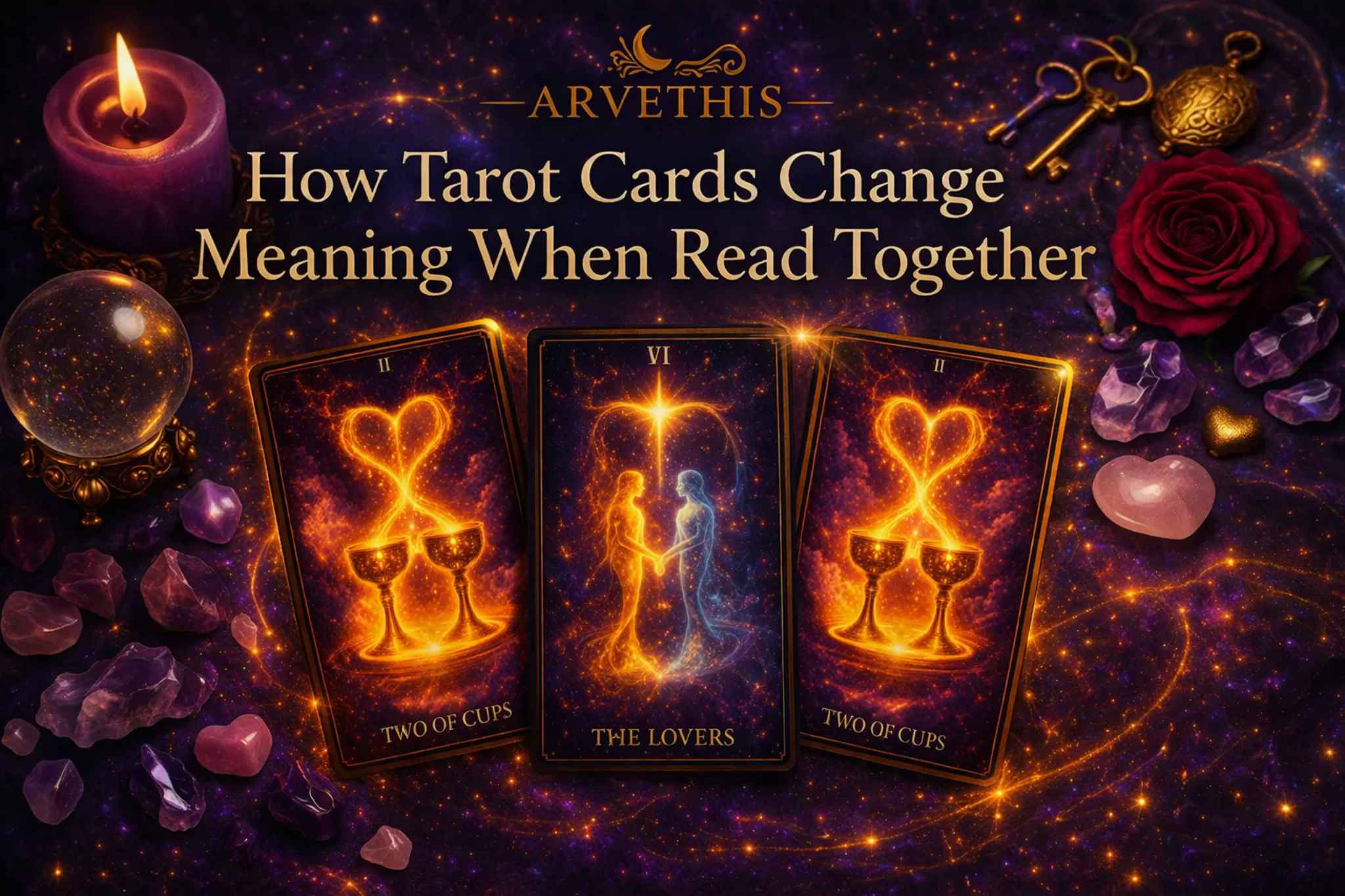
There is a moment in tarot reading that does not arrive dramatically, and yet it changes everything about how the cards are experienced. It appears quietly, often in the middle of a reading that feels technically correct, where each card has been interpreted with accuracy, and the structure seems intact, yet something remains unresolved beneath the surface. The meanings are there, the logic is present, and still the reading does not fully settle into something that feels alive. This is not failure, and it is not lack of knowledge. It is the exact point where tarot begins to move beyond memorization and into perception, where meaning is no longer something applied from memory, but something that begins to emerge through relationship, through interaction, and through a deeper form of attention that cannot be reduced to definitions alone. In that moment, the reading shifts from something constructed into something revealed, and the difference between those two experiences is far more significant than it first appears.
Most readers begin in a way that feels structured and reliable, learning each card as an individual symbol with a clear meaning that can be recalled when needed. This stage creates stability, and without it, tarot would remain abstract and difficult to access. You learn that The Fool carries openness, movement, and a willingness to step into the unknown, and this begins to form a mental anchor that you can return to in future readings. You understand that The High Priestess reflects inner awareness, subtle perception, and a kind of knowing that does not reveal itself through force, but through stillness and observation. You recognize the emotional steadiness of the King of Cups, the ability to remain present with feeling without becoming overwhelmed by it. These meanings are accurate, necessary, and deeply valuable, yet they represent only the surface layer of what tarot actually becomes over time, because the cards are not designed to function as isolated symbols, but as parts of a system that reveals itself through interaction.
When Tarot Moves Beyond Fixed Meanings
There comes a stage where the meanings you have learned remain true, yet they begin to feel incomplete when used on their own, as if they describe the cards accurately but fail to capture the full experience of the reading. The cards no longer behave as isolated symbols, and instead begin to influence each other in ways that cannot be reduced to individual definitions. The Fool beside The Sun creates a sense of openness that feels supported and illuminated, where movement carries a natural confidence that does not need to force itself forward, because clarity already exists within the situation. The same Fool beside The Moon enters a completely different space, where openness becomes more sensitive, more aware of uncertainty, and more attuned to emotional depth that cannot yet be fully understood.
The card itself has not changed, and yet its expression has transformed entirely, shaped by the presence of the card beside it. This is where tarot begins to reveal its deeper structure, showing that meaning does not exist as something fixed within each card, but as something that emerges through interaction. The cards are not static symbols waiting to be decoded, but dynamic elements that respond to each other, reshape each other, and create something new when placed together. Once this becomes visible, the reading shifts from something that is constructed piece by piece into something that is observed as a whole, where meaning unfolds through relationship rather than being assembled through memory, and this shift creates a depth that cannot be replicated through definitions alone.
The Limits of Memorization in Tarot
Memorization provides clarity in the beginning, but it eventually reaches a limit where it can no longer carry the depth that the reading requires. At this stage, many readings begin to feel repetitive, even when the cards themselves are different, because the method of interpretation remains unchanged. Each card is described accurately, yet the reading as a whole lacks cohesion, and the connection between the cards remains underdeveloped. This creates a subtle sense that something is missing, even though nothing is technically incorrect, and this sensation becomes more noticeable over time as the reader gains experience but does not yet shift their approach.
This limitation does not come from the cards themselves, but from approaching them as separate meanings rather than as parts of a living structure. Tarot does not function as a collection of definitions, and when it is treated that way, the reading cannot fully develop into something coherent and layered. The shift happens when the reader begins to see the relationships between the cards as the primary source of meaning, allowing the interpretation to move beyond repetition and into something more precise, more specific, and more aligned with the actual experience being explored. This is the point where tarot begins to feel less like a system you use and more like a language you begin to understand.
Tarot Combinations as the Core Language
When combinations become the focus, tarot begins to change in a way that feels immediate and undeniable, because meaning starts to form through interaction rather than through addition. A pairing like The Emperor and King of Cups does not simply combine authority and emotion, but creates a very specific expression of grounded emotional leadership, where structure holds feeling without suppressing it, and where emotional depth is stabilized through clarity rather than controlled through force. This is not an abstract interpretation, but a precise relational dynamic that can be recognized and felt within the reading itself.
The same Emperor placed beside the Seven of Cups creates a completely different experience, where structure encounters uncertainty, and clarity meets dispersion, forming a tension that reshapes both cards simultaneously. These differences are not minor variations, but entirely different expressions created through interaction, and this is why combinations are not an advanced technique but the actual language through which tarot communicates. Without this relational awareness, the reading remains technically correct but experientially incomplete, and with it, the cards begin to form something that feels coherent, alive, and deeply specific.
The Dimension of Movement in Tarot
Tarot is not only relational, but directional, and this direction plays a crucial role in how meaning unfolds across a reading. A sequence of cards carries movement, and this movement shapes the interpretation in ways that cannot be ignored. In a Three Card Tarot Reading, the progression from one card to the next creates a structure that reflects transition, development, and change, forming a kind of symbolic flow that reveals how one state evolves into another. This movement transforms the reading into something that feels dynamic rather than static, where meaning is not contained within individual cards but carried across the entire spread.
If the Ace of Cups is followed by the Five of Cups and then the Eight of Cups, the meaning emerges through progression, moving from emotional opening into disappointment and eventually into release or departure. This sequence creates a directional understanding that cannot be accessed by reading each card separately, because the meaning exists within the transition itself. Change the order, and the meaning shifts entirely, demonstrating that tarot is not only symbolic but temporal, shaped by sequence and flow in a way that adds depth and precision to interpretation.
Emotional Readings Reveal Hidden Layers
Emotional readings often reveal the relational nature of tarot with particular clarity, because emotional experiences rarely exist in a single dimension and tend to unfold through multiple layers at once. A card like the Two of Cups in feelings may suggest connection, mutual recognition, and shared emotional space when seen on its own, creating a sense of harmony that feels complete and stable. Yet when it appears beside the Four of Cups, that harmony becomes more complex, introducing a layer where connection exists but is not fully received, where emotional presence meets hesitation or internal withdrawal.
When the same Two of Cups appears alongside The Devil, the dynamic transforms again, introducing intensity, attachment, or entanglement that alters the nature of the connection entirely. These shifts are not contradictions, but expansions, showing that the meaning of the card is shaped by the context in which it appears. Emotional readings therefore require a relational approach, because the experience they reflect is inherently layered, and without that awareness, the interpretation remains incomplete, unable to fully capture the depth of what is being expressed through the cards.
Why Confusion Is a Necessary Threshold
At a certain point, confusion begins to appear in a way that feels different from simple uncertainty, and this shift often marks a turning point in how tarot is experienced. It is not that the cards are unclear, but that they hold multiple layers of meaning at once, and these layers do not immediately resolve into a single interpretation. This can feel frustrating at first, because the clarity that once came easily now seems less accessible, yet this stage represents a transition rather than a problem, a movement into a deeper level of perception that cannot be simplified without losing its richness.
This experience is explored more deeply in why your tarot reading feels confusing, where the focus shifts from eliminating confusion to understanding its role within the reading. When the reader stops trying to force a single interpretation and begins to observe the relationships within the spread, the confusion begins to transform into clarity, not by becoming smaller, but by becoming more complete. The reading does not simplify, but it becomes coherent in a way that reflects the full complexity of the situation it represents.
From Interpretation to Perception
Over time, something begins to shift in a way that is subtle but unmistakable, changing the experience of reading from interpretation into perception. The process becomes less deliberate, and the relationships between the cards begin to reveal themselves more naturally, creating a sense that the reading is unfolding rather than being constructed. Patterns that once required effort to recognize now appear without being actively searched for, forming a familiarity that does not rely on memorization but on recognition developed through repeated experience.
A pairing like The Fool and The Moon consistently carries a sense of openness moving through uncertainty, while The Fool and The Sun reflects openness supported by clarity and alignment. These patterns are not fixed meanings, but recurring relational dynamics that become visible through observation, allowing the reader to engage with the cards in a way that feels both intuitive and grounded. The reading becomes less about applying knowledge and more about seeing what is already present within the structure of the spread.
The Role of Structure and Tarot Spreads
Even as tarot becomes more fluid and relational, structure continues to play an essential role in shaping how meaning emerges, and this is where tarot spreads provide a framework that supports interpretation without limiting it. The spread creates positions, relationships, and context, allowing the cards to interact within a defined space that gives direction to the reading while still leaving room for flexibility and nuance. This structure acts as a container, holding the complexity of the cards in a way that allows their relationships to become visible and meaningful.
The balance between structure and fluidity is what allows tarot to remain both grounded and open, providing enough stability to guide interpretation while still allowing meaning to emerge organically through interaction. Without structure, the reading can become scattered, and without relational awareness, it can become rigid, but when both are present, the cards begin to form a coherent whole that reflects the depth and complexity of the situation being explored.
Why Tarot Feels Different Over Time
There is a noticeable shift that occurs as time passes and experience accumulates, and it is often difficult to describe because it does not come from learning something new in a traditional sense. Instead, it comes from seeing the same symbols in a different way, from recognizing patterns that were always present but not yet fully visible. The cards begin to feel less like objects that need to be interpreted and more like expressions that reveal themselves when given the right kind of attention. This change does not happen suddenly, but gradually, through repeated encounters that deepen familiarity without reducing complexity.
What once required effort becomes more natural, and what once felt uncertain begins to carry a sense of quiet recognition. The reader no longer searches for meaning in the same way, because meaning begins to appear through observation rather than through analysis. This does not remove depth from the reading, but enhances it, allowing the cards to be experienced in a way that feels both grounded and expansive at the same time. The system remains the same, yet the experience of it transforms, creating a sense that tarot is not something fixed, but something that continues to evolve alongside the reader.
The Role of Presence in Accurate Readings
Beyond knowledge, beyond structure, and beyond technique, there is another element that becomes increasingly important in tarot reading, and that element is presence. It is the ability to remain fully attentive to the cards, to the relationships between them, and to the subtle shifts that occur within the reading as it unfolds. Presence cannot be replaced by memorization, and it cannot be simulated through method alone, because it requires a kind of engagement that is both focused and open at the same time.
When presence is fully established, the reading begins to align in a way that feels clear without being forced, as if the meaning is already there, waiting to be recognized rather than constructed. This does not make the reading easier in a simplistic sense, but it makes it more accurate, because it allows the reader to perceive what is actually present rather than what they expect to see. In this state, tarot becomes less about effort and more about attention, less about control and more about awareness, and this shift creates a depth of clarity that cannot be reached through technique alone.
When the Reading Becomes a Whole
There is no final point where tarot becomes complete, because each reading presents a new configuration that must be understood on its own terms, yet there is a moment where the experience shifts from fragmentation into cohesion, where the cards begin to speak together rather than separately. This shift does not come from learning more meanings, but from seeing how those meanings interact, how they form patterns, and how those patterns create a structure that reveals itself gradually through observation and experience.
In that moment, tarot stops feeling like something that needs to be solved and begins to feel like something that can be observed, something that unfolds through relationship rather than through definition. The clarity that once felt difficult to reach becomes present within the structure itself, not because the reading has been simplified, but because it has been fully seen. And in that recognition, tarot reveals its deeper nature, not as a system of meanings, but as a system of relationships that continues to evolve with every reading, offering depth that cannot be exhausted and insight that continues to unfold with each new encounter.