
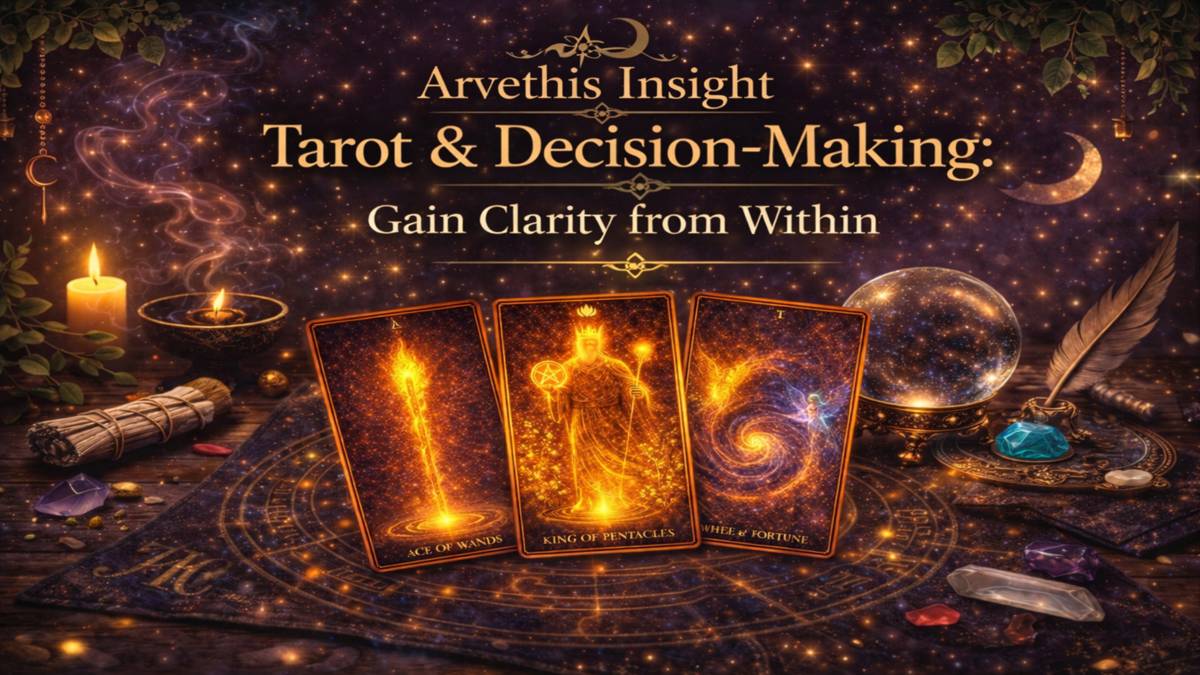
When decisions feel heavy, tarot often enters the picture
There are moments in life when decision-making becomes less about logic and more about tension. You may already know your options. You may have thought them through repeatedly. You may even have a sense of what each path could lead toward. And yet, something remains unresolved. The question does not disappear. It stays present, often quietly at first, then more persistently, asking for attention in a way that feels difficult to ignore.
It is often in these moments that tarot appears. Often because something internal has not yet become fully clear, rather than a need to predict something external. A decision that seems simple on the surface can hold layers of emotional weight, personal history, and subtle resistance. Tarot becomes relevant here as a way of seeing what has not yet been fully acknowledged, while the decision itself remains in your hands.
What makes tarot particularly useful in decision-making is that it offers a different kind of clarity. It supports your judgment while keeping responsibility where it belongs. It creates a structured way to observe your situation from a perspective that is less tied to immediate emotional pressure. It allows you to notice patterns, reactions, and underlying dynamics that may otherwise remain in the background.
This distinction matters. Many people approach tarot with the hope that it will tell them what to do. Over time, however, the more meaningful use of tarot reveals itself differently. Rather than providing a final instruction, it shows you how you are relating to the decision itself.
And in many cases, that is where clarity actually begins.
Why decisions become difficult in the first place
A decision rarely becomes difficult because of the number of options available. It becomes difficult because of what those options represent. Beneath a simple choice, there are often competing needs, fears, and expectations. One path may feel aligned but uncertain. Another may feel safe but limiting. A third may carry emotional attachment that makes it hard to see clearly.
When you look at a decision only on the surface level, it can appear as a problem to solve. When you begin to feel the deeper layers, it becomes something else entirely. It becomes a reflection of your internal state.
This is why thinking alone often does not resolve it. Logic can outline the possibilities, though it rarely explains why one option feels heavier than another. It also leaves unanswered why the same question returns even after reaching a conclusion, or why a “good” choice can still feel uncomfortable.
Tarot can enter here as a way to shift the process. Instead of trying to force a conclusion, it invites you to observe the relationship between you and the decision. It brings attention to emotional responses, symbolic meanings, and patterns that may not be immediately visible through analysis alone.
This can make the process feel more honest, even when it is not immediately easier. Over time, that honesty tends to lead to clarity that feels more stable.
What tarot actually does in decision-making
There is a common misunderstanding that tarot functions as a direct answer system. In decision-making, this often takes the form of yes-or-no expectations or a desire for confirmation. While those approaches can feel appealing, they tend to oversimplify what is actually happening.
Tarot works with uncertainty rather than forcing it into artificial certainty. It reframes uncertainty into something you can engage with more consciously.
When you use tarot in a decision-making context, several things begin to happen:
- It externalizes your internal state. Thoughts and emotions that are difficult to articulate take form through imagery and symbolism.
- It slows down reactive thinking. Instead of moving quickly toward a conclusion, you are invited to observe and reflect.
- It reveals underlying dynamics. Patterns, tensions, and motivations begin to surface in a way that feels more tangible.
- It creates distance. This distance allows you to see your situation more clearly, without being fully absorbed in it.
These effects are subtle, but they are significant. Over time, they change the way decisions are approached. Instead of asking, “What should I do?” the question becomes, “What is actually happening here?”
And that shift often leads to more grounded choices.
Why tarot should not make the decision for you
It can be tempting to treat tarot as a deciding authority. When uncertainty feels uncomfortable, having something external provide a clear direction can feel relieving. However, this approach creates a different kind of tension.
A decision that is made externally often leaves something unresolved internally. Even if the outcome appears clear, there can be lingering doubt, hesitation, or resistance. This is because the process of deciding is not only about the outcome. It is about alignment.
When tarot replaces your role in the process, it interrupts that alignment. It removes the opportunity to understand your own position within the situation. Over time, this can lead to dependence rather than clarity.
A more sustainable approach is to use tarot as a reflective tool. It supports the process without replacing it. It highlights what is present, while the direction remains yours to choose.
This distinction protects both the integrity of the reading and the autonomy of the person making the decision.
How to approach a decision with tarot
When you bring tarot into a decision-making process, the way you frame the reading matters as much as the cards themselves. A thoughtful approach creates space for meaningful insight.
Here is a grounded way to begin:
- Start with the situation. Focus on understanding the dynamics before thinking about outcomes.
- Ask open-ended questions. Questions that begin with “what,” “how,” or “what should be understood” tend to produce deeper insight.
- Limit the number of cards. Simplicity often leads to clarity. A three-card spread is often enough.
- Observe your reactions. Notice what you feel when you see each card. That reaction is part of the reading.
- Avoid repeating the same question. Repetition often increases confusion rather than resolving it.
If you want to explore a decision in a structured way, you can use a simple spread such as:
Try a three-card tarot reading for clarity
This type of reading creates a clear framework without overwhelming the process.
Understanding different types of decisions through tarot
Not all decisions carry the same weight, and tarot tends to reflect this difference. The way a reading unfolds often depends on the nature of the decision itself.
Emotional decisions
These decisions involve relationships, attachment, and vulnerability. Tarot readings in this context often emphasize Cups and Major Arcana cards. The focus tends to be on emotional truth, connection, and internal alignment.
Practical decisions
These involve work, finances, or tangible outcomes. Pentacles frequently appear, highlighting stability, long-term impact, and material considerations.
Transformational decisions
These are moments of significant change. Cards such as Death, The Tower, or Judgement may appear, indicating that the decision is part of a larger shift rather than an isolated choice.
Understanding the type of decision can help you interpret the reading in a way that feels more grounded and relevant.
When a reading feels unclear
There are times when a tarot reading does not immediately provide clarity. This can feel frustrating, especially when you are already uncertain. However, lack of clarity is often meaningful in itself.
It may indicate:
- That the situation is still unfolding
- That more information is needed
- That emotional intensity is affecting perception
- That the focus of the question may need to shift
Instead of forcing interpretation, it can be helpful to step back and return to the reading later. Distance often brings a different perspective.
If you frequently experience confusion in readings, you may find it helpful to revisit:
Why your tarot reading feels confusing
How different tarot combinations can shift your perspective
As you begin to work with tarot more consistently, one of the most noticeable shifts happens in how meaning forms between cards rather than within them. A single card can describe a feeling or a situation, though decisions rarely exist in isolation. They carry emotional weight, timing, context, and internal resistance all at once. This is where combinations begin to matter, because they reflect the way different forces interact rather than presenting a single fixed interpretation.
A card that might feel open and expansive on its own can take on a more cautious tone when placed next to something restrictive. In the same way, a card associated with hesitation can begin to feel intentional when supported by one that suggests clarity or emotional steadiness. Nothing is removed from the meaning. It becomes more precise, more reflective of how real decisions actually unfold. This is why relying only on isolated card meanings can start to feel limiting over time, especially when you are trying to understand something that already feels layered.
For example, a combination like The Lovers and the King of Cups can shift the focus from simple attraction toward emotional maturity and stability. The same connection feels different depending on what supports it. In this way, combinations reveal how meaning evolves through interaction rather than remaining fixed.
If you want to explore how meaning shifts through interaction rather than definition, you can look at how cards influence each other in real situations:
Explore tarot card combinations and layered meanings
Working with combinations does not make readings more complicated. It makes them more aligned with how experience actually feels when you are inside a decision rather than observing it from a distance.
Love and emotional decisions often require a different kind of clarity
Not every decision carries the same emotional intensity, and this becomes especially visible in situations involving connection, attachment, or vulnerability. Love-related decisions tend to feel heavier because they are more personal. They involve perception, expectation, and emotional investment in a way that is difficult to separate into clear categories.
In these moments, thinking alone often reaches its limit. You may understand the situation logically, yet still feel uncertain about what it means on a deeper level. Tarot becomes useful here because it allows emotional dynamics to surface without forcing them into simplified conclusions. Instead of asking what will happen, the focus begins to shift toward what is actually being experienced beneath the surface and how that experience shapes your perception of the decision.
If your situation is primarily relationship-based or emotionally complex, you may find it helpful to explore this perspective more directly:
Explore love-focused tarot guidance
This approach creates space for clarity to form in a way that feels more stable once it arrives.
Understanding feelings before making a decision
One of the most common sources of confusion in decision-making is the difference between what is felt and what is expressed. These two rarely move at the same pace. A situation may appear steady on the surface while holding uncertainty underneath, or it may appear uncertain while carrying a deeper sense of emotional direction that has not yet been acknowledged. This gap between inner experience and outward expression often creates the sense that something is unclear, even when part of you already understands more than it seems.
Tarot can help bring these layers into awareness without forcing them into a single interpretation. It allows you to observe emotional patterns, subtle reactions, and underlying tension in a way that feels less abstract. When these elements become visible, the decision itself often begins to feel less overwhelming, because it is being seen more fully.
If you want to focus specifically on emotional clarity and how feelings shape perception, you can explore this further here:
Understand emotional dynamics through tarot
When timing feels uncertain
Some decisions feel difficult because the timing surrounding them has not yet settled. You may sense that something is shifting or beginning to form, yet still feel unsure whether to move forward or remain where you are. This creates a particular kind of tension, where both action and stillness feel partially aligned and partially uncertain at the same time.
Tarot does not define timing in precise terms, though it can reveal the quality of it. Instead of focusing on when something will happen, it becomes more useful to observe what phase the situation is in and how ready it feels to move. In many cases, clarity emerges when the surrounding conditions begin to stabilize on their own.
This shift reduces urgency while keeping awareness present. It allows you to stay engaged with the decision while giving it space to take shape in a way that feels more grounded.
When reflection replaces overthinking
There is a subtle difference between reflection and overthinking, and tarot can move in either direction depending on how it is used. Reflection creates space. It allows meaning to develop gradually and gives you time to observe your own responses without immediately trying to resolve them. Overthinking, on the other hand, tends to repeat the same question in different forms, searching for certainty before clarity has had time to form.
When tarot becomes part of an overthinking loop, the reading itself can start to feel less clear. Pulling additional cards, repeating the same question, or looking for confirmation rather than understanding can gradually shift the process away from insight. Allowing distance between readings often changes this dynamic. What felt unclear in the moment can begin to settle into something more recognizable once there is space to reflect without pressure.
In this way, tarot remains most useful when it supports awareness rather than urgency. It becomes part of a process that unfolds over time, rather than something that needs to produce an immediate conclusion.
Decision-making becomes clearer when perspective shifts
At its core, tarot does not simplify decisions by reducing them. It clarifies them by changing how they are seen. What initially feels overwhelming often begins to separate into smaller, more understandable parts. What feels uncertain starts to reveal an internal structure. What feels urgent begins to lose some of its intensity as the underlying dynamics become clearer.
This is why tarot remains relevant even when no immediate decision is made. The value is not only in reaching a conclusion, but in developing a way of seeing that continues to influence how future choices are approached. Over time, this creates a different relationship with decision-making itself, one that is less reactive and more aware.
And in many cases, that shift in perspective is what allows a decision to finally take shape in a way that feels aligned from within rather than imposed from the outside.
Recognizing patterns in your decisions
One of the deeper ways tarot supports decision-making is by revealing patterns over time. When you look at multiple readings across different situations, certain themes may begin to repeat. These patterns are not random. They often point toward underlying dynamics that influence how you approach decisions. For example:- Choosing familiarity over growth
- Avoiding discomfort even when change is needed
- Seeking external validation before acting
- Moving quickly without fully considering emotional impact
Explore how tarot cards change meaning together
Building trust in your own decision-making process
Over time, the way you use tarot begins to influence how you relate to decisions in general. Instead of relying on the cards for answers, you begin to use them as a way to refine your own perspective. This shift is gradual, but it is significant. You may notice that:- You feel less urgency to resolve decisions immediately
- You become more comfortable with uncertainty
- You recognize your own patterns more quickly
- You trust your initial impressions more consistently
How to trust your tarot reading
Final perspective: clarity grows through reflection
Tarot supports the process of deciding. It does not eliminate uncertainty or guarantee outcomes. What it offers is a way to engage with decisions more consciously. When you feel stuck, the goal shifts from forcing movement to understanding what is holding that movement in place. Tarot can support this process by making the unseen more visible and the unclear more approachable. Over time, decisions begin to feel different. They may carry the same weight, though they are approached with greater awareness. And in many cases, that awareness is what allows a decision to finally take shape.Tarot works best as a reflective tool for gaining perspective rather than making fixed or external decisions.