
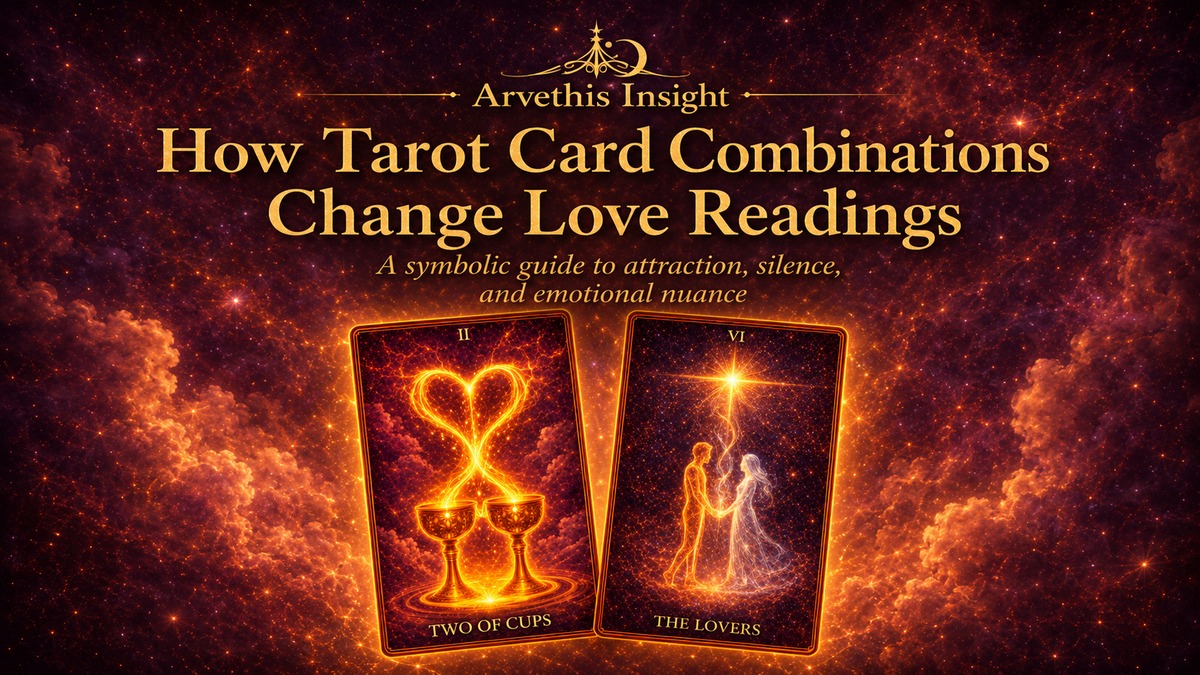
How Tarot Card Combinations Change Love Readings
Love readings are rarely made of one simple feeling. Attraction can live beside fear. Hope can sit beside hesitation. Silence can carry longing, distance, self-protection, confusion, or the need for time. A person can feel drawn toward someone and still struggle to speak clearly. A relationship can hold warmth and still contain pressure. This is why tarot card combinations matter so much in love readings. A single card may describe one emotional note, but a combination shows how that note changes when another symbol enters the room. The Two of Cups in love beside The Sun feels open, warm, and mutually visible. The same Two of Cups beside The Moon feels more mysterious, tender, uncertain, or emotionally hard to name.
Through the Arvethis lens, tarot combinations in love readings are best treated as symbolic mirrors rather than fixed romantic verdicts. They can help you notice emotional patterns, relational tension, desire, guardedness, timing, communication style, and the deeper atmosphere around a bond. They are not proof of what another person feels, and they should not replace honest conversation, consent, personal responsibility, or qualified support where needed. Yet when approached carefully, combinations can reveal the shape of a love question with surprising nuance. They can show whether the reading is more about attraction, fear, silence, healing, choice, attachment, projection, emotional maturity, or the kind of truth a connection is asking both people to meet.
This matters because love questions often arrive with urgency. Someone may ask whether a person misses them, whether reconciliation is possible, whether silence has meaning, whether the connection is real, or whether they should wait, speak, step back, or move on. A forced reading tries to turn the cards into immediate certainty. A careful reading asks which emotional pattern is being revealed, rather than forcing the cards into immediate certainty. Tarot combinations are powerful because they can hold more than one truth at once. They can show longing and fear. They can show affection and avoidance. They can show chemistry and poor timing. They can show hope and the need for boundaries.
Why love readings need combinations
A single love card can be meaningful, but it may also be too broad if read alone. The Lovers can speak of choice, attraction, values, union, intimacy, and the alignment between desire and conscience. The Lovers in love may point toward a meaningful emotional decision, while The Lovers as feelings can highlight attraction, sincerity, hesitation, or the difference between raw emotion and relational capacity. But The Lovers with Justice is not the same as The Lovers with The Moon. The Lovers with the Two of Swords is not the same as The Lovers with the Ace of Cups. Combination is what turns broad symbolism into relational texture.
The same is true for Cups cards. The Ace of Cups in love may describe emotional opening, tenderness, or the beginning of feeling. The Ace of Cups as feelings can suggest affection, care, and heart energy becoming available. Yet if the Ace of Cups appears beside the Four of Pentacles, the reading may show a heart opening while something still protects itself. If it appears beside the Eight of Wands, feeling may move quickly through messages or sudden contact. If it appears beside The Hermit, tenderness may need quiet, privacy, or inner reflection before it can be expressed clearly.
This is why love combinations are more useful than isolated keywords. The card alone names the emotional material. The second card shows the condition around it. Is love open, guarded, confused, patient, pressured, nostalgic, healing, or asking for truth? The answer usually appears in the relationship between the cards.
When attraction meets uncertainty
Some of the most common love combinations show attraction beside uncertainty. This is where cards like The Lovers, Two of Cups, Ace of Cups, Page of Cups, Knight of Cups, or Queen of Cups appear near The Moon, Two of Swords, Seven of Cups, Nine of Swords, or The High Priestess. These pairings often feel emotionally alive but unclear. There may be desire, tenderness, fantasy, longing, or a sense of connection, but the surrounding cards suggest that the feeling is not yet fully named, grounded, or understood.
The Moon in love readings deserves special care. It can suggest dreaminess, fear, projection, emotional fog, hidden sensitivity, confusion, or the way the unconscious colors perception. Beside the Two of Cups, it may show a bond that feels meaningful but difficult to see clearly. Beside The Lovers, it may show a choice clouded by longing, uncertainty, or fear of what the heart already suspects. Beside the Ace of Cups, it may show emotional opening that feels tender and mysterious. A forced reading might turn The Moon into suspicion. A more grounded reading asks what is unclear, what is imagined, what is felt but not spoken, and what kind of clarity would be kind rather than invasive.
This is where tarot reading projection vs intuition becomes useful. In love readings, the line between intuition and projection can feel thin because desire adds color to every symbol. A combination may reflect another person, but it may also reflect the seeker’s emotional lens. The cards can help separate what is known, what is felt, what is feared, and what is being hoped for.
When silence becomes part of the reading
Silence in love readings has many symbolic forms. The High Priestess may show unspoken knowledge, privacy, inner listening, emotional discretion, or the need to wait before naming something. The Hermit may show retreat, solitude, distance, maturity, or a person turning inward to understand themselves. The Four of Swords may show recovery, pause, mental rest, or the need for space after strain. The Hanged Man may show suspension, surrender, a changed perspective, or a period where movement slows so perception can shift. These cards do not all mean the same kind of silence. Tarot combinations help distinguish them.
The High Priestess with the Two of Cups may suggest that something emotional exists in the subtle field but is not fully spoken. The Hermit with the Two of Cups may suggest a connection where closeness and solitude are both present. The Four of Swords with the Ace of Cups may suggest that an emotional opening needs rest, gentleness, or time to settle. The Hanged Man with The Lovers may suggest that a choice cannot be rushed because the heart needs a different perspective. These combinations do not automatically say that someone is secretly feeling one specific thing. They show the symbolic quality of silence: private, reflective, healing, suspended, guarded, or not yet ready for direct expression.
This matters deeply in no-contact or separation questions. A seeker may want the cards to decode the other person’s silence, but a more useful reading often asks what the silence is doing to the whole emotional field. If the reading concerns silence and longing, does he miss me during no contact tarot can support a more focused symbolic exploration while still keeping the interpretation reflective rather than absolute.
When love meets truth
Some combinations bring love directly into contact with truth. These often involve Swords cards, Justice, Judgement, The Tower, or The Emperor. The Ace of Swords in a love reading may ask for clarity, naming, honesty, or a clean mental line. The Queen of Swords may bring discernment, boundaries, and emotionally mature truth-telling. The King of Swords may bring decision, structure, responsibility, and language that does not manipulate. Justice may ask whether the relationship is fair, balanced, accountable, and honest in its consequences. The Tower may show truth breaking through a fragile emotional structure.
When these cards appear beside Cups or The Lovers, the reading often becomes serious in a useful way. Love is not only feeling. Love also involves honesty, consent, choice, communication, and the willingness to meet reality. The Two of Cups with the Ace of Swords may suggest that emotional exchange needs clearer language. The Lovers with Justice may suggest that desire must answer to values, fairness, and consequence. The Queen of Cups with the King of Swords may show the need to hold feeling and clarity together. The Tower with the Two of Cups may show that a bond is being asked to face truth rather than preserve a fragile appearance of harmony.
A strong example of this symbolic tension appears in The Tower and Two of Cups. This pair can feel intense because it places emotional closeness beside sudden revelation. Yet the most grounded reading is not automatically rupture. It may show a moment where two people can no longer avoid the truth between them. Sometimes that truth exposes instability. Sometimes it clears the air. Sometimes it breaks a false peace. Sometimes it invites a more honest form of connection. The cards point to the pattern: love meeting revelation.
When chemistry moves faster than emotional clarity
Wands can bring heat into a love reading. The Ace of Wands may show spark, attraction, vitality, or the beginning of desire. The Knight of Wands may show pursuit, intensity, movement, chemistry, and restlessness. The Eight of Wands may show messages, speed, sudden contact, or emotional momentum. The Page of Wands may show flirtation, curiosity, playful interest, or a new energetic opening. These cards can be exciting, especially when they appear beside love cards. Yet combinations reveal whether the fire is supported by emotional maturity, clear communication, and real consistency.
The Knight of Wands with the Two of Cups may show strong attraction meeting emotional exchange, but surrounding cards decide whether the energy is reliable, impulsive, mutual, or still forming. The Eight of Wands with the Page of Cups may show quick messages, flirtation, or a sudden emotional opening. The Ace of Wands with The Lovers may show powerful chemistry that asks for conscious choice. The Page of Wands with the Seven of Cups may show curiosity and fantasy, but also the need to distinguish real connection from imagined possibility. Fire gives movement; it does not automatically give depth.
This is where combination reading protects the seeker from confusing intensity with intimacy. A reading can show attraction without turning that attraction into a promise. It can show desire without assuming commitment. It can show fast communication without assuming emotional readiness. If Pentacles appear nearby, the reading may ask whether desire can become consistent action. If Swords appear nearby, it may ask whether attraction can be spoken honestly. If Cups appear nearby, it may ask whether chemistry has emotional care beneath it.
When feelings need a clearer container
Love readings are not always about moving closer. Sometimes the cards highlight boundaries. This does not make the reading cold. A boundary can protect tenderness, restore dignity, clarify responsibility, and make love more honest. Cards such as Justice, The Emperor, Queen of Swords, Four of Pentacles, Seven of Wands, Nine of Pentacles, and Temperance may all speak to boundaries in different ways. Justice asks for fairness. The Emperor asks for structure. Queen of Swords asks for clear language. Nine of Pentacles asks for self-worth and independence. Temperance asks for balance and proportion.
When these cards appear beside love or feelings cards, the reading may ask whether emotional openness needs a clearer container. The Two of Cups with The Emperor may suggest that a bond needs maturity, structure, and stable presence. The Lovers with Queen of Swords may suggest that desire needs honest speech and discernment. The Ace of Cups with Nine of Pentacles may show emotional openness that needs to remain connected to self-worth, independence, and inner steadiness. The Ten of Cups with Justice may ask whether the image of harmony is supported by fairness in real life. Boundaries do not cancel love. They test whether love can stand in truth.
Even lighter cards need context. The Three of Cups as feelings can suggest warmth, enjoyment, affection, and the desire to spend happy time together. But if it appears beside the Seven of Swords, the reading may ask whether social ease is covering something indirect. Beside the Page of Wands, it may feel playful and flirtatious. Beside the Ten of Pentacles, it may suggest shared joy becoming part of a more stable life pattern. Feelings become clearer when the second card shows how they are being held.
When the past returns through the cards
Some love readings carry a strong atmosphere of memory. The Six of Cups may show nostalgia, tenderness, old bonds, innocence, emotional recall, or a past connection returning to awareness. Judgement may show a call from the past, a reckoning, or the need to review what has been lived. The World may show completion, integration, or the end of a cycle. Death may show deep transition, release, or the closing of an old form. The Wheel of Fortune may show a turning point or recurring pattern. When these cards combine with Cups or The Lovers, the reading often asks how the past is living inside the present.
The Six of Cups with The Lovers may show a choice colored by memory, familiarity, or an old emotional bond. The Six of Cups with The Devil may ask whether nostalgia is tied to attachment, compulsion, or a pattern that feels difficult to loosen. Judgement with the Two of Cups may suggest a relationship theme returning for honest review, not necessarily as a guaranteed reunion, but as a call to see what the connection awakened. The World with the Ace of Cups may suggest that an emotional cycle has been integrated enough for a new opening to form.
Past-focused combinations are delicate because the heart can easily turn them into expectation. The cards may show that someone or something still carries emotional meaning. They may show unfinished reflection. They may show an old pattern asking for closure, forgiveness, conversation, or release. They may show the need to understand the past before stepping into a new emotional chapter. A symbolic reading respects memory without letting memory command the future.
Using spreads for clearer love combinations
Love combinations become easier to read when the spread gives each card a clear role. Without positions, the reader may try to make every card answer every question at once. A simple three-card layout can be enough: “What is the emotional pattern?”, “What is hidden or difficult to see?”, and “What kind of response supports clarity?” Another useful layout may be: “My energy,” “Their visible energy,” and “The shared field.” A relationship spread can go deeper, especially when the question concerns dynamics rather than a single yes-or-no answer.
If you want a structured container, a relationship tarot spread can help separate personal feeling from shared pattern. This matters because love readings often blur the seeker, the other person, and the bond itself. A card in the seeker position may describe inner hope, fear, or longing. A card in the other person position may describe how their energy appears in the reading, not a guaranteed secret truth. A card in the shared position may show the relationship atmosphere. When combinations form across these positions, they become more precise.
For a focused romantic reading, the love tarot reading tool can offer a clearer symbolic container. For smaller emotional questions, a three card tarot reading may show movement without overwhelming the interpretation. The point is to match the spread to the question. A heavy emotional question may need structure. A simple reflective question may need spaciousness.
A practical method for love combinations
When reading a love combination, begin with the emotional theme of each card. Name the first card simply. Name the second card simply. Then ask what kind of relationship exists between them. Does one card open the heart while the other protects it? Does one card want movement while the other asks for patience? Does one card show desire while the other asks for truth? Does one card bring memory while the other asks for release? This question reveals the axis of the combination. Once you have the axis, interpret the pair in relation to the question, not as a universal rule.
For example, The Lovers with the Two of Swords may show choice and blocked clarity. In a new attraction, it may suggest that desire exists but a decision is being held back. In an established relationship, it may show a topic both people are avoiding. In a breakup question, it may show the heart caught between longing and self-protection. In a self-reflection reading, it may ask where the seeker is refusing to choose from deeper values. The pair has one main axis, but the expression changes with the doorway.
Another example: the Ace of Cups with the Four of Pentacles. The Ace of Cups opens feeling, tenderness, and emotional possibility. The Four of Pentacles holds, protects, controls, or guards. Together, they may show a heart opening while something still clenches. In a love reading, this can be a beautiful but cautious combination. It may show that emotional possibility exists, but trust, safety, or fear of vulnerability is part of the field. A forced interpretation might say that someone is closed off. A more useful one says that openness and protection are happening together, and the reading asks what would help the heart feel safe enough to soften without abandoning its boundaries.
Reading combinations without losing yourself
Love readings can become addictive when the seeker uses tarot to repeatedly check another person’s feelings. This is understandable when someone feels uncertain, but it can also create more anxiety. Tarot combinations are most helpful when they bring the seeker back to awareness rather than pulling them deeper into obsession. A strong love reading should illuminate the pattern, not make the seeker dependent on asking again and again. If the same cards keep appearing, the message may not be that more information is needed. It may be that the same emotional lesson is still asking to be met.
This is why it helps to include the seeker’s own agency in every love reading. Even when the question concerns another person, the reading can ask: What is this situation awakening in me? What do I need to see clearly? What boundary or conversation supports dignity? What kind of love am I actually choosing? What pattern am I participating in? These questions do not make the reading less romantic. They make it more honest. Love is not only about being chosen. It is also about how we choose, how we respond, and how we remain whole inside longing.
If a reading feels confusing, the blog on why your tarot reading feels confusing may help you understand why the cards sometimes feel mixed, layered, or emotionally hard to separate. Confusion is not always a failure of interpretation. Sometimes the reading is accurately reflecting a situation where the feelings themselves are not yet organized.
Let love readings remain symbolic and human
A love reading is most helpful when it respects both the symbols and the people involved. The cards can suggest patterns, but the people must still live, speak, choose, repair, release, or grow. A tarot combination may show that a conversation is needed, but it cannot have the conversation for you. It may show emotional distance, but it cannot decide whether someone is ready. It may show attraction, but it cannot turn attraction into mature love. It may show longing, but longing still needs self-respect, timing, and truth.
In the Arvethis approach, love readings should feel deep without becoming invasive, intuitive without becoming absolute, and emotionally honest without becoming frightening. The cards can show tenderness, but they can also show where tenderness needs boundaries. They can show hope, but they can also show where hope needs grounding. They can show silence, but they can also show whether silence is healing, avoidance, reflection, or anxiety. The strongest readings are the ones that help the seeker return to themselves with more clarity.
If you want to explore more pairings, the Tarot Card Combinations library can help you study how cards change when placed together. If your question is specifically romantic, the love tarot reading tool can offer a focused symbolic container. Let the cards speak in relationship to each other. Let the heart stay open, but also grounded. In love readings, the meaning often appears not in one card alone, but in the space where longing, truth, fear, timing, and care meet.
FAQ: Tarot combinations in love readings
What do tarot card combinations mean in love readings?
Tarot card combinations in love readings show how different emotional, mental, practical, and symbolic forces interact inside a relationship question. One card may show attraction, while another shows hesitation, truth, distance, memory, healing, or boundaries. The meaning comes from the relationship between the cards, the question, and the spread positions.
Can tarot combinations show how someone feels?
Tarot combinations can reflect emotional patterns, relational atmosphere, and possible feelings in symbolic form, but they should not be treated as proof of another person’s private inner world. A grounded reading uses careful language such as “may reflect,” “suggests,” or “points toward,” while encouraging real-world clarity, communication, and self-responsibility.
Why do love tarot readings feel confusing?
Love tarot readings can feel confusing because emotional situations are often layered. The cards may show attraction and fear, hope and hesitation, silence and longing, or chemistry and boundary issues at the same time. Confusion may mean the reading is showing complexity rather than a single simple answer.
How should I read difficult cards in love combinations?
Difficult cards should be read as symbolic pressure points, not automatic disasters. The Tower may show revelation, The Devil may show attachment or intensity, the Five of Cups may show grief, and the Seven of Swords may show indirectness or guardedness. Surrounding cards, spread position, and the question decide how the meaning should be held.