
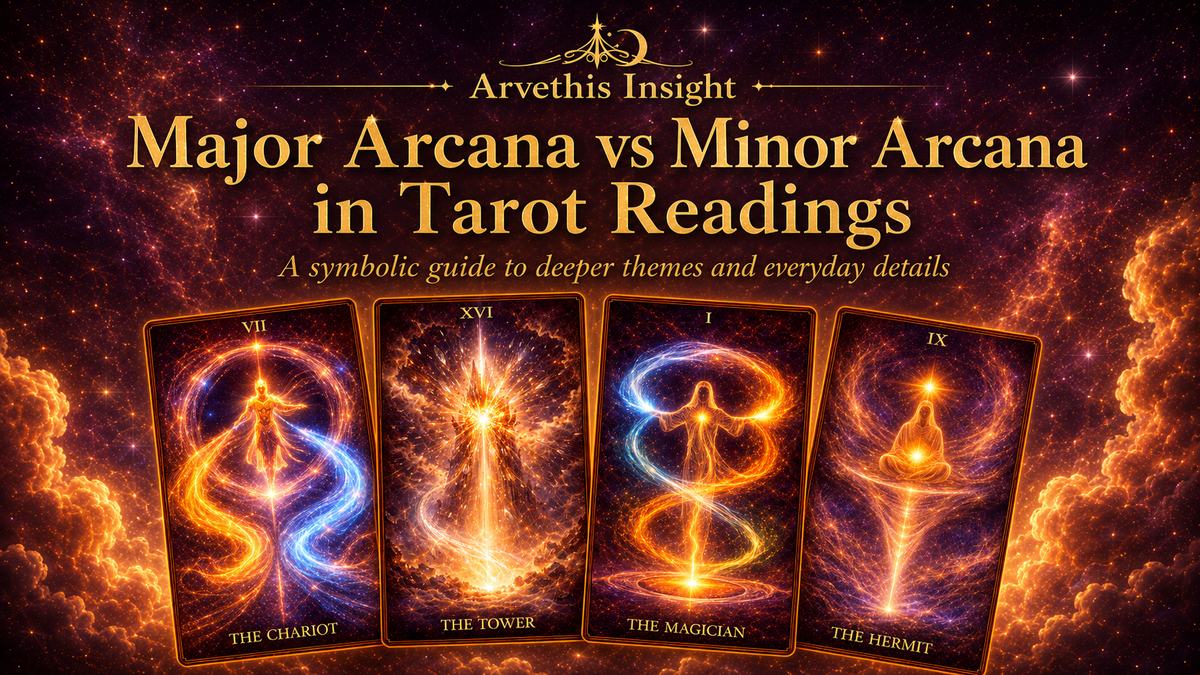
Major Arcana vs Minor Arcana in Tarot Readings
One of the clearest ways to understand a tarot reading is to notice whether the cards belong to the Major Arcana or the Minor Arcana. This difference does not make one group better than the other. It changes the scale of the message. The Major Arcana often points toward the deeper theme: the lesson, threshold, archetypal pressure, inner turning point, or symbolic atmosphere beneath the question. The Minor Arcana often shows how that deeper theme enters ordinary life: through emotions, conversations, work, timing, habits, desire, conflict, body, money, or daily choice. When you know which layer a card belongs to, the reading becomes easier to organize.
Through the Arvethis lens, the Major Arcana and Minor Arcana work like two levels of one symbolic language. The Major Arcana may feel like the wide sky of the reading. The Minor Arcana may feel like the road beneath your feet. The Magician may show conscious intention, language, skill, and the ability to direct attention into form. The Ace of Swords may show the first clear thought, statement, or decision. Together, they can suggest intention becoming language. The Major gives the deeper force. The Minor gives the human place where that force begins to move.
Tarot is most useful when it is treated as symbolic guidance rather than fixed prediction. The difference between Major and Minor Arcana does not tell you exactly what must happen. It helps you read proportion. Is the situation asking for deep inner growth, or is it mostly about practical adjustment? Is this a recurring life pattern, or a passing mood? Is the reading pointing toward a soul-level lesson, or toward a conversation, habit, boundary, message, or next step? These questions keep the reading grounded without flattening its symbolic depth.
What the Major Arcana usually shows
The Major Arcana contains the 22 archetypal cards from The Fool to The World. These cards often carry a larger symbolic weight in a reading. They can point toward life lessons, identity shifts, turning points, spiritual themes, inner awakenings, endings, beginnings, thresholds, and patterns that feel deeper than the surface event. When a Major Arcana card appears, the question may not only be about what is happening externally. It may also be about what the situation is teaching, revealing, challenging, or transforming inside the person who asked.
For example, The High Priestess may point toward intuition, silence, privacy, and the knowledge that has not yet become speech. The Chariot may bring willpower, movement, direction, discipline, and the need to hold opposing forces without scattering. The Hermit may ask for solitude, maturity, inner light, and a quieter kind of wisdom. The Tower may show truth breaking through a fragile structure. These cards do not simply describe events. They describe symbolic forces moving through the event.
When a Major Arcana card appears in a central position, ask what deeper pattern is being highlighted. What is the lesson beneath the situation? What truth is trying to become visible? What phase of growth is active? What part of the self is being asked to mature, release, trust, choose, or wake up? This does not mean the answer must be dramatic. A Major Arcana card can speak quietly. Temperance may ask for patience and integration. The Star may ask for healing after strain. The Empress may ask what truly nourishes life. The scale is deeper, but the expression can still be gentle.
What the Minor Arcana usually shows
The Minor Arcana contains 56 cards divided into four suits: Wands, Cups, Swords, and Pentacles. These cards usually bring the reading closer to daily life. They show how energy appears through desire, feeling, thought, communication, work, body, money, habits, timing, practical effort, and lived experience. If the Major Arcana is the deep symbolic weather, the Minor Arcana is the path you walk through that weather. It shows the actual steps, reactions, details, patterns, and human situations where the larger theme takes form.
This is why Minor Arcana cards should never be treated as secondary or weak. They often show the place where transformation becomes real. A reading may contain a powerful Major Arcana card, but the Minor card beside it may reveal the next clean step. The World with the Eight of Pentacles may suggest integration through steady craft. The Moon with the Ace of Swords may ask for clearer language around uncertainty. Strength with the Five of Swords may ask how inner power behaves when conflict enters the room. The Minor Arcana brings the lesson into the body of life.
Minor Arcana cards can also prevent a reading from becoming too abstract. A card like Judgement may feel vast: calling, reckoning, awakening, response. But if it appears beside the Page of Pentacles, the message becomes more grounded. The call may need study, humility, practice, and a beginner mind. If Judgement appears beside the Eight of Wands, the call may come through sudden messages, movement, or fast realization. The Major card opens the deeper field. The Minor card shows the doorway.
Major Arcana shows the theme; Minor Arcana shows the texture
A useful way to read the difference is this: Major Arcana shows the theme, while Minor Arcana shows the texture. The theme tells you what kind of symbolic force is active. The texture tells you how that force feels, where it appears, and what it may ask for in real life. If The Chariot appears, the theme may involve direction, control, momentum, discipline, and the need to steer conflicting impulses. If it appears with the Eight of Wands, the texture becomes speed, messages, travel, or fast development. If it appears with the Four of Swords, the texture becomes rest, recovery, and the need to pause before moving again.
This approach helps avoid overreading. If The Tower appears with a practical Pentacles card, the reading does not automatically need to become a total emotional catastrophe. It may point toward a sudden change in practical structure, work, security, resources, routine, or the body of a situation. If The Star appears with the Five of Cups, the reading may point toward healing after disappointment, not instant happiness. If Death appears with the Page of Wands, the reading may show an old chapter closing while a new spark of courage begins to form. The Major gives the larger arc. The Minor keeps the interpretation grounded.
The same principle helps with tarot combinations. Instead of adding two meanings together mechanically, you can ask which card provides the deeper symbolic pressure and which card shows the lived expression. That is why the Tarot Card Combinations library becomes more useful when you understand the Major-Minor relationship. A pair is not only two definitions side by side. It is a conversation between scale and detail.
How the four suits shape Minor Arcana meaning
The four suits are the heart of the Minor Arcana. Wands bring fire: desire, action, passion, creativity, courage, impulse, ambition, and life force. Cups bring water: feelings, relationships, memory, intuition, tenderness, healing, and emotional exchange. Swords bring air: thought, truth, communication, conflict, analysis, decision, and mental clarity. Pentacles bring earth: work, money, body, stability, time, resources, consistency, and practical reality.
This is especially helpful when a Major Arcana card appears with a suit-heavy reading. If The High Priestess appears with many Cups, intuition and feeling may be closely linked. If she appears with many Swords, the reading may ask how hidden knowing can become clear thought or honest speech. If The Emperor appears with many Pentacles, the theme may involve structure, responsibility, discipline, work, home, money, or practical stability. If The Devil appears with many Wands, desire, craving, impulse, or intensity may be part of the pattern. The suits tell you where the archetype lands.
Suit patterns also show imbalance. Many Swords may suggest that the reading is dominated by thought, analysis, communication, pressure, or the need to name truth. Many Cups may show emotional saturation, tenderness, grief, memory, or relational focus. Many Wands may show movement, passion, ambition, attraction, restlessness, or creative heat. Many Pentacles may show practical concerns, slow growth, money, health habits, work, reliability, or the question of what can be sustained. The suits help the reader understand the language the reading is using most strongly.
How court cards fit between Major and Minor energy
Court Cards can feel confusing because they bring personality, role, behavior, and posture into the reading. Pages often show beginnings, learning, messages, curiosity, vulnerability, or early expression. Knights show pursuit, movement, direction, intensity, and the way an energy acts. Queens show inner mastery, receptivity, maturity, emotional intelligence, embodiment, and stabilization. Kings show outward command, responsibility, decision, leadership, and structured expression. They belong to the Minor Arcana, but they often feel more personal than number cards because they show how energy is being carried or embodied.
When court cards appear with Major Arcana, the reading can become especially rich. The High Priestess with the Page of Cups may show intuitive sensitivity emerging softly, privately, or through a tender message. The Emperor with the King of Pentacles may show authority, responsibility, and practical stability becoming central. The Magician with the Knight of Swords may show focused intention moving quickly through speech, decisions, or mental force. Strength with the Queen of Cups may show emotional maturity meeting instinct, compassion, and the need to hold tenderness without losing inner power. The Major shows the deeper lesson. The court card shows the role or posture through which it is being lived.
It is wise not to assign court cards too quickly to one literal person. A Queen of Cups may describe someone in the situation, but she may also describe the emotional intelligence needed. A Knight of Wands may describe another person moving restlessly, but it may also show the seeker’s own desire for movement. The card can represent a person, a behavior, a mood, or a role. Context decides. This makes court cards very useful, especially when read beside Major Arcana cards that show the larger pattern.
How Aces show beginnings inside larger themes
Aces are the seeds of the Minor Arcana. They show beginnings in their purest form: a spark, opening, idea, chance, feeling, conversation, or practical opportunity. The Ace of Wands may show a new impulse or creative fire. The Ace of Cups may show emotional opening, affection, healing, or tenderness. The Ace of Swords may show clarity, truth, speech, or a clean decision. The Ace of Pentacles may show a practical start, resource, offer, opportunity, or material seed. When an Ace appears with a Major Arcana card, the reading often shows a large theme beginning to express itself through one clear opening.
The Star with the Ace of Cups may suggest healing that begins through emotional openness. The Magician with the Ace of Swords may suggest that intention needs clear language. The Fool with the Ace of Wands may show the courage to begin something new with vitality. The Empress with the Ace of Pentacles may show creativity or care becoming something tangible. The Ace keeps the reading from becoming too abstract. It says: this is where the larger archetype may begin to take form.
At the same time, an Ace is only a seed. It does not guarantee the full-grown result. This is an important distinction for grounded tarot reading. The Ace of Swords may show that a truth is beginning to surface, while the surrounding cards reveal whether it is spoken gently, resisted, sharpened, softened, or delayed. The Ace of Pentacles may show opportunity, but Pentacles still require time and care. Aces are invitations. Major Arcana cards show what kind of deeper field the invitation belongs to.
Reading Major and Minor cards together in love readings
In love readings, Major and Minor Arcana cards can show the difference between the deeper relationship lesson and the emotional detail of the moment. The Empress may bring embodied care, attraction, softness, nourishment, sensuality, and the question of what truly feeds the heart. The Four of Pentacles may bring guardedness, self-protection, holding back, or fear of losing control. Together, they may suggest that affection is present in the field, but the body or heart may still be protecting itself. The message is more nuanced than simple romance. It asks how care can remain warm without becoming possessive, and how protection can remain wise without closing the heart completely.
The Hermit with the Page of Cups offers a different kind of love reading. The Hermit brings solitude, maturity, inward listening, and the need to hear one’s own lantern before responding. The Page of Cups brings tenderness, emotional curiosity, apology, sweetness, or a small vulnerable message. Together, they may suggest that feeling is present, but it needs quiet, privacy, or emotional maturity before it can be expressed cleanly. This is a very different tone from a fast or dramatic love reading. It is slower, softer, and more inward.
A symbolic love reading should avoid turning cards into proof of another person’s private feelings. Major and Minor Arcana together can suggest patterns, emotional atmosphere, and relational dynamics, but they are best used for reflection rather than certainty. The stronger question is often: what does this combination show about the field between desire, timing, communication, self-respect, and care? That keeps the reading human, safe, and useful.
Reading Major and Minor cards together in career readings
In career readings, Major Arcana cards often show the bigger professional lesson, while Minor Arcana cards show the actual work, decision, pressure, skill, resource, or practical development. The Emperor may point toward structure, leadership, boundaries, authority, and responsibility. The Eight of Pentacles may point toward steady practice, repeated effort, and the slow building of skill. Together, they may show the need to build authority through disciplined work rather than only through ambition. The Chariot with the Three of Pentacles may show direction supported by collaboration. The Hermit with the Seven of Pentacles may show a period of quiet evaluation around long-term growth.
This matters because career questions can easily become outcome-focused. A person may want to know whether success is coming, whether they should change jobs, or whether a project will work. Tarot can support reflection, but it should not replace financial, legal, employment, or professional advice. A grounded reading asks what pattern is active. Is the issue structure, confidence, timing, skill, burnout, collaboration, clarity, or sustainability? Major Arcana gives the deeper theme. Minor Arcana shows the workplace reality where the theme is being tested.
For example, The Magician with the Ace of Pentacles may suggest that skill and intention have a practical opening. The Devil with the Ten of Wands may show overwork, pressure, or attachment to an unsustainable burden. The Star with the Six of Pentacles may suggest healing around support, generosity, or fair exchange. The Tower with the Eight of Pentacles may show a disruption that changes how work is practiced. These combinations are best held as symbolic structures, not guarantees.
Reading Major and Minor cards together in spiritual readings
In spiritual readings, the Major Arcana often carries the central teaching, while the Minor Arcana shows how that teaching becomes embodied. The Hermit may point toward solitude, inner guidance, and the need to listen away from noise. The Four of Swords may show the practical form of that lesson: rest, mental quiet, recovery, and pause. Temperance may point toward integration, balance, and spiritual moderation. The Two of Pentacles may show that this balance needs to be practiced through daily rhythm, choices, and priorities. The High Priestess may point toward intuition, but the Page of Cups may show the tender, early emotional form of that intuition.
This is where tarot becomes less abstract and more useful. A spiritual lesson is meaningful when it can be lived. The World may show completion, integration, and wholeness, but the Nine of Pentacles may show the personal stability that makes that wholeness real. Judgement may show a call to awaken, but the Ace of Swords may show that the call begins with a clean truth. The Moon may show uncertainty, dream, fear, and subconscious material, but the Eight of Cups may show the practical act of walking away from an emotional pattern that no longer feeds the soul.
Spiritual readings are strongest when they stay grounded. A Major Arcana card can feel vast, but the Minor Arcana brings it back to daily life. What habit supports the insight? What conversation needs to happen? What boundary protects the lesson? What emotional pattern is asking for care? What step can be taken without forcing the outcome? These questions keep symbolic guidance connected to reality.
When a reading has mostly Major Arcana cards
A reading with many Major Arcana cards often feels significant, charged, or connected to a deeper pattern. It may suggest that the question touches identity, transformation, values, timing, or life direction. This does not mean the situation is automatically dramatic. It means the reading is speaking in archetypal language. The seeker may be standing inside a larger phase rather than a small passing mood. The lesson may involve growth, release, truth, choice, healing, maturity, or a change in how they relate to themselves and the world.
When many Majors appear, slow down. Ask which card is central and which cards support it. If The Tower, The Star, and Temperance appear together, the reading may show disruption, healing, and integration as one larger arc. If The Emperor, Justice, and Judgement appear together, the theme may involve responsibility, accountability, and a call to respond with maturity. If The Moon, The High Priestess, and The Hermit appear together, the reading may be deeply inward, private, intuitive, and reflective. The cards may be asking for patience rather than immediate action.
Many Major Arcana cards can also mean that the seeker should avoid reducing the reading to a quick yes-or-no answer. The cards may be showing a phase, not a simple outcome. This is a good moment to use a structured spread, journal the reading, or return to it after some time. Archetypal readings often unfold slowly. They may become clearer as the seeker lives into the question.
When a reading has mostly Minor Arcana cards
A reading with mostly Minor Arcana cards often points toward practical details, emotional states, communication patterns, timing, behavior, and daily choices. This can be extremely helpful. It may suggest that the situation is workable through ordinary action rather than waiting for a huge life shift. The cards may be saying: look at the conversation, the habit, the plan, the boundary, the routine, the emotional response, the message, the money, the effort, or the next step. Minor Arcana readings can be direct without being shallow.
If many Cups appear, the reading may be asking for emotional honesty, tenderness, healing, or relational awareness. If many Swords appear, the reading may ask for clearer thought, truthful communication, boundaries, or a reduction of mental pressure. If many Wands appear, the reading may focus on desire, movement, courage, creativity, or the need to avoid impulsive action. If many Pentacles appear, the reading may point toward stability, time, resources, money, body, work, or consistency. The suit pattern is often the key.
Mostly Minor Arcana readings can be empowering because they bring the message into the seeker’s hands. The question may not require a grand symbolic interpretation. It may require one honest conversation, one practical adjustment, one pause, one boundary, one steady effort, or one emotional truth. This is why Minor Arcana cards deserve respect. They show the lived places where clarity becomes real.
How to read a Major-Minor pair step by step
When you read one Major Arcana card with one Minor Arcana card, begin by naming the Major as the deeper theme. Then name the Minor as the practical or emotional expression. After that, ask how the two interact. Does the Minor support the Major, resist it, soften it, sharpen it, or show where it becomes real? This simple method prevents the reading from becoming a list of disconnected meanings. It turns the pair into a relationship.
For example, The Hermit with the Three of Cups may show solitude and community standing beside each other. The Major theme is inner guidance, quiet, and withdrawal from noise. The Minor expression is friendship, celebration, shared joy, or social connection. Together, the pair may ask how a person can belong without losing inner clarity. In another context, it may show the need to step back from a social field in order to understand what is truly felt. The meaning depends on the question, but the axis remains: solitude and community.
Another example is The Moon with the Ace of Swords. The Major theme is uncertainty, dream, fear, intuition, projection, or emotional fog. The Minor expression is clarity, truth, language, or decision. Together, the pair may ask for a clean thought inside a confusing emotional field. It may suggest that something needs to be named gently, without pretending that every feeling is already clear. This kind of pair shows why Major-Minor reading is so useful. The Major opens the depth. The Minor shows the tool.
How this helps with tarot card combinations
Understanding Major and Minor Arcana makes tarot card combinations much easier. Instead of asking only what two cards mean together, you can ask what kind of relationship exists between scale and detail. Is a larger life lesson being expressed through a small conversation? Is a practical issue revealing a deeper archetypal pattern? Is an emotional state part of a major turning point? Is a spiritual theme asking for one concrete next step? This approach makes combination reading deeper without making it forced.
This is especially useful for pairings like The Magician and Ace of Swords, The High Priestess and Page of Cups, The Chariot and Eight of Wands, Strength and Five of Swords, or The Emperor and Ten of Pentacles. The Major Arcana card gives the larger symbolic pressure. The Minor Arcana card shows the specific field: thought, message, conflict, stability, work, timing, or emotion. When you learn this structure, combinations stop feeling random. They begin to form a language.
If you want to strengthen this skill, the blog guide on how to read tarot card combinations can support the next step. You can also use how to interpret a tarot reading when a spread feels crowded or unclear. Both approaches become stronger when you understand whether the reading is speaking through archetype, daily detail, or the relationship between the two.
Using tools to practice the difference
A simple way to practice Major versus Minor Arcana is to pull one card and ask what scale it belongs to. If it is a Major Arcana card, ask what deeper lesson or archetypal theme is present. If it is a Minor Arcana card, ask where the message is appearing in everyday life. A one card tarot reading can be enough for this. One card teaches proportion when you slow down and listen to whether it speaks as a major theme or a practical detail.
A three card tarot reading can show the relationship more clearly. If the first card is Major, the second is Minor, and the third is Minor, the reading may show a deeper theme moving into practical development. If the first two cards are Minor and the final card is Major, the reading may show ordinary events leading toward a larger lesson. If all three are Major, the spread may ask for patience and deep reflection. If all three are Minor, the spread may ask for grounded choices and practical action.
The point is not to make the reading rigid. The point is to give your intuition a structure. Tarot becomes clearer when you know what kind of message each card is carrying. Major and Minor Arcana are not separate worlds. They are two levels of the same symbolic system.
Depth needs detail
The Major Arcana and Minor Arcana work best when read together. Depth needs detail, and detail needs depth. A Major Arcana card can reveal the larger lesson, but the Minor Arcana shows where the lesson touches life. A Minor Arcana card can show a practical moment, but a Major Arcana card can reveal why that moment feels meaningful. Together, they prevent readings from becoming either too vague or too literal. They allow tarot to speak as both symbol and lived experience.
When you see a Major card, listen for the archetype. When you see a Minor card, listen for the human situation. When they appear together, listen for the bridge between them. That bridge is often where the real reading begins. It may show how fear becomes a conversation, how healing becomes a habit, how truth becomes a boundary, how desire becomes discipline, or how spiritual insight becomes one grounded next step. This is the beauty of the tarot deck: it can hold the vast and the ordinary in one spread.
If you want to continue learning, explore the Major Arcana and Minor Arcana hubs side by side. Then return to the Tarot Card Combinations library and notice how often the deeper theme and the daily detail speak together. The more you understand this relationship, the less you need to force meaning. The cards begin to organize themselves, and the reading becomes calmer, clearer, and more human.
Tarot works best here as a reflective tool for emotional clarity, pattern recognition, and deeper perspective within complex relationship dynamics.