
Wheel of Fortune + Four of Cups
Explore how these two tarot cards interact in a reading through symbolic overlap, contrast, and shared narrative. Tarot combinations often reveal meaning that neither card fully expresses on its own.
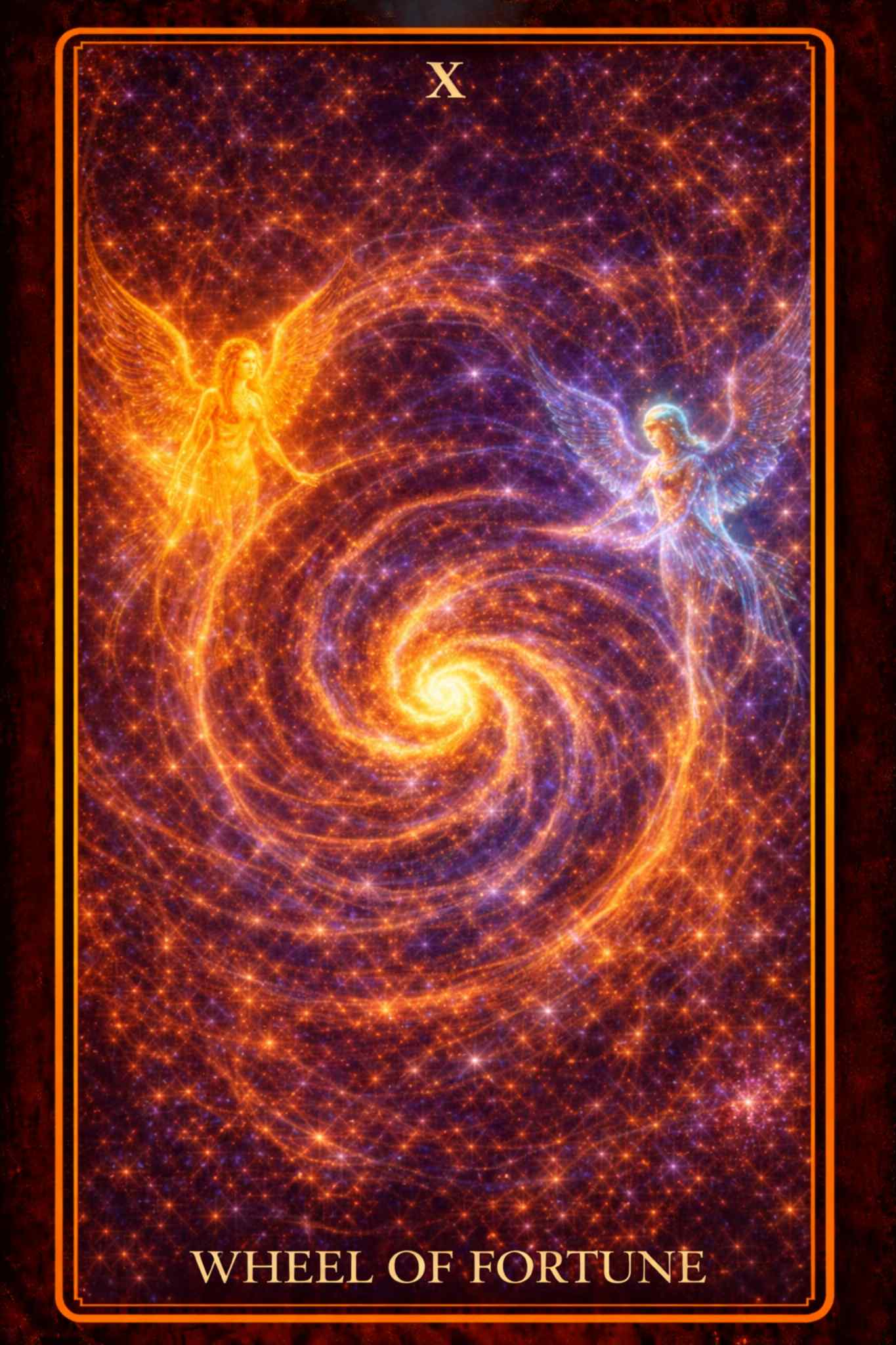
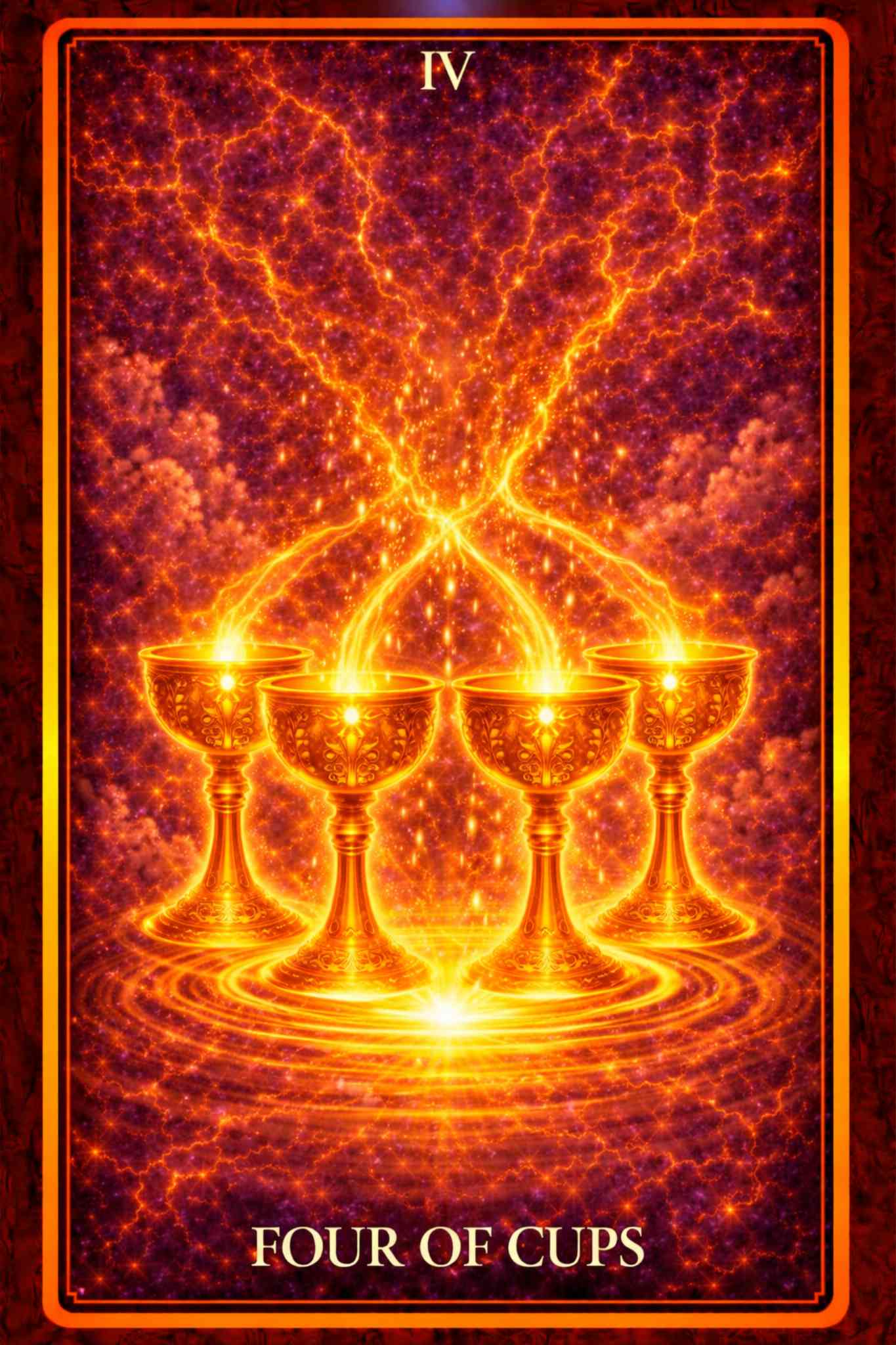
The Wheel of Fortune and Four of Cups Tarot Combination Meaning
Some turning points begin long before visible action appears. They begin in the quiet discomfort of emotional sameness, in the sense that something has gone flat, and in the subtle realization that the old way of feeling can no longer carry the next chapter. The Wheel of Fortune and Four of Cups speaks to that threshold. This pair is about emotional stagnation meeting movement, inward dissatisfaction meeting ripening change, and the moment a person begins to sense that a cycle is shifting even before they fully know what comes next. The Four of Cups carries withdrawal, contemplation, emotional fatigue, reluctance, and the strange experience of feeling untouched by what once would have mattered. The Wheel of Fortune changes the meaning of that stillness. It suggests that the pause is part of a larger turning, where what appears inactive is often a stage of recalibration rather than absence.
This is one of the reasons the pair can feel psychologically dense. The Four of Cups is often reduced to boredom or missed opportunity, though in deeper readings it reflects misalignment between inner state and outer offering. A person may be surrounded by possibilities, yet unable to engage because those possibilities belong to a previous version of themselves. The Wheel of Fortune enters as a reminder that cycles move regardless of conscious readiness. The question is no longer whether change is coming, but whether the person is willing to recognize that the emotional framework they have been operating within is already losing relevance.
When disengagement becomes information
The Four of Cups rarely appears without reason. Emotional withdrawal is often treated as something to overcome quickly, though in this pairing it becomes a signal that something deeper is shifting. The absence of response may indicate that the heart has stopped investing in a pattern that once felt necessary. This does not always feel empowering. It can feel confusing, even uncomfortable, because it removes familiar emotional anchors without immediately replacing them with something new. The Wheel of Fortune suggests that this in-between state is meaningful. It marks the point where repetition begins to break down.
Rather than pushing toward immediate clarity, the wiser approach here is observation. What no longer holds attention? What feels repetitive without offering depth? What situations seem unchanged on the surface, yet feel different internally? These shifts often happen quietly, though they carry structural meaning. Emotional disengagement becomes informative when it is understood as a response to misalignment rather than as a flaw.
- moments where interest fades without a clear external reason
- repeated situations that no longer create emotional response
- a growing awareness that familiar patterns feel increasingly distant
- difficulty engaging with options that once felt meaningful
This stage often precedes visible change. The Wheel of Fortune suggests that once the pattern is recognized, movement accelerates, even if it does so gradually at first.
Attention, energy, and emotional direction
Another important layer of this combination appears in how attention is distributed. The Four of Cups often reflects a withdrawal of energy from what is available, while the Wheel of Fortune introduces the possibility that attention itself is being redirected. A person may still be physically present within a situation, yet their emotional investment begins to shift elsewhere. This is not always conscious. It develops through repeated exposure to the same environment until the response changes naturally.
Need a little more context around this pairing?
A short reading can help you reflect on the tension, direction, or lesson this combination may be pointing toward.
This creates a subtle but important distinction between avoidance and reorientation. Avoidance tends to maintain the same pattern while resisting engagement. Reorientation shifts attention toward something new, even if that new direction is not yet fully defined. The Wheel suggests that this redirection is already in motion. The Four of Cups shows how it feels from the inside: uncertain, detached, and temporarily unresponsive.
When emotional direction begins to change, the person may struggle to articulate what they want. What they can often recognize more clearly is what they no longer want to invest in. This negative clarity becomes the foundation for a more accurate alignment later on.
Love and relational dynamics
In relationship readings, this pair often reflects a shift in emotional engagement that has not yet been fully acknowledged. One or both people may feel less responsive, less available, or less connected to the current dynamic. This does not automatically define the outcome of the relationship. It highlights that the existing emotional pattern is changing.
The Four of Cups may show hesitation, lack of enthusiasm, or the sense that something is missing without being able to name exactly what that is. The Wheel of Fortune indicates that this state belongs to a larger cycle. The relationship may be approaching a point where its structure must change in order to remain meaningful. That change may involve renewal, adjustment, or redirection.
Emotional disengagement in this context often carries information about repetition. A dynamic that once felt engaging may now feel predictable. A pattern that once created intensity may now feel flat. The Wheel brings attention to this repetition, not as a problem to solve immediately, but as a signal that the cycle is reaching a turning point.
In situations where emotional withdrawal needs deeper interpretation, Four of Cups intentions meaning can help clarify whether the pause reflects uncertainty, resistance, or quiet processing. When the relationship feels caught between stagnation and movement, a Problem Solution Tarot Spread can provide structure to understand what is ending and what is trying to emerge.
Resistance to change and subtle attachment
One of the more complex aspects of this pairing is the role of resistance. The Four of Cups may appear passive, though it often contains a quiet attachment to what has already been experienced. Even when something no longer feels aligned, there can be a reluctance to fully release it. The Wheel of Fortune introduces movement that challenges this attachment. It creates situations where the person must confront the difference between familiarity and relevance.
This resistance is rarely dramatic. It appears as hesitation, as delayed response, as the tendency to remain in a state of observation rather than engagement. The person may recognize that something is changing, yet feel uncertain about how to participate in that change. The Wheel suggests that participation becomes easier once the pattern is acknowledged clearly.
Over time, this tension between holding on and moving forward becomes unsustainable. The Four of Cups begins to lose its stability as a position. What once felt like a pause begins to feel like stagnation. This shift often marks the point where the cycle is ready to turn more visibly.
Inner timing and readiness
The Wheel of Fortune emphasizes that timing is not only external. Inner readiness plays an equally important role. The Four of Cups may show a person who is not yet emotionally available to engage with what is emerging. This does not prevent the cycle from moving. It simply delays recognition.
As readiness develops, perception changes. The same situation may begin to feel different. What once seemed uninteresting may reveal new relevance. What once felt confusing may become clear. These changes are not imposed from outside. They emerge as the internal state shifts.
For a contrasting dynamic where introspection actively shapes emotional understanding, The Hermit and Four of Cups explores how withdrawal becomes intentional rather than reactive.
Where the cycle becomes visible
There is a stage in every emotional cycle where repetition becomes impossible to ignore. The Wheel of Fortune and Four of Cups often appears at that stage. The same patterns continue, though their effect changes. What once felt engaging now feels empty. What once felt stable now feels limited.
At this point, the shift often remains internal before it becomes visible in action. The emotional withdrawal begins to carry direction, even if it has not yet turned into a clear decision. This quiet reorientation contrasts with the more immediate emotional opening seen in The Wheel of Fortune and Ace of Cups, where the turning point expresses itself through renewed feeling rather than hesitation.
This shift does not require immediate action. It requires recognition. Once the pattern is seen clearly, the direction of change becomes easier to understand. The Wheel moves forward. The Four of Cups begins to release its hold. The turning point becomes visible, not as a sudden event, but as the natural result of accumulated awareness.
At this stage, the question is no longer what is missing. It becomes what is ready to change, and how that change can be met with clarity rather than resistance. The answer develops gradually, shaped by attention, experience, and the willingness to acknowledge that emotional life has already begun to move in a different direction.
Want to place this combination into a wider reading?
If this pairing feels close to something you are experiencing, a simple spread can help you reflect on the surrounding energy with more clarity.
Micro-turning points and quiet decisions
One of the less visible aspects of this combination is how change often begins through very small decisions rather than dramatic shifts. The Four of Cups tends to slow everything down, creating a space where action feels distant and emotional clarity remains incomplete. The Wheel of Fortune operates differently. It introduces movement, though that movement does not always arrive in obvious ways. Instead, it appears through moments where the person begins to respond differently to the same situation, even if the difference is subtle at first.
This may look like a slight shift in attention, where something that once held focus no longer does. It may appear as a change in emotional tolerance, where patterns that were previously accepted begin to feel less sustainable. It can also emerge through a quiet sense of readiness, where the person begins to recognize that continuing in the same way requires more effort than allowing something new to develop. These micro-turning points rarely feel decisive in the moment, though they accumulate over time and gradually reshape the direction of the cycle.
The Four of Cups can make these shifts difficult to recognize because it tends to flatten emotional contrast. Everything may feel equally unengaging, which can obscure the fact that change is already happening beneath the surface. The Wheel of Fortune becomes visible when the person begins to notice that their responses are no longer identical to what they once were. Even a small deviation from the usual pattern carries meaning, because it indicates that the cycle is no longer repeating in the same way.
This is where awareness becomes more important than certainty. The goal is not to force a clear decision prematurely, but to recognize the direction in which these small shifts are moving. Over time, they form a trajectory. What begins as a barely noticeable change in perception can become a clear emotional movement. The person may not yet know exactly what they are moving toward, though they can begin to see what they are moving away from.
In this sense, the turning point is not a single moment. It is a series of quiet adjustments that gradually alter the emotional landscape. The Wheel of Fortune provides the motion. The Four of Cups provides the stillness in which that motion can be felt. When these two states are understood together, the experience of being “stuck” begins to reveal itself as a transitional phase rather than a final condition.
More combinations with Wheel of Fortune
More combinations with Four of Cups
Continue with Wheel of Fortune
Explore Related Guides by Topic
If you want to explore this combination through a more specific emotional lens, these tarot guides can help you follow the broader pattern behind the reading.