
The Hierophant + Four of Cups
Explore how these two tarot cards interact in a reading through symbolic overlap, contrast, and shared narrative. Tarot combinations often reveal meaning that neither card fully expresses on its own.

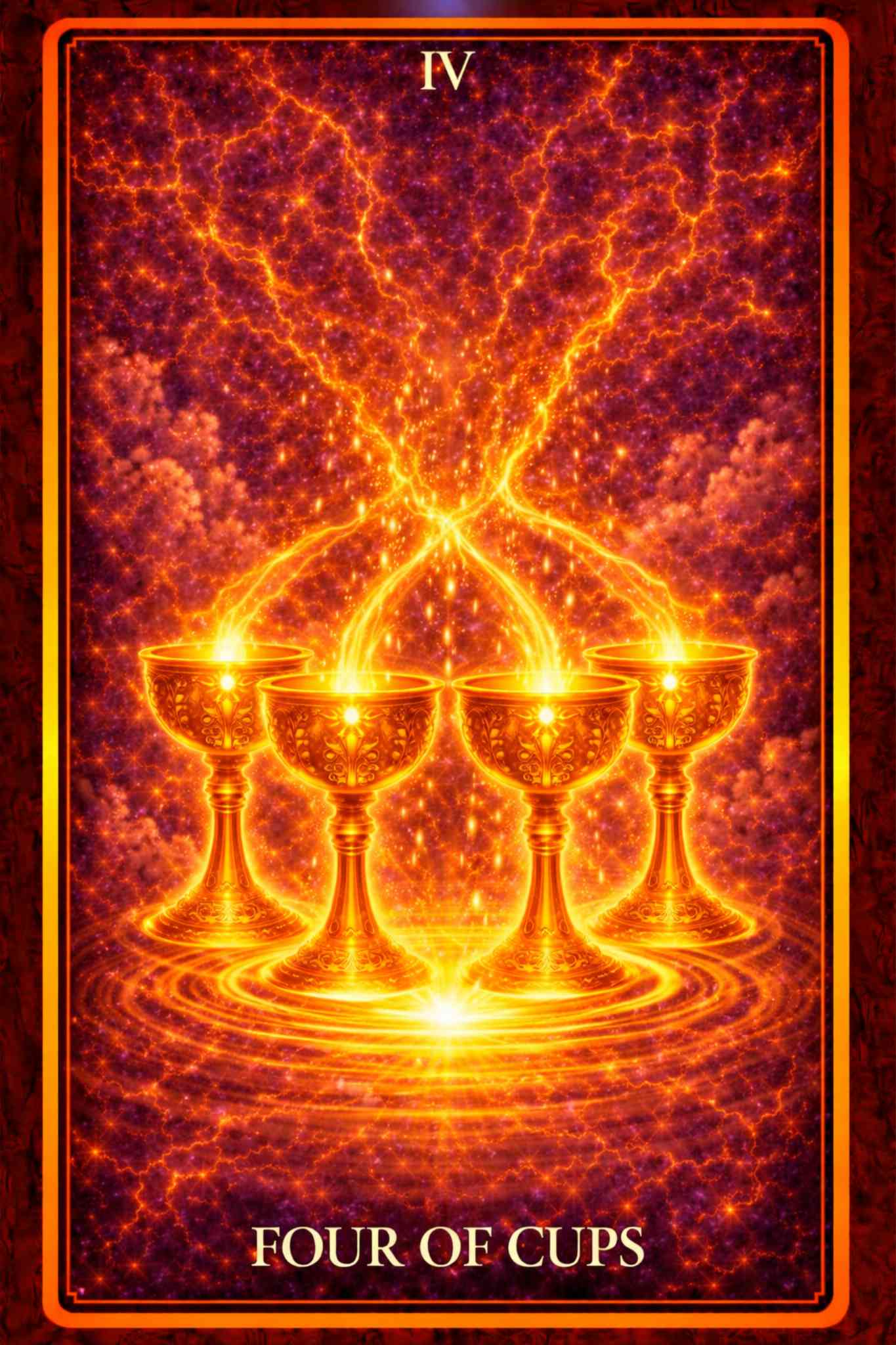
The Hierophant and Four of Cups Tarot Combination Meaning
Some emotional pauses are simple. A person feels tired, overstretched, or briefly disconnected from what usually moves the heart. Yet there are other pauses that carry a more exact intelligence. They appear when something outwardly acceptable, familiar, or even admirable no longer reaches inwardly, and the soul begins to withhold its participation. The Hierophant and Four of Cups speaks to that kind of moment. This pair explores the distance between what appears right on the outside and what feels true on the inside. It describes emotional withdrawal that may look passive at first, yet often contains a deep refusal to keep consenting to what has lost meaning. The Four of Cups brings reserve, introspection, lowered emotional appetite, and the difficult awareness that what is available does not stir genuine response. The Hierophant brings moral structure, inherited patterns, expectation, interpretation, and the question of whether the forms shaping a person's choices still belong to the life they are trying to live. Together, these cards suggest that emotional flatness may emerge when inner truth can no longer fully inhabit outer correctness.
This is what gives the combination its depth. The Four of Cups is often read as apathy, boredom, or withdrawal, and sometimes those words do describe part of the experience. Yet beside The Hierophant, the emotional quiet becomes more specific. It may arise because the person is surrounded by forms that look meaningful while feeling empty from within. They may be facing an offer, a relationship, a role, or a pattern of living that seems respectable enough, yet the heart remains unconvinced. The Hierophant brings attention to systems of value, spiritual inheritance, habit, tradition, duty, and the many invisible frameworks that tell people what should matter. The Four of Cups then asks a piercing question: what happens when those frameworks remain intact, but the soul no longer finds life inside them?
That question changes the whole tone of the pair. This is not merely a card combination about disinterest. It is about dissonance between emotional truth and accepted form. A person may be trying to respond the way they once did. They may even believe they ought to feel gratitude, enthusiasm, affection, or commitment. Still, something deeper has gone quiet. The heart does not awaken simply because the external structure appears sound. The Hierophant and Four of Cups often appears exactly there, where a person is beginning to realize that sincerity cannot be manufactured by effort alone. Something in them is asking for deeper alignment, and until that alignment returns, emotional participation may remain partial, restrained, or altogether absent.
When the heart withdraws from what seems acceptable
The Four of Cups often enters a reading when the emotional field has become muted. Offers may be present. Opportunities may exist. A connection may still stand. Yet inwardly, the person feels separate from what is being presented. Beside The Hierophant, this emotional distance begins to look less like simple fatigue and more like a response to misalignment. The outer world may still be offering what once felt appropriate, sensible, or even desirable, though the deeper self is no longer able to meet it with full presence. Something has changed at the level of meaning.
This is where The Hierophant becomes profoundly important. He represents structures that organize life: moral language, inherited beliefs, social expectations, familiar commitments, spiritual frameworks, and the collective understanding of what gives a situation legitimacy. In many readings, he brings wisdom and grounding. Here, however, he can also show the weight of established meaning pressing against an inner life that has begun to evolve. The person may still be standing inside a form that looks honorable from the outside, while inwardly they are feeling less and less alive within it. The Four of Cups does not always rebel openly. Sometimes it simply stops responding. That silence can be a sign that the soul is no longer willing to animate what it cannot honestly inhabit.
There is a painful dignity in that realization. Many people try to correct emotional distance by pressuring themselves toward appreciation. They tell themselves they should feel more connected, more receptive, more invested. Yet this pair suggests that the deeper issue may lie elsewhere. The problem may not be a lack of effort. The problem may be that the available structure has ceased to carry living meaning. The Hierophant and Four of Cups therefore invites a different kind of inquiry. Instead of asking how to make yourself feel what you are expected to feel, it asks whether your emotional reserve is revealing that some outer arrangement has outlived its inner truth.
Inner refusal can be a sign of integrity
One of the strongest teachings in this combination is that withdrawal is not always weakness. Sometimes it is the soul's final way of preserving honesty. The Four of Cups shows an emotional body that has stopped reaching automatically toward what is offered. The Hierophant asks whether that withdrawal may carry ethical or spiritual intelligence. A person may be learning that they can no longer give emotional assent to roles, bonds, or situations that fail to resonate at a deeper level. They may still recognize the surface legitimacy of what stands before them, yet legitimacy alone is no longer enough. Something more intimate is required. The inner life wants to recognize itself in what it is being asked to accept.
Need a little more context around this pairing?
A short reading can help you reflect on the tension, direction, or lesson this combination may be pointing toward.
This is especially significant for those who have built much of life through discipline, loyalty, or adherence to what seemed proper. Such people often know how to remain faithful to an external pattern long after vitality has drained from it. They may continue showing up, continue saying the right words, continue preserving the structure even while the heart has already retreated. The Hierophant and Four of Cups interrupts that split. It reveals the cost of living too long in outer coherence without inner consent. Emotional dullness becomes the signal that something essential is no longer participating.
There is no need to make this dramatic in order for it to be real. Often the shift is subtle. A person simply notices that what once felt meaningful now feels distant. Conversations sound thinner. Commitments feel heavier. Emotional offerings arrive and leave no real trace. The Four of Cups can look passive from the outside, though inwardly it may be engaged in a very serious act of discernment. It is sorting through what still carries truth and what remains only as form. The Hierophant lends language to that process. He suggests that integrity sometimes begins with the refusal to keep calling something meaningful when the deeper self has already withdrawn its blessing.
Love and relationship meaning
In love readings, The Hierophant and Four of Cups often points to a relationship dynamic in which emotional reserve is asking for careful interpretation. There may be a bond, a proposal, or a familiar relational structure present, yet the heart is not fully opening to it. The Four of Cups shows the inward turning clearly. The Hierophant raises the deeper question of why. Is the emotional distance a passing mood, or is it the result of a connection that appears right while no longer feeling alive? Has the relationship become something that survives through expectation, habit, or shared form more than through genuine emotional meaning?
This pair can be especially revealing in situations where a relationship looks stable from the outside. There may be commitment, history, or a recognizable pattern that seems respectable and understandable. Even so, one or both people may feel a quiet emptiness growing beneath the surface. The Hierophant suggests that the relationship may still possess structure, while the Four of Cups shows that structure alone cannot generate sincerity. When these cards appear together, they often call for an honest look at whether the bond is being sustained by living truth or by inherited ideas about what love is supposed to look like.
That is what makes the combination so exacting. It does not dismiss commitment. It does not romanticize emotional drift either. It asks whether the relationship still carries a meaning the heart can inhabit fully. Sometimes the answer is yes, though that meaning has become obscured by routine or by an overemphasis on roles and expectations. Sometimes the answer is more difficult, and the emotional withdrawal reflects the soul's inability to keep pretending that form alone is enough. In either case, the cards invite deep honesty. They ask whether affection is being supported by inner alignment, whether values are truly shared in a living way, and whether the connection still nourishes what is most essential in each person.
There is also an important lesson here around emotional pressure. A person may feel guilty for being less responsive than they believe they should be. They may try to force warmth because the relationship seems worthy on paper. Yet the Four of Cups rarely responds well to pressure. The more the heart is ordered to feel, the more inward it often goes. The Hierophant can help transform that guilt into reflection. Instead of shaming the reserve, he asks what it is trying to reveal. Perhaps the relationship needs renewal of meaning, deeper truth, a more conscious shared path, or an honest reckoning with what has quietly faded. The wisdom of the pair lies in allowing that revelation to unfold without rushing toward easy reassurance.
Spiritual dryness, vocation, and the loss of living meaning
Outside romance, this combination can speak to work, faith, purpose, family roles, creative callings, or any area of life where a person continues to stand within a recognized form while feeling inwardly absent from it. This is one of the most revealing applications of the pair. The Hierophant represents institutions, teachings, duties, and systems of meaning that may once have provided direction. The Four of Cups shows what happens when those systems remain in place, yet the emotional current that once animated them has weakened. A person may continue doing what appears sensible or worthy while privately wondering why none of it reaches the heart anymore.
This can describe spiritual dryness in a profound way. Practices may continue. Language may remain familiar. A person may still know all the forms of devotion, discipline, or moral effort, yet feel distant from the life that once moved through those forms. The combination does not treat this as failure. It treats it as a summons to greater honesty. The issue may not be the absence of structure. It may be that the structure is being asked to deepen, to renew, or to become truthful again in a way that can actually meet the person where they now are.
The same applies to vocation and identity. Someone may be outwardly successful, respected, and fully legible within a social framework, yet inwardly untouched by what they are doing. The Four of Cups can mark that strange sorrow of being surrounded by acceptable options while feeling no real desire for any of them. The Hierophant then asks whether the person's life has become shaped by inherited definitions of worth rather than by direct relationship to meaning. In this sense, the cards together can signal a serious turning point. Emotional dryness becomes the evidence that a former structure is no longer sufficient for the soul that now inhabits it.
Timing and the wisdom of remaining still long enough to understand
Timing matters strongly with this pair because it often appears during a stage when emotional energy has already withdrawn and the immediate task is understanding rather than action. The Four of Cups suggests that the heart has slowed for a reason. The Hierophant suggests that the reason may only become clear through reflection, silence, contemplation, or serious self-examination. This is rarely a moment for fast conclusions. It is a moment for listening closely to what your reserve is protecting and what your lack of response is refusing to bless.
There is real wisdom in that pause. People often assume that movement itself is progress, though this pair suggests that progress may begin with a refusal to keep participating in misalignment. When enthusiasm has faded, the instinct may be to replace it quickly. Yet if the deeper issue concerns meaning, then replacement alone solves very little. The more useful question becomes: what kind of life, bond, or path would allow genuine emotional presence to return? The Hierophant and Four of Cups asks for that level of seriousness. It invites the person to let stillness become diagnostic, to let emotional quiet reveal what outward form has ceased to nourish the soul, and to wait until truth becomes clearer before offering renewed consent.
Explore the next layer of this reading.
This combination can mean different things depending on context. A short tarot reading can help you reflect on the question behind the cards.
Closing reflection
There is something quietly uncompromising in The Hierophant and Four of Cups because it shows that the heart does not remain available forever to what merely appears right. The Four of Cups turns inward when emotional life can no longer find itself in what is being offered. The Hierophant reveals that this inward turn may be more than mood; it may be a profound refusal to keep honoring outer correctness at the expense of inner truth. Together, these cards suggest that emotional distance can become a form of integrity, a necessary pause in which the soul stops lending warmth to structures that have lost their living meaning. What looks like disengagement may in fact be the beginning of a more honest life, one in which feeling returns only where value, truth, and genuine alignment can be fully lived.
More combinations with The Hierophant
More combinations with Four of Cups
Continue with The Hierophant
Explore Related Guides by Topic
If you want to explore this combination through a more specific emotional lens, these tarot guides can help you follow the broader pattern behind the reading.