
The Hierophant + Seven of Wands
Explore how these two tarot cards interact in a reading through symbolic overlap, contrast, and shared narrative. Tarot combinations often reveal meaning that neither card fully expresses on its own.

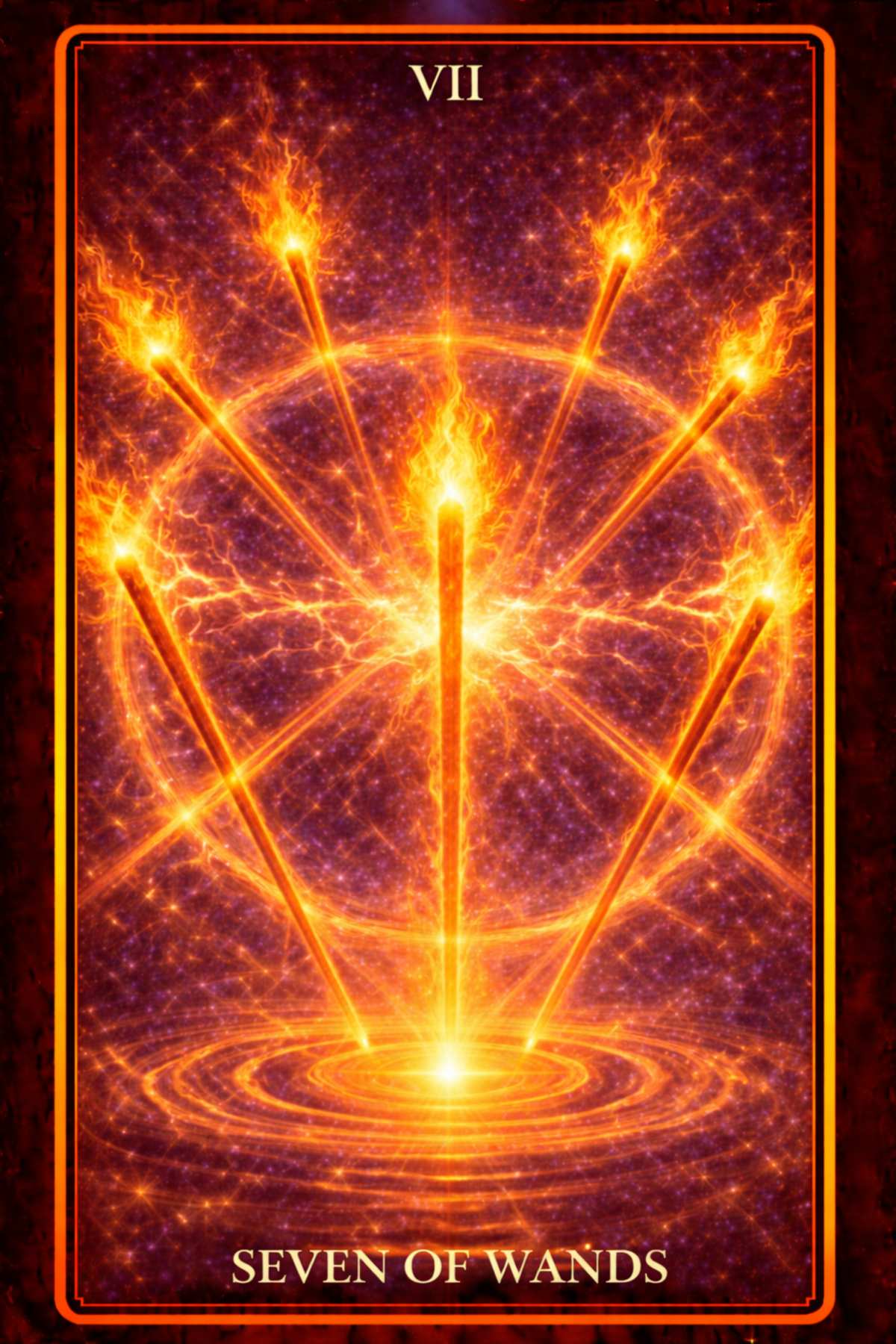
The Hierophant and Seven of Wands Tarot Combination Meaning
The Hierophant and Seven of Wands form a combination about defended conviction. The atmosphere here is not one of easy belonging, smooth approval, or effortless certainty. It is the atmosphere that emerges when a principle, a standard, a worldview, or a hard-won inner position comes under pressure and must now be actively maintained. The Seven of Wands is a card of holding ground. It does not describe relaxed confidence so much as pressure-tested stance. Something has already been claimed, and now it must be defended against challenge, competition, intrusion, or erosion. The Hierophant brings a deeper layer to that defense. He represents teachings, ethical frameworks, inherited systems of meaning, spiritual structures, social codes, and the question of what deserves allegiance when life becomes noisy. Together, these cards often indicate a period in which your values are no longer something you simply admire in theory. They are becoming something you must uphold in practice.
This changes the meaning of the Seven of Wands considerably. On its own, that card can point toward resilience, opposition, self-protection, and the need to assert boundaries under pressure. When paired with The Hierophant, the struggle becomes more morally and spiritually charged. The challenge may concern what is right, what is true, what should be allowed, or what deeper philosophy should guide action. This is not merely a pair about conflict for conflict’s sake. It is about whether you know what you stand on, and whether that ground is living truth or borrowed rigidity. Some people encounter this combination when defending healthy values against chaos, manipulation, or erosion. Others encounter it when defending inherited structures that no longer deserve the same obedience. That distinction matters. The reading becomes most useful when it helps separate principled firmness from fear-based entrenchment.
Core symbolic dynamic
At the symbolic level, The Hierophant and Seven of Wands bring conviction into an exposed field. The Hierophant represents tradition, legitimacy, interpretation, discipline, and the frameworks through which a person or community defines what should be honored. The Seven of Wands represents challenge from below, pressure from outside, the strain of maintaining position, and the refusal to surrender space too easily. Together, they often point toward defended values, contested authority, or the effort required to remain aligned when the surrounding environment pushes in another direction. There may be criticism. There may be misunderstanding. There may simply be cumulative pressure from many small forces at once. Whatever form it takes, the key issue is that conviction no longer lives in abstraction. It has entered the arena.
This can show up externally or internally. Externally, a person may feel called to defend standards in a relationship, workplace, community, or spiritual setting where those standards are being challenged, diluted, or dismissed. Internally, the struggle may be quieter but no less real: resisting old habits, staying faithful to a chosen path, or protecting a more grounded moral center from distraction, social pressure, or emotional exhaustion. The Hierophant asks what is worthy of discipline and loyalty. The Seven of Wands asks what you are willing to keep choosing when choosing it becomes inconvenient. Together, the cards often reveal that integrity is not only about clear ideals. It is also about endurance. It is about what remains when ease disappears and external agreement is no longer available as reinforcement.
Love and relationship meaning
In relationship readings, The Hierophant and Seven of Wands often indicate the need to defend the values or boundaries that make love sustainable. This can take many forms. A relationship may be under outside pressure from family, social expectations, differing belief systems, cultural frameworks, or competing obligations. Just as often, the pressure comes from inside the relationship itself, where one or both people are being asked to protect standards around honesty, commitment, exclusivity, respect, or emotional conduct. The Seven of Wands adds effort and pushback. It suggests that whatever the relationship is trying to preserve will not remain intact without conscious stance. The Hierophant asks whether the bond is rooted in principles strong enough to justify that effort.
Want to explore this combination in a more personal way?
If this pairing feels important right now, a simple tarot spread can help you reflect on it with more context.
This pairing can be especially revealing when a connection has already chosen some form of seriousness. The relationship may know what it wants to be, but external forces or internal inconsistency keep testing that clarity. One person may feel they are doing too much of the boundary-holding. There may be recurring challenges around family influence, old conditioning, competing moral frameworks, or the difference between a commitment spoken aloud and one truly lived. In some cases, the pair points toward healthy defense: protecting a bond from interference, naming standards more clearly, or refusing to let the relationship be shaped entirely by outside approval. In other cases, it reveals rigidity disguised as devotion, where the effort to preserve the bond becomes overly moralized or controlling. The deeper question is not simply whether you are fighting for the relationship, but whether what you are fighting for is mutual, honest, and still alive.
Career, leadership, and professional integrity
In work and vocation, The Hierophant and Seven of Wands often describe the strain of upholding standards in an environment that does not make that easy. The Hierophant can represent institutional values, ethics, training, credentials, codes of conduct, teaching responsibility, or the need to operate from a principled foundation. The Seven of Wands indicates that once you take such a position, resistance may follow. You may need to defend your methods, maintain boundaries, refuse corrosive shortcuts, or hold your professional center while surrounded by noise, competition, pressure, or expectation to conform. This is especially relevant in fields where trust matters: education, guidance, healing, leadership, spiritual practice, counseling, publishing, and any work where people interpret your tone and choices as signs of what is acceptable.
The combination can also point to tension between personal ethics and institutional demands. Sometimes the standards you are defending belong to a tradition or field that genuinely deserves respect. Other times, the institution itself may be the source of pressure, asking you to protect appearances, comply with weak values, or uphold norms that are increasingly disconnected from truth. The Seven of Wands reminds you that defense costs energy. The Hierophant reminds you to examine what exactly you are preserving. Is it integrity, or simply belonging? Is it craftsmanship, or fear of judgment? Is it responsibility, or a refusal to adapt? The strongest version of this pair in career is disciplined moral courage: the willingness to remain accountable to real standards even when that makes the path less comfortable, less popular, or less immediately rewarded.
Spiritual and psychological lesson
Spiritually, this pairing often marks a period when belief is no longer protected by consensus. You may care deeply about a teaching, a practice, a philosophy, or a way of living, but now find that maintaining it requires actual resistance. Perhaps you are moving away from distraction and must defend more intentional practices. Perhaps you are trying to preserve sincerity in an environment shaped by performance or cynicism. Or perhaps the challenge runs in the opposite direction: you are questioning inherited doctrine and must defend your conscience against external authority. The Hierophant brings the subject of sacred or moral framework into focus. The Seven of Wands shows that your relationship to that framework has become contested. This can be exhausting, but it can also be clarifying. It reveals whether your convictions have roots or only borrowed language.
Psychologically, the cards can point toward the development of an adult moral self. Earlier in life, many people borrow standards from parents, institutions, culture, or peers without fully examining them. Later, pressure forces differentiation. Which values remain yours when they cost you something? Which disappear the moment approval is removed? Which beliefs are genuinely integrated, and which survive only in safe environments? The Seven of Wands shows the strain of that process. The Hierophant gives it ethical depth. Together, they ask for firmness without brittleness. You are not being asked to become endlessly defensive or self-righteous. You are being asked to know the difference between grounded conviction and mere reactivity. A principle worth holding should make you more coherent, not merely more combative.
Shadow expression and challenge
The shadow of this combination appears when defense becomes identity. A person may become so focused on protecting their stance, role, or worldview that they can no longer distinguish living principle from ego attachment. The Hierophant, in shadow, can become dogmatic, superior, overly concerned with legitimacy, or unable to question inherited assumptions. The Seven of Wands, in shadow, can become defensive, suspicious, chronically braced, and too ready to interpret pressure as proof of righteousness. Together, they can produce rigidity that feels noble from the inside while becoming increasingly disconnected from humility, openness, and real learning. In relationships, this may look like moral boundary language used to control rather than clarify. In work, it may look like guarding territory under the language of standards. In spiritual life, it may look like defending doctrines or practices without any remaining tenderness or self-examination.
There is another shadow here as well: exhaustion from defending something that no longer truly belongs to you. Sometimes people remain in battle mode because they have not admitted that the structure, identity, or value system they are protecting has already gone spiritually hollow. The Seven of Wands shows effort. The Hierophant asks whether the effort still serves truth. If the answer is no, then the pressure you feel may not be a call to fight harder. It may be a sign that a more honest framework is needed. These cards do not automatically celebrate resistance. They ask whether resistance is serving integrity or simply preserving old allegiance out of habit, fear, or the discomfort of uncertainty.
What this combination is really asking
This pairing asks a direct and difficult question: what do you need to defend in order to remain true, and what are you defending only because letting go would unsettle your identity? The Hierophant and Seven of Wands together are rarely casual. They bring up pressure around boundaries, values, moral clarity, social expectation, or spiritual direction. You may indeed need to hold your ground. You may need to articulate your standards more clearly, stop outsourcing your conviction, or protect a chosen path from ongoing interference. But the pair also asks for humility. Not every defended position is wise. Not every challenge is persecution. Sometimes pressure reveals where your principles are becoming stronger. Sometimes it reveals where they need revision.
Integrity is not proven by how loudly you defend it, but by how truthfully you inhabit it under pressure.
Want to place this combination into a wider reading?
If this pairing feels close to something you are experiencing, a simple spread can help you reflect on the surrounding energy with more clarity.
Closing reflection
The Hierophant and Seven of Wands describe a field of tested conviction. Something matters enough that it can no longer remain passive. A relationship, a practice, a standard, a vocation, a philosophy, or a personal moral center is being asked to stand in clearer form. That standing may feel tiring. It may require boundary work, self-examination, and the willingness to be misunderstood by people who prefer easier compliance. Yet the deeper message is not simply to hold the line at all costs. It is to become more conscious about the line itself. Know what it protects. Know what it serves. Know whether it remains alive.
The most grounded response is to defend what makes you more truthful, more responsible, and more whole — and to release what only keeps you armored. When these two cards work well together, they do not produce brittle moralism. They produce steadiness: a form of conviction that can withstand pressure without losing intelligence, humility, or heart.
More combinations with The Hierophant
More combinations with Seven of Wands
Continue with The Hierophant
Explore Related Guides by Topic
If you want to explore this combination through a more specific emotional lens, these tarot guides can help you follow the broader pattern behind the reading.