
The Empress + Five of Cups
Explore how these two tarot cards interact in a reading through symbolic overlap, contrast, and shared narrative. Tarot combinations often reveal meaning that neither card fully expresses on its own.

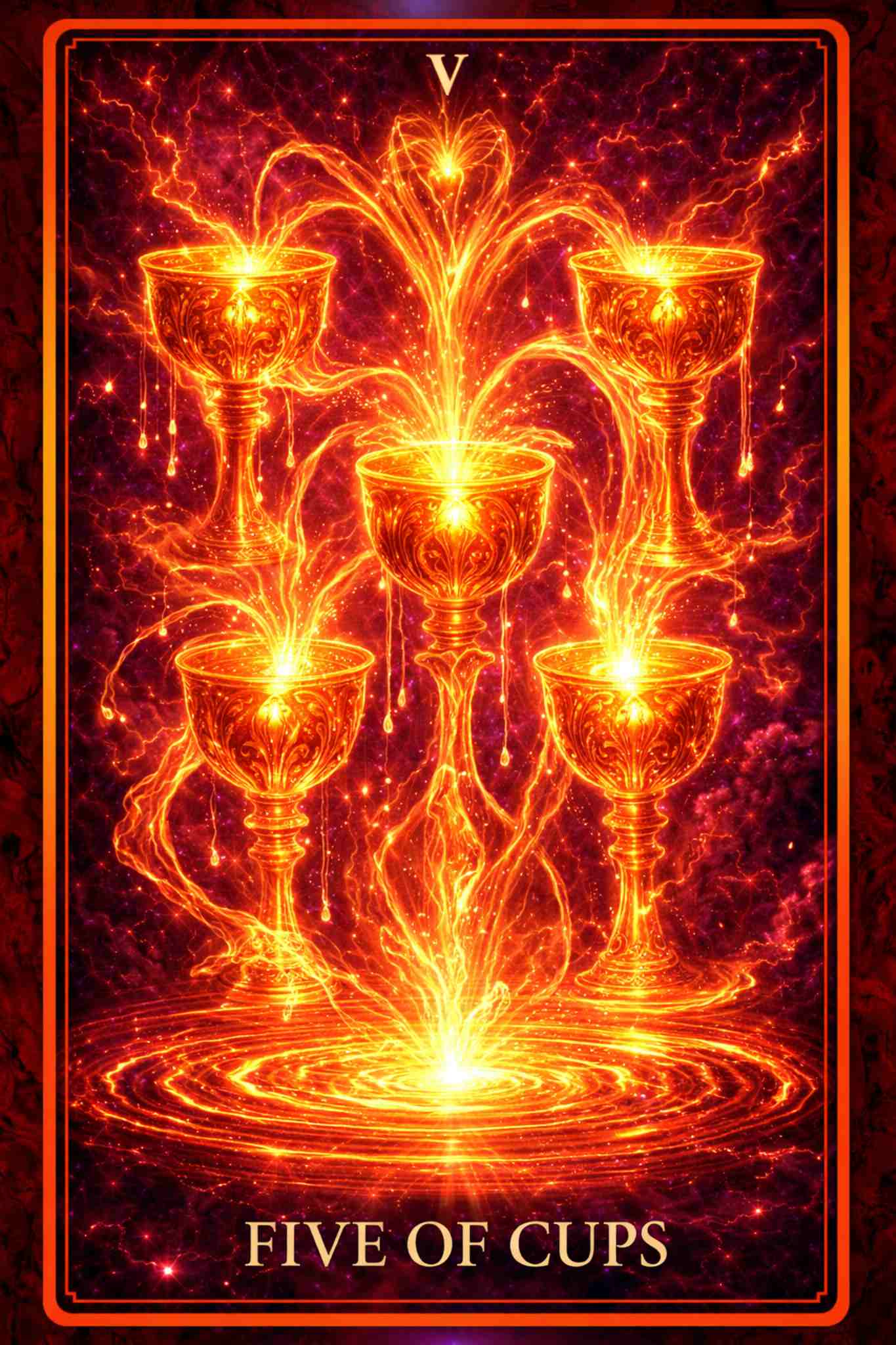
The Empress and Five of Cups Tarot Combination Meaning
Some sorrow closes the heart around absence. A person loses something meaningful, and all emotional energy gathers around what is gone, as if pain itself has become the final proof that something once mattered. Other sorrow does something more inward and more transformative. The loss is still real, the grief still has weight, though beneath the first wave of hurt another process begins. The heart starts asking what this pain is changing in the way it trusts, receives, remembers, and reaches for life again. The Empress and Five of Cups belongs to that second kind of grief. This pair speaks of emotional pain as a turning point in the heart's relationship to love, hope, and nourishment. The Five of Cups brings loss, regret, disappointment, mourning, and the strong pull toward what has spilled beyond recovery. The Empress enters that landscape with tenderness and depth, asking how grief is being lived inside the body and inner world, and whether the sorrow is being held in a way that allows emotional truth to deepen rather than collapse into permanent inner winter.
This is what gives the combination its particular richness. The Five of Cups is often read through the image of grief alone, though beside The Empress it becomes a reading about what grief is doing to the heart's future capacity for trust. Loss here is not abstract. It is embodied. It may live in the chest as heaviness, in the throat as ache, in the nervous system as caution, and in the emotional field as a subtle reluctance to believe in warmth too quickly. The Empress does not try to erase any of that. She understands that when something tender has been bruised or broken, the person is rarely grieving only the event itself. They are also grieving the version of themselves that existed before the loss reshaped their emotional landscape. This is why the cards feel so psychologically alive together. They are not only about sadness. They are about what sadness changes, and how that change can be met with care instead of fear.
That distinction matters deeply because the Five of Cups can keep awareness fixed on what went wrong, what cannot be restored, what arrived too late, or what slipped away before the heart was ready. The Empress honors that pull without letting it become the only story. She asks whether grief is being given enough warmth that trust can one day return in a new form. She asks whether the heart is learning only caution from loss, or something more complex and more humane. The Empress spirituality meaning deepens this layer because The Empress is not only comfort or beauty; she is the living intelligence of care, embodiment, receptivity, and nourishment after inner depletion. Can pain deepen discernment without turning into emotional famine? Can regret become wisdom without becoming identity? Can the person remain in honest relationship with what is broken while still protecting some quiet devotion to what may yet live? These are the questions that make the pair so much more than a simple symbol of sorrow. They turn it into a reading about the reconstruction of inner emotional trust after disappointment.
When grief changes the way the heart reaches
The Five of Cups often appears when emotional pain is concentrated and immediate enough that the heart naturally turns toward what has been lost. A person may feel the absence of something vividly. There may be grief over what ended, regret over what was missed, or a private ache around what never fully became what it seemed it might become. In many readings, this card reflects the stage where loss is still shaping attention very strongly. Beside The Empress, the focus becomes more intimate. The question is no longer only what has been lost. The deeper question is what the loss is teaching the heart to expect from life now. This is where the combination begins to open. Sorrow is still sorrow, though it is also actively reorganizing how emotional life feels from within.
This is why the pairing can feel both soft and demanding at the same time. The Empress brings compassion, though her compassion is not vague comfort. She wants to know how the person is living with what hurts. Are they allowing grief to move, breathe, and be felt as a real response to love or hope that mattered? Or are they beginning to shape themselves around disappointment so completely that pain becomes the center of identity? The Five of Cups can drift toward that second condition when loss becomes the main lens through which everything else is interpreted. The Empress responds by bringing the grieving self back into the picture. She reminds the person that grief is happening inside a living being who still needs warmth, food, rest, beauty, slowness, gentleness, and trustworthy contact with what has not died. This does not diminish mourning. It protects the mourner from disappearing into it.
There is also a quieter layer here that often goes unnoticed. Loss can make a person less trusting of emotional life itself. After disappointment, even tenderness may begin to feel risky because tenderness once led somewhere painful. Hope may feel expensive. Openness may feel naive. The Empress understands this reaction at a deep level, and she approaches it with great care. She does not ask the person to reopen instantly. She asks whether the heart can remain soft enough to heal in a way that preserves dignity without building permanent emotional defenses around every future possibility. This is where the transformation begins. The Five of Cups shows what was wounded. The Empress shows how that wound can be held so that trust becomes wiser and more embodied, rather than simply smaller.
Grief can deepen the heart without teaching it to starve
One of the deepest teachings in this combination is that grief always changes the inner world, though the form of that change matters immensely. Pain can narrow life. It can teach the heart to expect less, risk less, feel less, and stay close only to what is familiar because familiarity feels safer than hope. Yet grief can also deepen emotional life in another way. It can make the person more reverent toward what is real, more sensitive to false nourishment, more honest about what truly matters, and more capable of loving from depth rather than illusion. The Empress stands precisely at that threshold. She does not remove sorrow. She helps shape what sorrow becomes inside the person.
You may also want to go one step deeper.
The Empress + Five of Cups can open up differently inside a focused personal reading.
This is especially important because pain often creates a false sense of loyalty. A grieving person may feel that softening would betray what was lost, as though healing too visibly would mean the wound never mattered. The Empress offers a different truth. Care is not disloyalty. Warmth is not forgetting. Letting life re-enter the emotional field in small ways does not erase what happened. A useful contrast appears in The Fool and Five of Cups, where grief meets innocence, vulnerability, and the difficult possibility of beginning again without fully knowing what comes next. The Empress is less impulsive and more embodied. She asks the grieving self to return to life slowly, with protection, softness, and enough patience for sorrow to be held without rushing it into optimism. This is one of the most beautiful aspects of the pair. The Five of Cups says that something precious mattered enough to leave an ache. The Empress says that the self carrying that ache also matters, and deserves to remain alive while mourning unfolds.
The shadow side can move in more than one direction. A person may keep circling the wound through repetitive inner narratives that preserve pain while preventing movement. Or they may surround themselves with softness, comfort, and soothing language while quietly refusing to let the loss become fully conscious. The healthiest expression of these cards avoids both extremes. It lets grief be specific, embodied, and emotionally true. It also lets care remain active, so that the pain is held in an atmosphere where the heart can metabolize it instead of freezing around it. This is why The Empress changes the Five of Cups so profoundly. She turns grief from a closed emotional chamber into a living process that can eventually restore depth without restoring innocence in the same form.
Love and relationship meaning
In love readings, The Empress and Five of Cups often points to hurt that is actively shaping the heart's ability to trust, receive, or remain open within relational life. There may be disappointment in the bond, grief over a separation, pain around something that could not be repaired, or a quieter sorrow over what was hoped for and never fully arrived. The Five of Cups shows the ache itself, though The Empress reveals the deeper issue beneath it: how this pain is influencing the person's future relationship to tenderness. This makes the pair emotionally serious. It is rarely about fleeting sadness. It is about whether love remains livable after it has bruised the heart.
In some situations, the cards may describe grief inside an existing relationship. Something may have been lost between two people: ease, trust, innocence, emotional security, a shared dream, or the sense that the bond was moving in a certain direction. The Empress brings the possibility of holding that loss with greater compassion and honesty. She asks whether the relationship can make enough room for real mourning to occur without immediate defensiveness, blame, or rushed repair. Sometimes couples try to move too quickly toward solutions because the pain of naming what has changed feels unbearable. The Five of Wands love meaning can clarify a nearby but different pattern, where conflict, friction, and emotional heat may dominate the relationship field. Here, with The Empress and Five of Cups, the emphasis is less on active conflict and more on the tender aftermath of hurt. These cards suggest another rhythm. Let the grief become speakable. Let the emotional wound have shape. Let care create a container strong enough that truth can be felt without the whole bond collapsing under the weight of it.
In other cases, this combination reflects a person grieving a relationship already gone or a connection that never ripened into the life they imagined. The Empress then becomes a card of self-holding in the aftermath. She asks whether the person is allowing themselves to mourn without turning the loss into proof that intimacy itself is unsafe. That question sits at the center of the pair. If the heart decides that pain means love is no longer worth trusting, sorrow starts shaping the future through fear. If the heart is allowed to grieve fully while still receiving care, another possibility opens. The person becomes changed by the loss, though not permanently exiled from tenderness.
The deeper relational message often concerns what is happening to emotional trust beneath the visible grief. Is the person trying to replace the loss quickly because emptiness feels too raw to inhabit? Are they staying so close to what went wrong that new connection already feels guilty or implausible? Or are they slowly allowing pain to become part of their wisdom rather than the ruler of their entire emotional life? The Empress and Five of Cups tends to appear where these inner movements matter more than surface appearances suggest.
Self-relationship, regret, and the reshaping of emotional faith
Outside romance, this pair can speak to many kinds of grief: missed opportunities, creative disappointment, family pain, changing identity, spiritual disillusionment, and the ache of seeing a cherished vision dissolve before it could fully become lived reality. The Five of Cups often locks awareness onto the loss itself, which is understandable because the wound is vivid. The Empress broadens the field by asking how the whole self is being treated in the presence of that wound. This is where the reading becomes profoundly healing. The person may need less instruction and more nourishment. Less pressure to reinterpret the event and more permission to feel its truth while staying connected to what is still capable of growth within them.
Psychologically, the pair can mark a transition from grief as self-abandonment to grief as self-companionship. That shift may seem subtle from the outside, though inwardly it changes everything. It may be the moment the person stops speaking to themselves as though suffering were evidence of failure. It may be the moment they notice that appetite, rest, creative impulse, or bodily softness is slowly returning and understand that this return does not dishonor what was lost. It may be the recognition that regret can teach discernment without becoming a life sentence. A more visible and outwardly affirming Empress pairing appears in The Empress and Six of Wands, where care, beauty, recognition, and confidence meet in a more public emotional field. The Empress and Five of Cups is quieter and more interior. It asks how the self is restored when recognition is absent and the heart must learn to nourish itself from within. These are deeply Empress-like movements. She does not take pain away. She keeps the person from becoming emotionally orphaned inside it.
Creatively and spiritually, the combination can be fertile in a painful but profound way. The loss may still be active, though if it is given enough warmth and honesty, it can deepen expression instead of flattening it. The Empress creates atmosphere rather than formula. She allows what hurts to become integrated through contact with life, embodiment, and emotional truth. In that sense, the pair can describe the slow return of meaning after disappointment, where the person begins to feel that something inside them still wants to create, feel, and participate in life, even though innocence has changed form.
Timing and the wisdom of protecting the heart's future capacity
Timing matters strongly with this pair because it often appears when the next step is not speed, suppression, or forced optimism. It is care that protects the heart's future capacity to trust. This may be a time to grieve honestly, to stop demanding immediate closure, to give the body and inner world what they actually need, and to notice what kind of emotional beliefs the loss is quietly producing. The Empress and Five of Cups rarely supports hardening. It favors tenderness strong enough to remain present with sorrow while also guarding against the temptation to turn sorrow into permanent emotional law.
A useful reflection here is: what is this grief teaching my heart about love, trust, and life, and is that teaching helping me remain human? That question reaches the center of the combination. It asks the person to look beneath the wound and notice the new emotional architecture forming around it. Another Empress contrast appears in The Empress and Wheel of Fortune, where growth, receptivity, and life cycles meet change in a broader turning of circumstance. The Empress and Five of Cups is more intimate. The wheel has already turned in a way the heart feels deeply, and the question becomes how to care for what remains. Once that becomes visible, grief often starts to change shape. It may remain grief for quite some time, though it begins to move with more honesty, more self-respect, and less hidden fear about what tenderness will cost in the future.
Want to place this combination into a wider reading?
If this pairing feels close to something you are experiencing, a simple spread can help you reflect on the surrounding energy with more clarity.
Closing reflection
There is something deeply tender and quietly transformative in this pairing. The Five of Cups says something mattered enough to leave real sorrow behind. Loss is real, disappointment is real, and the heart has turned toward what can no longer be restored in its earlier form. The Empress says that grief is also changing the heart's relationship to trust, and that this change deserves great care. She reminds us that mourning is never only about what ended. It is also about what the self who remains will come to believe about love, nourishment, and emotional safety afterward.
The wisdom of these cards is to hold sorrow in a way that deepens the heart without teaching it to starve. Let grief be specific. Let regret speak where it needs to speak. Let disappointment reveal what once mattered. Though also let care remain close. Let warmth protect what still lives. Let life return in small, embodied ways. The Empress and Five of Cups often appears exactly there, where pain is asking to be honored and the deeper task is learning how to mourn without surrendering the future capacity to trust, receive, and love again.
More combinations with The Empress
More combinations with Five of Cups
Continue with The Empress
Explore Related Guides by Topic
If you want to explore this combination through a more specific emotional lens, these tarot guides can help you follow the broader pattern behind the reading.