
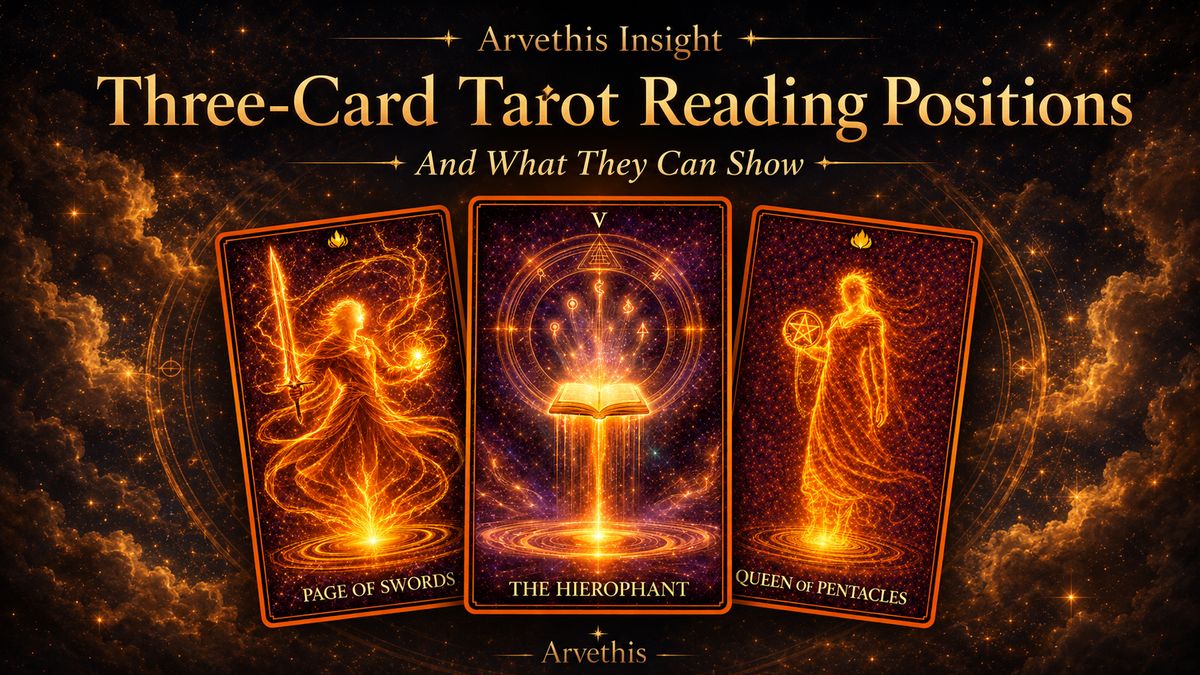
Three-Card Tarot Reading Positions and What They Can Show
A three-card tarot reading works because it gives a question just enough room to move. One card can be a clear mirror, but three cards create a small rhythm. Something opens, something shifts, and something asks for response. This is why a three-card spread can feel simple and surprisingly deep at the same time. It does not need a large ritual or a complicated layout. It works best when each position has a clear purpose, so the cards can relate to one another instead of floating as separate messages. When those jobs are clear, the reading begins to behave like a small symbolic sentence rather than a pile of separate meanings.
The mistake many readers make is treating three cards as three isolated answers. Card one says this. Card two says that. Card three says something else. Then the reading feels scattered, and the mind starts forcing a story. A stronger approach is to read the movement between the cards. The first card may open the room. The second may change the pressure. The third may show where the response begins. The meaning is not only inside each card. It is also in the way one card leans into the next. This is where a three-card reading becomes alive.
Through the Arvethis lens, a three-card spread is best used as reflective structure rather than a verdict over the future. It can help you notice sequence, pressure, contrast, emotional tone, and possible response, while real-life choices still belong to you. The cards can suggest what is active in the symbolic field, but they are not a replacement for judgment, conversation, practical research, or qualified help where serious matters are involved. A good three-card reading does not trap you inside an answer. It gives you a cleaner way to stand inside the question.
Three cards are a small sentence, not three separate answers
One of the most useful ways to read three cards is to imagine them as a sentence. The first card is the opening phrase. The second card introduces tension, contrast, or development. The third card shows where the sentence begins to land. This does not mean every spread has to tell a neat story. Life is rarely that tidy. But it does mean the cards should be read in relationship to each other. A three-card reading becomes stronger when you ask what changes between card one and card two, and what card three does with that change.
For example, a spread might move from uncertainty to clarity to rest. Another might move from desire to hesitation to a grounded boundary. Another might move from pressure to truth to a softer kind of patience. The exact cards matter, but the movement matters just as much. If you only read each card alone, you may miss the turning point. Often the second card is where the reading becomes honest. It may interrupt the first card, complicate it, or show what the first card was avoiding. The third card then asks what kind of response becomes possible once that interruption is seen.
This is why three-card readings are especially useful for people who feel overwhelmed by big spreads. They offer structure without drowning the question. The three card tarot reading tool can be used this way: not as a machine that hands down a final answer, but as a small room where the question can arrange itself into beginning, pressure, and response. The spread becomes useful when you read the whole sentence, not only the individual words.
The first card opens the room
The first card in a three-card reading is often the doorway. It sets the atmosphere. It may show the visible situation, the starting point, the root mood, or the part of the question that has already entered awareness. This card should not be rushed. Many readers glance at the first card and immediately move toward the second and third because they want the answer. But the first card tells you what kind of room you are standing in. If you misunderstand the room, the rest of the reading may become distorted.
Think of the first card as the first light turned on. It does not show everything, but it changes how everything else is seen. If the first card carries stillness, the spread begins in stillness. If it carries conflict, the spread begins with pressure. If it carries hope, the spread begins with an opening. If it carries exhaustion, the spread begins with the need to acknowledge what has already been carried. The first card does not always show the cause. Sometimes it shows the doorway through which the seeker is entering the reading.
A useful question for the first card is: “What is already present?” This keeps the interpretation grounded. Instead of making the first card predict, diagnose, or decide, let it name the field. What tone is already active? What part of the situation is asking to be seen first? What is the reading asking you not to skip? When the first card is respected, the rest of the spread has a stronger foundation.
The middle card changes the pressure
The second card is often the most interesting card in a three-card spread. It sits in the middle, where the reading turns. Sometimes it shows the challenge. Sometimes it shows the hidden tension. Sometimes it shows the emotional or practical pressure that changes the meaning of the first card. The middle card may support the opening, but it may also disturb it. This is not a problem. The middle card is where the spread becomes more than a simple statement.
If the first card says there is desire, the second card may ask whether that desire is grounded, rushed, fearful, or clear. If the first card says there is silence, the second may show whether that silence is healing, avoidance, protection, or waiting. If the first card shows movement, the second may reveal whether the movement is aligned or reactive. The middle card gives the reading friction. Without friction, a spread can become too smooth to be useful. With friction, it begins to show the real question beneath the question.
This is also where the reader needs patience. Do not flatten the second card into “the problem” too quickly. A challenge is not always an enemy. Sometimes the middle card shows the necessary truth that makes the reading honest. Sometimes it shows the pause that prevents an impulsive step. Sometimes it shows the boundary that protects a softer possibility. A three-card reading becomes more human when the middle card is allowed to complicate the story without turning it into fear.
The third card is direction, not a locked ending
The third card often receives too much pressure. In a past-present-future spread, people may treat it as a fixed outcome. In an advice spread, they may treat it as an order. In a decision spread, they may treat it as the final verdict. This can make the reading feel more certain than it really is. A healthier way to read the third card is as direction, response, integration, or the next symbolic place the pattern is moving toward. It can be meaningful without being absolute.
The third card may show what becomes possible if the current pattern continues. It may show the attitude that supports clarity. It may show what wants to be integrated after the first two cards have spoken. It may show a next step, but that step still needs real-life judgment. If the third card is gentle, it does not guarantee ease. If it is intense, it does not guarantee disaster. It shows the kind of energy that deserves attention as the reading begins to land.
A useful question for the third card is: “What response is being invited?” This lets the third card remain a form of guidance, not a final verdict about what must happen. The reading may be asking for patience, truth, rest, conversation, release, steadiness, courage, or a more honest relationship with the question. That is different from saying the future has been sealed. The third card is not a cage. It is a doorway out of the spread and back into life.
Past, present, future — without forcing prediction
The past-present-future spread remains popular because it is easy to understand. But it works best when the future card is not treated as a fixed event. A more grounded version is: background, current field, possible direction. The first card shows what shaped the question. The second shows what is active now. The third shows where the pattern may be moving if nothing important changes, or what kind of awareness may help shape the next phase.
This layout is useful when a situation has a clear timeline. It can help you see how an old pattern is still influencing the present, or how the present is beginning to separate from the past. Sometimes the past card explains why the current situation feels heavier than it appears. Sometimes the present card reveals that the past is not as dominant as it once was. Sometimes the third card shows the need for a different response rather than a fixed destination.
The safest way to use this spread is to read it as development, not certainty. Ask: what came before, what is active now, and what direction wants attention? This makes the spread practical and reflective. It allows tarot to show sequence without pretending that the future has only one path. If you often feel confused by timelines in readings, the guide on why your tarot reading feels confusing can help you notice when a spread is showing layers rather than one clean prediction.
Weather, friction, response
A less mechanical three-card layout is weather, friction, response. The first card shows the atmosphere around the question. The second card shows what rubs, resists, or creates pressure inside that atmosphere. The third card shows the response that may help you meet the situation with more clarity. This spread works well because many questions begin as a feeling before they become a plan. You may not know what you need to ask yet, but you can sense the weather.
The weather card might show emotional fog, creative heat, mental pressure, stillness, excitement, grief, or a quiet opening. The friction card shows what makes the weather difficult to move through. Maybe the atmosphere is hopeful, but the friction is impatience. Maybe the atmosphere is calm, but the friction is avoidance. Maybe the atmosphere is intense, but the friction is a lack of grounding. The response card then shows what kind of posture brings the reading back into balance.
This layout is especially good for daily or weekly reflection because it does not pretend that every question has a neat storyline. Some days have weather. Some days have pressure. Some days only ask for the right response. Weather, friction, response gives the reading a living shape without making it too heavy.
Signal, noise, anchor
Signal, noise, anchor is a three-card spread for moments when you cannot tell what matters. The signal card shows the meaningful thread. The noise card shows what is distracting, amplifying fear, or pulling attention away from the center. The anchor card shows what can help you return to steadiness. This spread is useful when the mind has too many interpretations and the heart is tired of sorting them.
The signal is not always the loudest card. Sometimes the quietest card carries the truth. The noise card is not always “bad.” It may show a valid concern that has become too large. It may show old fear, outside opinion, urgency, fantasy, comparison, or the need to stop gathering more information for a moment. The anchor card is the place where the reading becomes useful. It tells you what helps you come back to the ground.
This spread pairs naturally with the blog on tarot and overthinking. When a reading becomes noisy, more cards may not help. A signal-noise-anchor layout can do the opposite: it reduces the field. It asks what matters, what is interfering, and what brings you back to yourself. That is often more valuable than another layer of explanation.
Need, fear, honest next step
Need, fear, honest next step is a powerful spread when a question has emotional charge. The first card asks what is genuinely needed. The second asks what fear is shaping the situation. The third asks what a grounded next step might look like. This spread does not shame fear. It gives fear a place, so it does not have to disguise itself as certainty, urgency, control, or avoidance.
The need card may show rest, truth, affection, distance, structure, patience, expression, or practical care. The fear card may show what the seeker is trying not to feel or what the situation seems to threaten. The honest next step card brings the reading into proportion. It may not be dramatic. It may be a conversation, a pause, a boundary, a small act of preparation, or a decision to stop pushing for an answer before the question is mature.
This spread is useful because it separates need from fear. In emotionally charged situations, those two can become tangled. A person may think they need immediate reassurance, when the deeper need is steadiness. They may think they need an answer from someone else, when the deeper need is to stop abandoning their own center. Tarot should not be used to replace real support in serious emotional or safety situations, but this spread can help name the inner pattern more clearly.
Question, mirror, refinement
Another three-card spread that feels different from the usual beginner layouts is question, mirror, refinement. The first card reflects the question as it is currently being asked. The second card mirrors the energy underneath that question. The third card refines the question into something more honest. This spread is especially useful when you feel that your original question is too narrow, anxious, or loaded with expectation.
For example, someone may ask, “Will this work?” The first card may show the surface pressure. The second may reveal fear, longing, ambition, or exhaustion beneath it. The third may suggest a better question, such as “What part of this needs more grounded effort?” or “Where am I trying to force certainty before I have enough information?” The spread does not only answer the question. It improves the question.
This is one of the most underrated uses of tarot. Sometimes the card that helps most is not the one that gives an answer, but the one that teaches you how to ask more cleanly. If this feels relevant, how to ask a tarot question can support the same skill from another angle. A better question can change the whole reading.
How to read the space between the cards
The space between the cards is often where the real interpretation lives. Look at the transition from card one to card two. Does the energy become softer, sharper, faster, slower, more hidden, more exposed, more grounded, or more conflicted? Then look from card two to card three. Does the spread resolve, deepen, pause, redirect, or ask for a different kind of response? These shifts matter. They show how the reading moves.
You can also notice visual echoes. Are two cards facing each other? Does one feel closed while another feels open? Is there a repeated symbol, color, gesture, or atmosphere? Does the spread move from darkness into light, or from movement into stillness? These details should not be forced into artificial meaning, but they can help the reading feel more embodied. Tarot is visual before it is verbal. Let the images speak before the keywords take over.
This is where tarot card combinations become useful in a three-card spread. A combination is not only two cards sitting next to each other. It is the tension, support, correction, or echo between them. In a three-card reading, you have several relationships at once: card one with card two, card two with card three, and the whole spread as a single symbolic movement. That is enough depth for many questions.
When three cards are too many
Three cards are simple, but they can still be too many if the mind is already flooded. Sometimes the honest reading is one card. Sometimes the question needs quiet before it needs symbolism. If you pull three cards and immediately feel the urge to pull three more, pause. The issue may not be that the spread is incomplete. It may be that the nervous system is looking for certainty faster than the reading can responsibly provide it.
A three-card reading can also be too much when the question is actually very small. If you only need a daily focus, one card may be cleaner. If you only need a journaling prompt, one card may be enough. If the question is too large, three cards may feel too narrow. The right number of cards depends on the size and quality of the question. There is no virtue in using more cards than the situation needs.
The best readers know when to stop. They do not keep adding cards just because the first spread was uncomfortable. They also do not force a small spread to carry a life-changing decision alone. Three cards are a tool, not a rule. Use them when they create clarity. Step back when they create noise.
When three cards are exactly enough
Three cards are exactly enough when you need movement but not complexity. They are enough when you want to understand the shape of a situation, not every hidden detail. They are enough when the question can be held through three clear roles: what is present, what is pressing, and what response is invited. This is why three-card spreads remain useful even for experienced readers. They create enough structure to keep the reading honest and enough openness to let intuition breathe.
They are also enough when you want to practice reading without becoming dependent on long explanations. Three cards teach proportion. The first card may be strong, but the second can shift it. The third may soften the whole spread or make it more direct. You learn to read relationship, not only definition. You learn to hear the sentence, not only the words.
If you use the Arvethis three-card tarot reading tool, try choosing your positions before you draw. Decide whether you are reading past-present-direction, weather-friction-response, signal-noise-anchor, or need-fear-next step. That choice matters. The same cards can speak differently when their roles change. A spread becomes clearer when the cards know what they are being asked to do.
Let the spread breathe before you explain it
After pulling three cards, give the spread a moment before interpreting. Look at it as an image. Where does your eye go first? Which card feels loudest? Which card feels quiet but important? Does the spread feel like it is moving forward, turning inward, pausing, breaking open, or settling? This first visual impression can be valuable. It often tells you the shape of the reading before the mind starts sorting meanings.
Then read each position. Only after that should you blend the whole message. This order matters. If you blend too early, the reading can become vague. If you stay only with positions, it can become stiff. A good three-card reading has both structure and breath. The positions give the cards a job. The relationship between the cards gives the reading life.
When you write the interpretation, keep it human. You do not need to explain every possible meaning of every card. Write what the spread is showing in this question, in this moment, with these positions. A short, honest interpretation often carries more truth than a long list of meanings. The goal is not to sound impressive. The goal is to help the question become clearer.
A different way to practice three-card readings
Instead of practicing by memorizing layouts, try practicing movement. Pull three cards with no big question and ask: what is the shift from the first to the second? What changes from the second to the third? Does the spread become warmer, cooler, more active, more inward, more grounded, more uncertain, more direct? This teaches you to read flow, which is the real heart of three-card tarot.
You can also practice by giving the same three cards different positions. First read them as past-present-direction. Then read them as weather-friction-response. Then read them as need-fear-next step. Notice how the same cards change when their roles change. This is not confusion. This is how spread positions work. A card does not speak in a vacuum. It speaks through the job it has been given.
Over time, this practice makes readings less mechanical. You begin to see why position matters. You begin to feel when a spread is too tight or too loose. You begin to know when the third card is asking for action, when it is asking for patience, and when it is simply showing the direction of awareness. That is a more mature skill than memorizing one fixed layout.
Closing reflection: three cards, one living movement
A three-card tarot reading is useful because it gives the question a living movement. It does not have to say everything. It only has to show enough: the opening, the pressure, and the response. Or the weather, the friction, and the anchor. Or the need, the fear, and the honest next step. When the positions are chosen well, three cards can hold a surprising amount of truth without becoming overwhelming.
The strength of a three-card spread is its restraint. It does not invite you to chase every possible outcome. It asks you to listen to the relationship between a few symbols. The first card opens the room. The second changes the pressure. The third points toward response. Somewhere between them, the reading begins to speak. Not as a fixed verdict, but as a symbolic shape you can meet with more awareness.
Use three-card readings when you need clarity with movement. Use them when one card feels too narrow and ten cards would be too much. Let the spread breathe before you explain it. Let the positions do their work. Let the cards become a sentence, and then let that sentence return you to life with more steadiness, more honesty, and a clearer sense of where your attention belongs.
FAQ: Three-card tarot readings
What is a three-card tarot reading?
A three-card tarot reading uses three cards in chosen positions to explore a question. The positions may show sequence, contrast, pressure, response, or different layers of the same situation. The reading works best when the cards are read as one symbolic movement rather than three isolated answers.
Does the third card predict the future?
The third card does not have to be read as a fixed future. It can show possible direction, response, integration, or what deserves attention next. In a past-present-future layout, it is often safer to read the third card as the direction of the current pattern rather than a guaranteed outcome.
What are good three-card tarot positions?
Useful three-card positions include past-present-direction, weather-friction-response, signal-noise-anchor, need-fear-honest next step, situation-pressure-response, and question-mirror-refinement. The best layout depends on the kind of clarity the question needs.
Is a three-card tarot spread good for beginners?
Yes. Three-card spreads are excellent for beginners because they are structured but not overwhelming. They help readers practice position-based interpretation, card relationships, and symbolic movement without needing a large spread.
How do I interpret three tarot cards together?
Read each card according to its position first. Then look at the movement between the cards. Notice whether the spread becomes softer, sharper, clearer, heavier, calmer, or more active as it moves from card one to card three. The relationship between the cards is often where the deeper meaning appears.