
Justice + Ten of Wands
Explore how these two tarot cards interact in a reading through symbolic overlap, contrast, and shared narrative. Tarot combinations often reveal meaning that neither card fully expresses on its own.
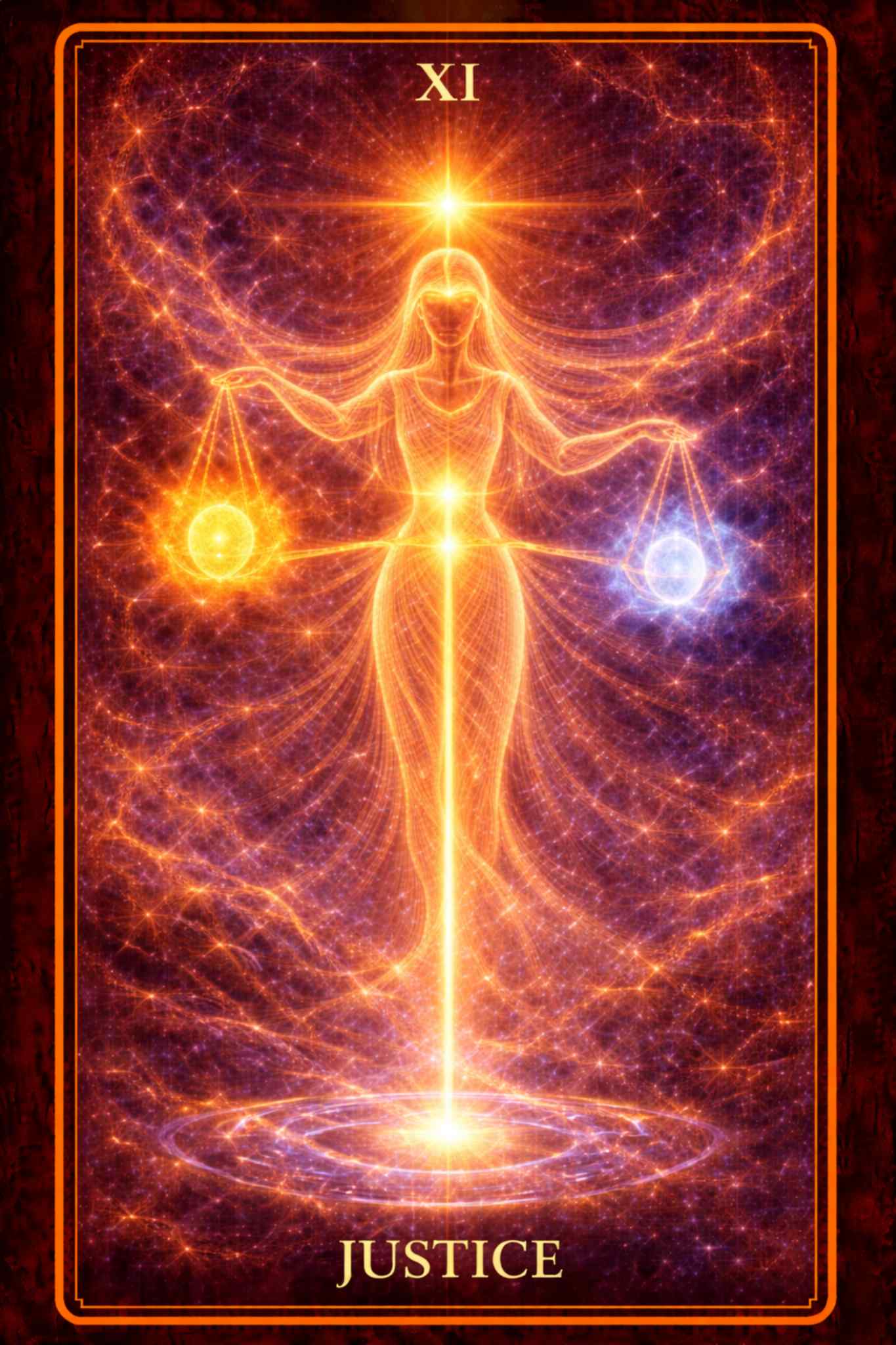
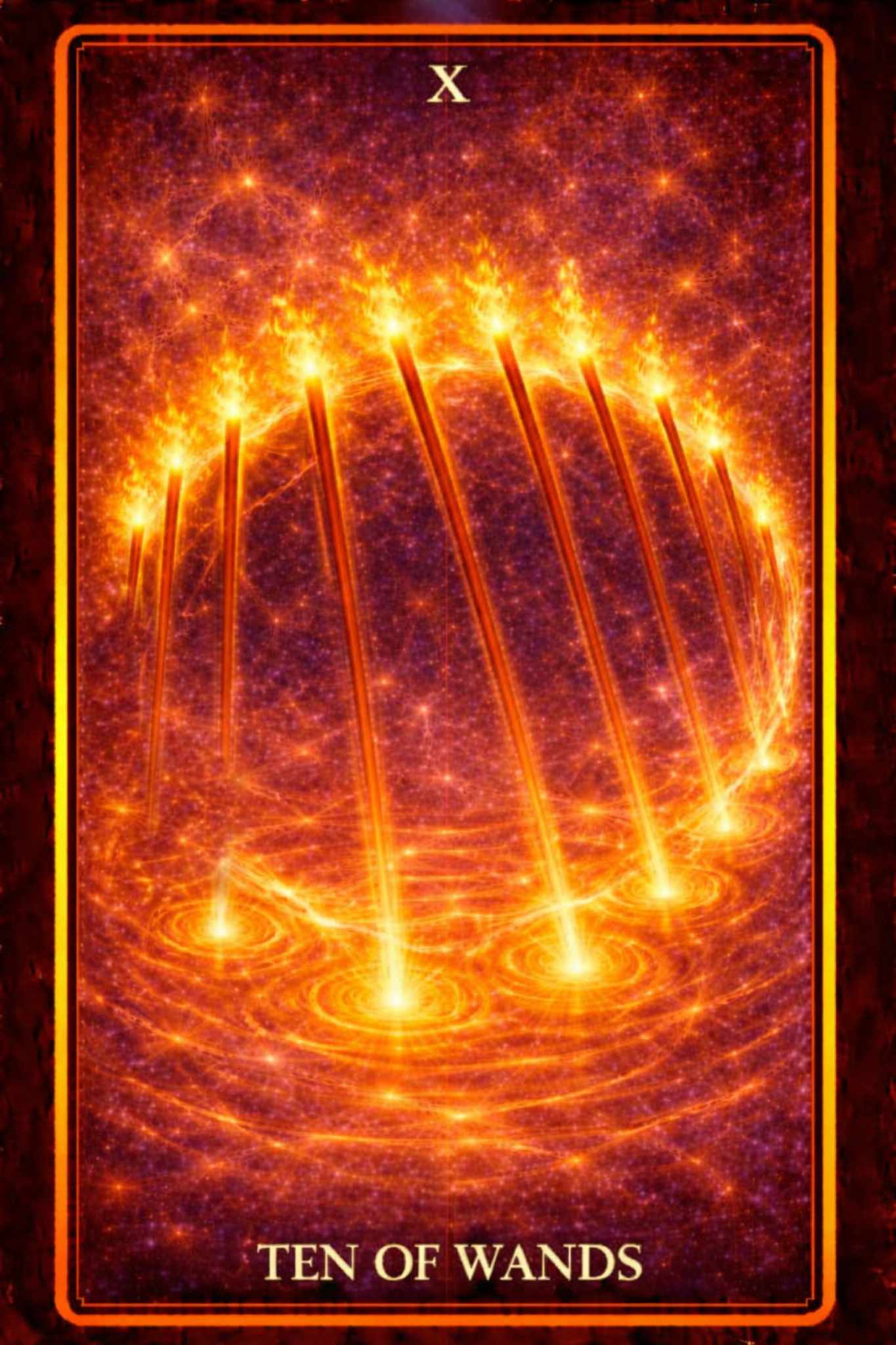
Justice and Ten of Wands Tarot Combination Meaning
Justice and Ten of Wands meet where responsibility has already become weight, and where that weight can no longer be understood only as effort, dedication, or strength. Something has accumulated. A person has been carrying, managing, containing, or compensating for long enough that the burden now says something on its own. Justice enters this condition with a very particular demand. It asks for a cleaner accounting of what belongs to duty, what belongs to consequence, and what belongs to imbalance that has simply been tolerated until it started to feel normal. The Ten of Wands does not describe a light strain or a passing inconvenience. It describes a life, bond, or structure under visible load. Together, these cards rarely speak only about hard work. They speak about the truth of hard work when it has continued long enough to reveal the architecture beneath it.
This is what gives the pairing its seriousness. The Ten of Wands often appears after sincerity has already been proven. The person has shown up, kept going, and borne more than they originally expected. Justice does not dismiss that. It recognizes that some burdens are real consequences of meaningful choices, commitments, or necessary obligations. Yet it also asks whether the present arrangement still has proportion. It asks whether strength has quietly become a reason to load one person more heavily than the situation can ethically justify, and whether endurance is now preserving something that should have been restructured much earlier.
When burden becomes evidence
People often explain their burdens in moral language long before they examine them structurally. They call the weight loyalty, professionalism, love, maturity, reliability, resilience, or necessity. Sometimes those names are accurate. Sometimes they are only the first layer of a more complicated truth. The Ten of Wands makes that truth harder to sentimentalize because it brings heaviness into direct view. Something is being carried, and it is no longer light enough to be justified only by good intentions. Justice responds by asking how this came to be. What choices led here? What patterns were allowed to continue? What responsibilities were clearly yours, and which ones attached themselves gradually because no one interrupted the imbalance once it began?
This is why the pairing can feel both validating and unsettling. It validates the reality of the load, but it refuses vagueness. Justice wants the burden translated into actual structure. Who carries what? What happens if the current arrangement continues unchanged? What part of this weight reflects a meaningful obligation, and what part reflects an old adaptation that has gone unquestioned for too long? Once the Ten of Wands appears, the pressure itself becomes part of the evidence.
The difference between true responsibility and overcarrying
One of the deepest themes in this combination is the difference between responsibility that has inner coherence and responsibility that has become distorted through repetition. True responsibility may be heavy, but it remains legible. A person understands what they are doing, why it matters, and what part of the burden is rightly theirs. Overcarrying feels different. It often includes invisible attachments: guilt, fear of disappointing others, the need to prevent collapse, the desire to remain indispensable, or the learned habit of stepping in before anyone else has to feel the consequence of their own inaction. Justice is essential here because it restores proportion to that blurred field.
Want to explore this combination in a more personal way?
If this pairing feels important right now, a simple tarot spread can help you reflect on it with more context.
The Ten of Wands frequently appears when this distinction has already been obscured. Outwardly, the person may still seem capable. The work may still be getting done. The family may still be functioning. The relationship may still be intact. But the internal cost has become too high to ignore honestly. Justice asks whether the current arrangement can still be defended as fair and sustainable, or whether burden is now being romanticized because changing it would expose truths that others — or the person themselves — have avoided facing.
Love and relationship meaning
In relationship readings, Justice and Ten of Wands often point to a bond carrying more strain than its visible surface admits. The issue is rarely only effort. More often, it is the distribution of effort. One person may be holding practical responsibilities, emotional regulation, conflict repair, long-range planning, or the quiet labor of keeping the relationship functional while both people continue referring to it as shared. Justice asks what is actually fair here, not in abstraction, but in lived terms. What does each person carry? What remains unnamed because naming it would alter the story the relationship has been telling about itself?
This pairing can be especially revealing in bonds where burden has been mistaken for devotion. A person may have normalized overfunctioning because it felt easier than confronting what would be exposed if they stopped. They may continue organizing, softening, remembering, explaining, stabilizing, and compensating while telling themselves this is simply what love requires. The Ten of Wands shows the weight of that pattern. Justice asks whether love is truly being protected by it, or whether the pattern is preserving an arrangement that only looks more mutual than it actually is.
At its best, this combination can support difficult but healing correction. Responsibilities may become more visible. Invisible labor may be acknowledged. A person may finally admit that what they have been carrying is no longer compatible with staying open-hearted inside the bond. Justice gives that admission legitimacy. In more difficult expressions, the cards can show a relationship where heaviness has become so normal that each new demand is simply folded into the existing pattern.
Career, work, and structural overload
In professional contexts, Justice and Ten of Wands are among the clearest combinations for unsustainable load, role distortion, and the ethical need to distinguish between meaningful responsibility and chronic overextension. The Ten of Wands may reflect too many tasks, too much containment, too many promises, or the late-stage fatigue that comes from becoming the place where unresolved inefficiencies quietly land. Justice asks what arrangement produced this and whether it remains fair in terms of role, authority, compensation, accountability, and actual scope of responsibility.
What makes this pairing especially relevant in work is that many people internalize structural imbalance as personal duty. They assume the problem is not the load itself, but their own supposed need to become better, faster, calmer, or stronger. Justice interrupts that logic. It asks whether the burden is proportionate to what the position was ever meant to hold. It asks whether the person has become the silent absorber of what others defer, mishandle, or avoid. The Ten of Wands shows that the system is already speaking through strain.
This can be a very important combination for people in leadership, caregiving, service, or creative roles, where overextension often hides behind dedication. Justice does not ask for collapse or abandonment. It asks for clearer terms. What needs delegation? What needs to be refused? What needs to be named before the burden becomes the central truth of the role? The most ethical action here is often not more noble endurance, but more accurate structuring.
Psychological and spiritual meaning
Psychologically, Justice and Ten of Wands often describe the point at which heaviness itself becomes a truth signal. The burden may have been present for a long time, but only now does it become undeniable enough to interpret directly. The person may notice that fatigue is no longer occasional, that irritability comes more easily, or that the thought of continuing in the same way creates a kind of inward compression. The Ten of Wands gives visible form to that state. Justice asks the person to read it without sentimentality and without self-accusation. What is this heaviness actually saying? What arrangement is the body or mind testifying about through the simple fact of sustained load?
Spiritually, the pairing often cuts into moral myths around sacrifice and worth. Many people learn that goodness is proven by carrying more, staying useful, enduring longer, and treating depletion as evidence of commitment. Justice challenges that theology of overextension. It does not dismiss duty. It examines whether duty remains rightly ordered. Some burdens are worth carrying for a time. The lesson is simply that burden itself is not automatically sacred.
Shadow expression and challenge
The shadow side of this combination appears when the person treats overcarrying as virtue and therefore resists any correction that would reduce the weight. They may keep saying yes because they are capable. They may continue because stopping feels like failure, or because identity has become entangled with being the one who can withstand more than others. The Ten of Wands can dignify endurance so strongly that it becomes difficult to notice when endurance has stopped serving truth and started serving self-distortion. Justice is crucial because it asks whether the current load still reflects coherent responsibility or whether burden itself has become morally idealized.
There is also a different distortion in which all heaviness is blamed entirely on external unfairness while one’s own patterns remain unexamined. Some burdens are imposed, unquestionably. Others are partly self-maintained through guilt, control, the fear of letting consequences land where they belong, or the inability to tolerate disappointing others. Justice asks for the fuller reading. Who created the imbalance? Who continued it? What belongs to the system, and what belongs to your own reluctance to stop carrying what was never cleanly yours?
Timing and the moment of honest limit
This pairing often raises a very specific timing question: has the point of honest limit arrived? Sometimes the answer is clearly yes. The burden has accumulated long enough. The consequences are already visible. Waiting longer will not create clarity. It will only deepen distortion. Justice then supports naming the truth now, because the Ten of Wands shows that the load is no longer hypothetical. It has already become part of lived reality. In such cases, the right action may involve speaking, restructuring, refusing, delegating, or ending a pattern rather than heroically extending it yet again.
At other times, the cards suggest that a heavy phase is near completion and that what is needed is not abrupt abandonment, but a more accurate distinction between temporary exertion and chronic overextension. Justice helps determine that proportion. The pairing is less interested in drama than in threshold recognition — the moment when truth about the load becomes clearer than the narratives that once justified it.
What this combination is really asking
Justice and Ten of Wands ask: what are you carrying that is truly yours, and what are you still carrying because the imbalance has become normal? That is the heart of the pair. The burden may be real, and some part of it may still be meaningful. But the cards ask for a more exact accounting. What belongs to duty? What belongs to guilt? What belongs to habit? What belongs to structure? What is being carried because it matters, and what is being carried because no one has forced the truth of the arrangement fully into the open?
The deeper lesson is that responsibility becomes distorted when it loses proportion. Justice gives clarity, ethical order, and consequence-awareness. The Ten of Wands gives visible weight, accumulated strain, and the undeniable evidence that something has become heavy enough to matter. Together, they create one of the clearest combinations for honest reevaluation of load.
Explore the next layer of this reading.
This combination can mean different things depending on context. A short tarot reading can help you reflect on the question behind the cards.
Closing reflection
There are seasons when life genuinely asks more of a person. But there is a difference between carrying what matters and becoming the place where every unexamined imbalance eventually lands. This pairing appears when that difference can no longer remain blurred, when the weight itself has started to speak more clearly than the explanations around it.
Justice clarifies the load. The Ten of Wands makes it visible. Between them is the possibility of a cleaner form of responsibility, one that still honors devotion, labor, and endurance while no longer confusing overextension with virtue. When that distinction becomes visible, the burden changes. Even before the outer structure shifts, the truth of what is being carried begins to separate itself into what must remain, what can be shared, and what was never meant to become part of the self at all.
More combinations with Justice
More combinations with Ten of Wands
Continue with Justice
Explore Related Guides by Topic
If you want to explore this combination through a more specific emotional lens, these tarot guides can help you follow the broader pattern behind the reading.