
The Hermit + Seven of Wands
Explore how these two tarot cards interact in a reading through symbolic overlap, contrast, and shared narrative. Tarot combinations often reveal meaning that neither card fully expresses on its own.

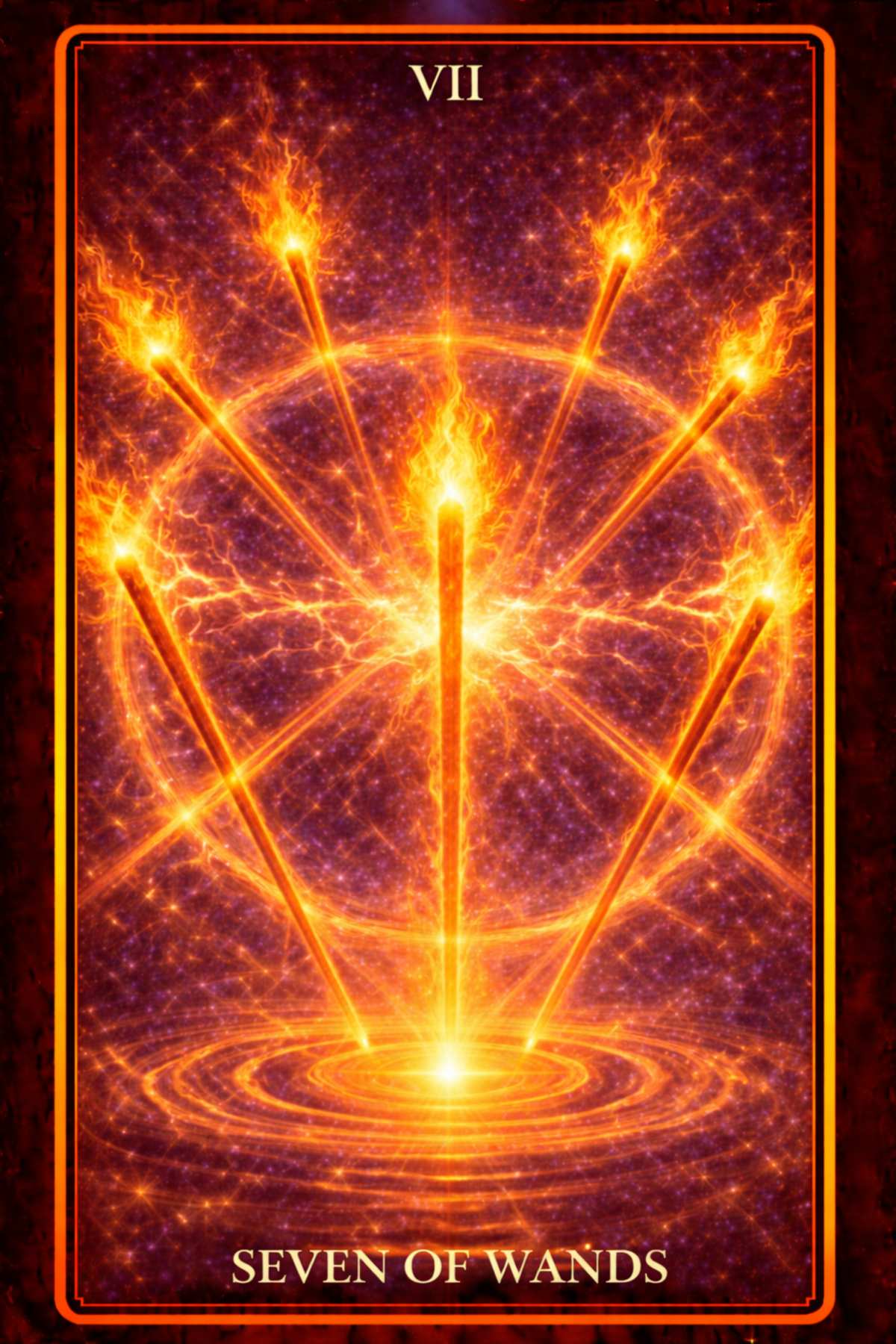
The Hermit and Seven of Wands Tarot Combination Meaning
The Hermit and Seven of Wands create a combination of inward certainty and outward pressure. The Hermit turns away from noise in order to hear what is true at a deeper level. He is not interested in reacting to every opinion, not because he is indifferent, but because he knows that clarity becomes distorted when the soul is crowded by too many demands. The Seven of Wands brings a very different experience of fire. It is not the first spark of desire, nor the broad horizon of future possibility, nor even the messy clash of scattered tension. It is the moment when something must be defended. A position has been taken, a truth has been reached, and pressure begins to gather around it. Together, these cards speak about what happens when quiet conviction must hold its ground.
This makes the pairing especially meaningful for periods in which you already know more than you wish to argue about. The Hermit does not enjoy needless conflict. He would rather step back, observe, and allow truth to clarify itself without theatrical struggle. Yet the Seven of Wands suggests that life may not leave that truth unchallenged. There may be outer pressure, competing voices, emotional demands, criticism, or internal fear that tests whether your insight is strong enough to survive contact with resistance. The central issue is not aggression. It is integrity under pressure. The Hermit asks whether what you are defending is genuinely rooted in inner wisdom. The Seven of Wands asks whether that wisdom is strong enough to remain upright when the world presses against it.
Quiet boundaries rather than loud resistance
One of the clearest insights in this combination is that defense does not always have to be dramatic. The Seven of Wands often shows the need to hold position, but when paired with The Hermit, the tone changes. The resistance here becomes quieter, more deliberate, less interested in spectacle. This is not about winning every argument or proving your superiority to those who misunderstand you. It is about not surrendering your deeper truth simply because it would be easier to appease the noise around you. The Hermit does not defend himself from vanity. He defends what conscience has clarified, and that gives the Seven of Wands a more mature, less reactive quality.
This can be a very necessary kind of fire. Many people imagine boundaries only in loud or confrontational terms, but these cards together show another possibility: calm refusal, inward firmness, the ability to step back without collapsing, and the willingness to preserve what is true even when others want access, explanation, or compliance. The Seven of Wands supplies energy, courage, and tension. The Hermit supplies distance, self-knowledge, and restraint. Without The Hermit, the Seven of Wands can become reactive or embattled. Without the Seven, The Hermit might remain too inward, too reluctant to occupy visible ground. Together, they form the image of a person who does not speak quickly, but whose silence is not surrender.
- Not every challenge deserves equal attention.
- Some truths need protection before they need explanation.
- Distance can be a boundary, not an avoidance.
- Conviction becomes visible when it remains steady under pressure.
When inner truth must be protected
The Hermit often appears after experience has taught someone to become more selective. They may have learned to stop giving energy away indiscriminately, to stop confusing openness with availability, or to stop letting external pressure define what they know inwardly. The Seven of Wands then suggests that this inner learning is now being tested. A person may need to protect their time, their emotional clarity, their spiritual process, their values, or a choice that others do not fully understand. This can be uncomfortable, because The Hermit usually prefers not to perform his boundaries publicly. Yet some truths only become real when they are upheld under pressure.
This does not mean that every challenge should be met with defensiveness. The Hermit still asks for discernment. Which challenge deserves a response, and which merely deserves distance? Which pressure reveals an area where your conviction is still weak, and which pressure comes from people who simply dislike not having influence over your path? The Seven of Wands can make everything feel immediate, but The Hermit slows the moment enough to ask what is actually at stake. In many cases, the real work is not fighting harder. It is refusing to be drawn into battles that are not worthy of your life force while still standing clearly where it matters. That difference is what turns self-protection into integrity rather than reaction.
Love and relationship meaning
In love readings, The Hermit and Seven of Wands often point to relational boundaries, emotional self-protection, or the need to defend a quieter truth inside a connection. One or both people may feel pressure around timing, expectations, emotional access, or the form the relationship is taking. The Hermit suggests that inner clarity, private reflection, or personal space is essential. The Seven of Wands suggests that this need may not be easily understood or easily respected. Someone may feel pushed, questioned, or required to justify their pace. In other cases, the pair may describe a relationship that must be protected from external influence, outside commentary, or internal patterns that keep destabilizing its deeper truth.
At its healthiest, this combination shows mature emotional boundaries. A person may know that they care, but also know that care alone is not enough to override their need for authenticity, self-respect, or proper pacing. The Hermit keeps the connection honest by refusing false closeness. The Seven of Wands gives courage to uphold that honesty when another person, or even one's own longing, pushes for quicker reassurance than the truth can support. This can be especially important in relationships where intensity tempts people to override what they inwardly know. The cards do not say “close your heart.” They ask whether your heart is being protected by wisdom or rushed by pressure.
In more difficult expressions, the pairing can show guardedness hardening into defensiveness. Someone may have genuine reasons for protecting themselves, but the line between boundary and barricade can become thin. The Hermit may withdraw so far inward that the Seven of Wands becomes constant emotional bracing. If that is happening, the cards ask whether the current defenses still serve truth or whether they have started serving fear. A good reading here does not shame caution. It simply asks whether the thing being defended is aliveness or isolation, and whether the person still knows the difference.
Career, vocation, and practical life
In work readings, The Hermit and Seven of Wands can indicate the need to protect your methods, standards, or deeper direction in the face of pressure. The Hermit may represent specialized knowledge, thoughtful work, independent thinking, or a slower and more careful approach than the surrounding environment rewards. The Seven of Wands suggests that this approach may need defending. There may be criticism, competition, unrealistic demands, or pressure to conform to a pace or style that does not align with what you know produces real quality. The issue is rarely laziness here. More often, it is the strain of holding to a meaningful standard in a culture that may reward immediacy more than depth.
Need a little more context around this pairing?
A short reading can help you reflect on the tension, direction, or lesson this combination may be pointing toward.
This pairing can be highly relevant for anyone whose work depends on concentration, integrity, and inward coherence. Teachers, writers, healers, strategists, researchers, creatives, or spiritually led workers may especially recognize this pattern. They may know inwardly what kind of process the work requires, yet encounter external forces that want speed, visibility, immediate response, or simplified output. The Hermit helps preserve seriousness. The Seven of Wands helps maintain position. Together, they suggest that part of the path may involve holding to your standard even when quicker, louder, or more crowd-pleasing routes seem easier. That does not always make life simpler, but it often makes the work truer.
At the same time, the cards invite self-honesty. Not every resistance to pressure is noble. Sometimes a person hides behind principle when they are actually avoiding adaptation. The Hermit therefore asks a difficult but healthy question: am I defending what is true, or am I defending what is familiar? The Seven of Wands brings challenge not only from the outside, but also to the inside. It tests whether your position has living conviction behind it or merely protective habit. The most constructive reading does not glorify stubbornness. It asks for conscious firmness.
Spiritual meaning
Spiritually, The Hermit and Seven of Wands can point to the need to defend inner truth against the constant demands of the outer world. This does not always mean obvious attack. It may mean distraction, overexposure, comparison, advice overload, spiritual performance, or social expectations that subtly pressure the soul away from its own honest rhythm. The Hermit seeks direct knowing. The Seven of Wands reveals how difficult it can be to keep that knowing intact when many other voices compete for authority. In this sense, the pairing can describe a stage where spiritual life becomes less about inspiration and more about protection of what has already been clarified.
This combination can also describe a stage where maturity requires a stronger boundary around what is sacred. Not everything discovered in solitude needs immediate explanation or exposure. Not every insight belongs in debate. Some truths must be protected while they deepen. The Hermit understands this naturally. The Seven of Wands gives the fire required to uphold it when life becomes intrusive. In this sense, the pairing can be read as spiritual self-respect: the willingness to guard the soul's deeper process from dilution, interruption, or performance. What is inwardly real does not always need outward argument in order to remain real.
Shadow expression and challenge
The shadow form of this pair often appears when inner conviction becomes rigid self-protection. The Hermit may stop listening altogether, assuming that any challenge is mere noise. The Seven of Wands can then turn into defensiveness, irritability, or the exhausting feeling of being perpetually embattled. In this form, a person may be guarding themselves so continuously that there is little room left for relationship, correction, or genuine exchange. The boundary becomes an identity rather than a tool, and what began as discernment may slowly harden into isolation dressed as wisdom.
On the other hand, the Seven of Wands can expose where conviction is weaker than it appears. A person may believe they have found truth, but under pressure they become reactive, easily shaken, or overly concerned with what others think. The Hermit reveals that deeper grounding is still needed. The challenge, then, is not to build a louder defense, but to return to the inward source from which real steadiness comes. If your truth must be shouted constantly in order to feel real, it may not yet be anchored deeply enough. This pairing therefore tests not only whether you can resist pressure, but whether your center remains available while you do.
What this combination is really asking
The Hermit and Seven of Wands ask: what are you willing to quietly but firmly protect? This is not about ego territory. It is about the part of your life, heart, work, or inner path that has become too meaningful to hand over to confusion, pressure, or misalignment. The Hermit wants you to know why it matters. The Seven of Wands wants you to remain standing when others question, crowd, or test that knowledge. Together they suggest that some truths become fully yours only when you have had to uphold them in less-than-ideal conditions.
The deeper lesson is that true boundaries are not built from fear alone. They are built from understanding. The Hermit contributes that understanding. The Seven of Wands contributes the courage to act on it. Together, they suggest that the healthiest defense is not frantic resistance, but calm and sustained fidelity to what inner truth has already made clear. The more settled the inward knowing becomes, the less energy is wasted on proving it to people who were never going to understand it by argument alone.
Explore the next layer of this reading.
This combination can mean different things depending on context. A short tarot reading can help you reflect on the question behind the cards.
Closing reflection
The Hermit and Seven of Wands describe a season in which your inward clarity may need visible protection. You may feel pressure to explain yourself, compromise too quickly, open before you are ready, or trade truth for ease. The cards suggest that not every demand deserves compliance. Some things in you have been learned too honestly to be surrendered for convenience.
When lived well, this pairing does not create a hardened, isolated life. It creates a life with cleaner edges and a quieter but stronger sense of self. The fire here is not loud conquest. It is the fire of conviction held steadily in the lantern of a soul that has learned the difference between isolation and integrity.
More combinations with The Hermit
More combinations with Seven of Wands
Continue with The Hermit
Explore Related Guides by Topic
If you want to explore this combination through a more specific emotional lens, these tarot guides can help you follow the broader pattern behind the reading.