
The Hanged Man + Five of Wands
Explore how these two tarot cards interact in a reading through symbolic overlap, contrast, and shared narrative. Tarot combinations often reveal meaning that neither card fully expresses on its own.
The Hanged Man and Five of Wands Tarot Combination Meaning
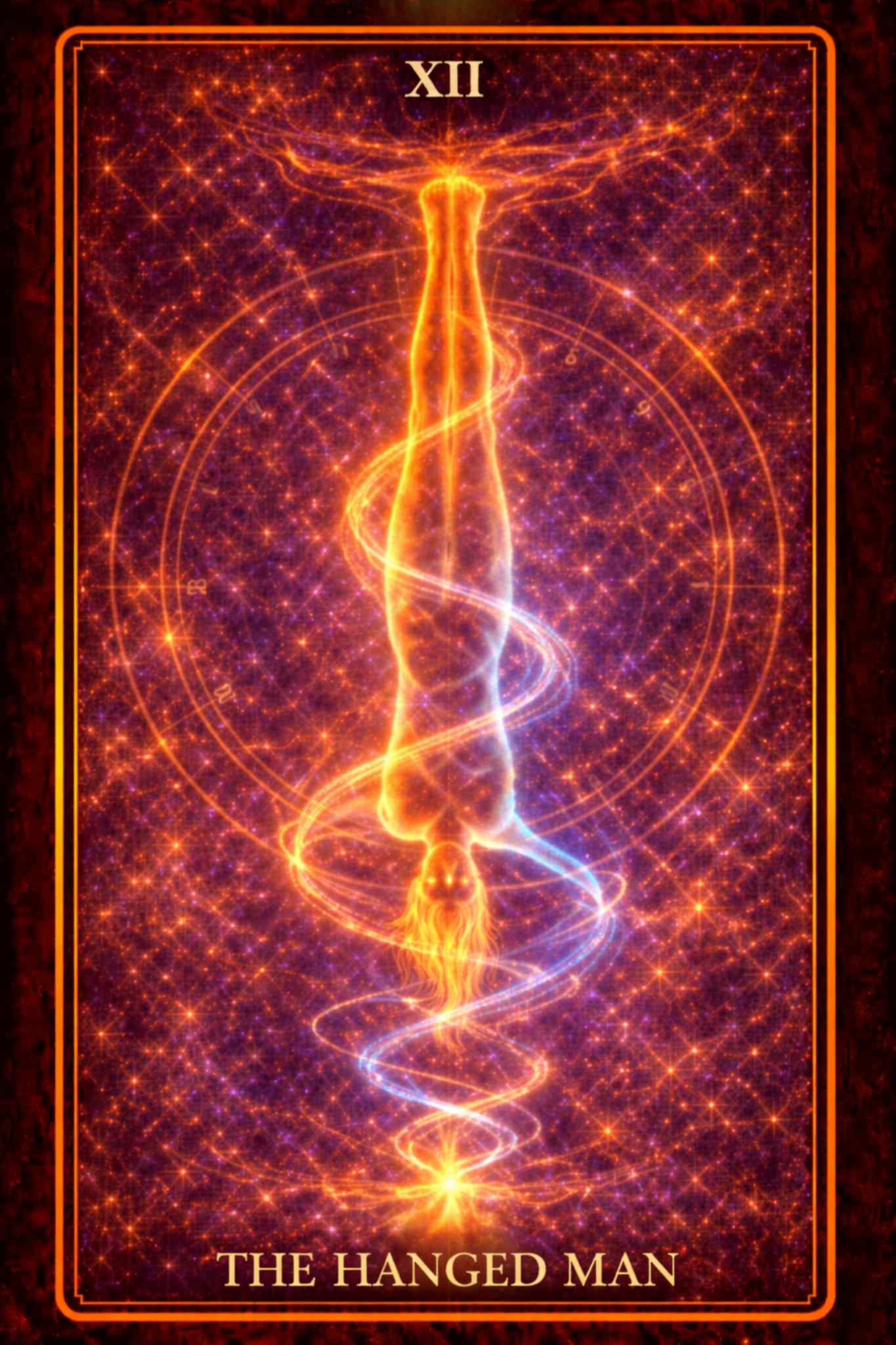
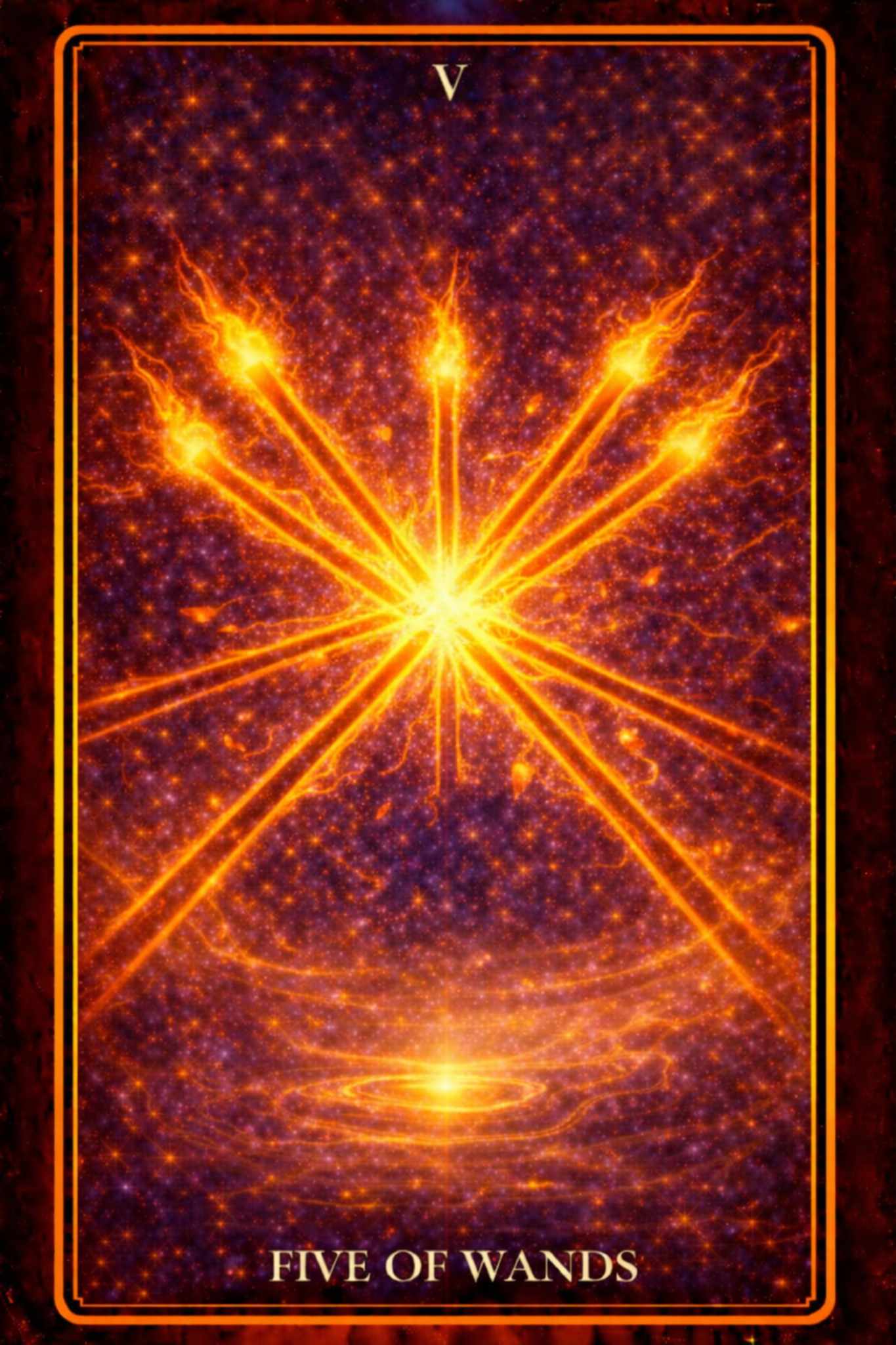
The Hanged Man and Five of Wands meet where struggle is active, noisy, and insistent, yet cannot be resolved through more force of the same kind. The Five of Wands brings friction immediately into view. It is a card of competing energies, clashing agendas, provocation, inner agitation, and the sense that too many impulses are trying to move at once without a shared center. It can describe outer disagreement, and it often points to inner conflict as well, where desire, pride, fear, ambition, and reactive energy all push against one another. The Hanged Man enters that heated field with a very different demand. He suspends the reflex to fight on ordinary terms. He slows reaction. He asks what this struggle looks like from another angle and whether the current way of engaging it is simply keeping the tension alive. Together, these cards often appear when pressure is real, yet the next truth lies beyond winning the contest in its current form.
This is what makes the pair so psychologically sharp. The Five of Wands creates movement through collision. It produces heat through contrast, challenge, resistance, and the instinctive urge to push back. The Hanged Man stands apart from that kind of momentum for its own sake. He asks whether the friction is clarifying anything or simply exhausting everyone involved. He asks whether the person is responding from grounded perspective or from the urge to end discomfort quickly by asserting, defending, or proving. That is often the hidden conflict beneath the visible one. A person may believe they are trying to solve the problem, while in reality they are mainly trying to escape the strain of the struggle itself. The Hanged Man interrupts that loop. What looks like delay may actually be the first intelligent move, because without it the conflict simply repeats in new language.
When tension keeps feeding itself
One of the deepest themes in this combination is the recognition that conflict is not automatically useful just because it is energetic. The Five of Wands often carries a sense of activity without real resolution. Much is happening, yet clarity does not necessarily increase. People may be speaking, reacting, defending, pushing, comparing, or competing, while the deeper issue remains strangely untouched. This is where The Hanged Man becomes essential. He exposes the possibility that the struggle is being approached from the wrong level of consciousness altogether. The problem may not be lack of effort, lack of voice, or lack of engagement. The whole field may be stuck inside a reactive frame that cannot generate the insight needed for genuine movement.
The Hanged Man therefore asks for something that can feel deeply unnatural in the middle of friction: the suspension of automatic participation. He asks whether the person can stop feeding the momentum of the struggle long enough to see what is actually being enacted. Who is trying to win what? What identity is being defended? What fear is disguised as argument, competitiveness, righteousness, or insistence? What part of the tension belongs to the real issue, and what part comes from the nervous system’s refusal to tolerate unresolved energy? These questions change conflict from a battlefield into revelation. The Five of Wands shows the heat. The Hanged Man asks what the heat is exposing beneath its own noise.
Conflict as invitation to perspective shift
This pairing sees struggle clearly. It does not pretend that friction melts away through patience, spirituality, or detachment. The Five of Wands makes it plain that differences are real, competing drives are real, and pressure is real. Yet The Hanged Man changes the purpose of what the struggle is for. Instead of assuming the task is to overpower, outargue, outperform, or outlast the opposing force, he asks whether the conflict exists partly to reveal a perspective that could only emerge through tension. Sometimes what feels like blockage is actually an encounter with the limits of the current way of seeing.
You may also want to go one step deeper.
The Hanged Man + Five of Wands can open up differently inside a focused personal reading.
This becomes especially important when the struggle is internal. A person may feel torn between action and restraint, desire and wisdom, assertion and patience, independence and closeness, ambition and surrender. The Five of Wands can make that inner field feel crowded, emotionally noisy, and difficult to organize. The Hanged Man asks whether the person can tolerate the inner contest without rushing to silence it too quickly. In that pause, something more truthful can emerge. One may begin to see that the competing parts are not all speaking from equal depth, or that the real shift required lies beyond choosing the louder side. Sometimes the real turning point comes from stepping outside the frame in which the competition was structured.
Love and relationship meaning
In relationship readings, The Hanged Man and Five of Wands often point toward tension that is very much alive, while not necessarily meaningful in the form it is currently taking. There may be bickering, defensiveness, repeated misunderstandings, clashing needs, mixed signals, or a dynamic in which both people keep trying to get their experience recognized without making enough room for a different perspective to enter. The Five of Wands brings the relational heat clearly. It can make the bond feel energized, but also strained, reactive, and caught in small contests that never fully resolve. The Hanged Man suggests that the usual way of engaging the tension has reached its limit. Something has to stop, not because the relationship is empty, but because it has become too easy to repeat the same pattern under changing circumstances.
This can be a crucial combination in love because it often asks whether the conflict is really about the stated issue. Two people may appear to be arguing about timing, attention, priorities, commitment, independence, or communication style, while the deeper wound involves recognition, fear of powerlessness, or the inability to remain inside uncertainty without demanding immediate reassurance. The Hanged Man asks for a radical softening of the need to win the moment. He asks whether one can stop trying to achieve instant relief through argument and instead allow the discomfort to expose what has not yet been clearly seen. That is difficult work, yet it can change the entire quality of the relationship if both people are capable of it.
In more difficult expressions, this combination can show a bond trapped in repetitive friction because neither person is ready to release their preferred interpretation. The Five of Wands keeps the emotional field charged. The Hanged Man makes clear that resolution will come through a change in the level from which the conflict is being held. Sometimes that means silence, perspective, and patience. Sometimes it means recognizing that the relationship has been using struggle as a substitute for deeper honesty. Either way, the lesson remains the same: emotional intensity alone is not the same as progress.
Career, work, and competitive pressure
In work readings, The Hanged Man and Five of Wands often describe an environment full of competing priorities, ego clashes, misaligned efforts, performance pressure, or a general sense that many people are pushing without a shared center. The Five of Wands is particularly strong in contexts where friction becomes normalized: teams with conflicting visions, workplaces driven by comparison, creative environments full of overlapping ambition, or any situation where multiple wills are trying to define the direction. The Hanged Man suggests that the person may need to step out of the usual competitive reflex in order to understand what is really happening. This is rarely comfortable, especially in environments that reward visible assertion. Yet the cards imply that more noise will not produce better alignment.
This can also reflect internal career struggle. A person may be full of drive, while divided about how to use it. They may want recognition, freedom, expansion, validation, and peace all at once without having integrated how those desires pull against one another. The Five of Wands can make ambition feel scattered or combative. The Hanged Man intervenes by asking what success looks like once reactive comparison falls away. Are you moving toward meaningful work, or merely trying to avoid feeling behind? Are you fighting for something true, or fighting because friction has become your default way of feeling engaged? These questions are demanding, yet they often reveal where professional struggle is being intensified by identification rather than by the task itself.
At its healthiest, this pair helps someone stop wasting force. The Five of Wands contains real energy. The Hanged Man prevents that energy from being spent in futile competition or argument with conditions that cannot be transformed from the current angle. A stronger move may come later, yet first the person has to see where their own will has become tangled up in the very field they are trying to master.
Psychological and spiritual meaning
Psychologically, The Hanged Man and Five of Wands often describe what happens when the nervous system is crowded with competing impulses. One part wants to act, another wants to defend, another wants to prove, another wants to withdraw, another wants to win, and another simply wants the discomfort to stop. The Five of Wands gives form to that crowding. It can make a person feel restless, sharp, overstimulated, and unable to locate the deeper center from which a clean response could arise. The Hanged Man becomes invaluable here because he asks the person to step outside the compulsion to solve the tension through movement alone.
Spiritually, this pairing can represent a major lesson around non-reactivity. This is a disciplined refusal to let friction dictate consciousness. The Five of Wands shows how easily fire becomes fragmented when it is split across too many identifications. The Hanged Man asks whether the self can surrender the illusion that every tension has to be answered on the level where it first appears. Sometimes the deepest act is to stop feeding the contest long enough for a wider seeing to arise. In that sense, conflict becomes teacher. It reveals where ego still confuses activation with truth and pressure with necessity.
Shadow expression and challenge
The shadow side of this combination appears when a person either romanticizes struggle or misuses suspension. In one version, conflict becomes identity. The person feels most alive when resisting, arguing, competing, or staying activated against something. The Five of Wands then stops being a temporary condition and becomes a style of being. The Hanged Man challenges that by exposing how much energy is being consumed without real transformation. In another version, a person uses The Hanged Man to avoid necessary engagement. They tell themselves they are stepping back for perspective, while actually avoiding the vulnerability of naming the conflict directly or claiming their part in it. The healthier expression refuses both distortions. It asks that the struggle be met from a deeper level.
That means the pause must be alive. It has to lead toward greater clarity, wider vision, and a more truthful relationship to the friction itself. If the waiting produces only more resentment, then the suspension is not yet doing its work. If the conflict only keeps getting louder, then the field may still be interpreted through the same reactive lens. The Five of Wands should eventually reveal where the energy is real and where it is merely scattered. The Hanged Man should eventually reveal what cannot be seen while one is still trying to win the wrong contest.
Timing and the right use of pressure
This pair carries a strong timing lesson. The Five of Wands creates urgency because conflict naturally pushes the psyche toward immediate engagement. One wants to answer, fix, defend, respond, compete, or push through. The Hanged Man says that urgency is not always the same as right timing. Sometimes action taken in the thick of friction only multiplies the pattern. A delay may therefore be necessary, so that reactivity no longer defines the next move. That does not mean everything should be postponed indefinitely. It means the right move will most likely come after a shift in perception, rather than before it.
In some situations, the pressure has to be endured without instant discharge. That can feel like powerlessness to the ego, yet it often marks the beginning of true agency. Once the person sees the structure of the conflict differently, they can decide what deserves engagement and what does not. They may speak more simply, withdraw energy from futile struggle, or realize that the entire contest was built around a false need to prove something. The timing lesson is subtle but essential: some heated moments call for action, while others call for perspective first. Sometimes the wisest use of fire is to refuse to let it burn through the same pattern again.
FAQ — The Hanged Man and Five of Wands
Is this a difficult tarot combination?
It can be challenging because it often reflects friction, inner conflict, competing agendas, or emotionally reactive dynamics. At the same time, it can be very valuable, because it shows where a struggle begins to change once the person stops feeding it in the usual way.
Does this combination mean arguments in a relationship?
It can. This pair often appears with repeated tension, defensiveness, clashing needs, or circular disagreements, especially when both people are reacting from fixed positions and the real issue remains underneath the visible argument.
What does The Hanged Man and Five of Wands mean in career readings?
It often points to workplace friction, competition, ego clashes, scattered ambition, or wasted effort. The deeper lesson is usually about stepping out of noise, comparison, or reactive pressure long enough to regain clarity about what deserves your energy.
Is The Hanged Man passive in this pairing?
He represents conscious suspension, a pause that interrupts reactivity so a more intelligent response can become possible.
What is the core lesson of this tarot combination?
The core lesson is that every struggle does not deserve an answer on the level where it first appears. Sometimes the real breakthrough comes from perspective, restraint, and the willingness to stop repeating the same contest.
What this combination is really asking
The Hanged Man and Five of Wands ask whether you are trying to solve a conflict by becoming even more entangled in its current language. That is the heart of the pair. The struggle may be real. The tension may be legitimate. The competing energies may deserve acknowledgment. Yet the cards ask whether more force, more argument, more assertion, or more inner wrestling will actually create clarity. Often they will not. Often what is needed is the difficult discipline of stepping out of the immediate contest so the structure of that contest can finally be seen.
The deeper lesson is that fire becomes wiser when it stops mistaking activation for truth. The Five of Wands brings raw energy, pressure, competition, irritation, and the undeniable fact of friction. The Hanged Man brings pause, surrender, altered perspective, and the recognition that many meaningful problems are not solved through direct pressure alone. Together, they form a demanding but valuable teaching: struggle may indeed be the doorway, but only when one becomes willing to see through the struggle rather than treating it as the whole path.
Explore the next layer of this reading.
This combination can mean different things depending on context. A short tarot reading can help you reflect on the question behind the cards.
Closing reflection
There are moments when life fills with heat, noise, mixed signals, and competing impulses. This pairing belongs to those moments. It does not deny the strain, and it does not romanticize it either. Instead, it asks whether the friction is being met from the level where it can actually reveal something useful. The Hanged Man suspends the reflex to fight on old terms, while the Five of Wands shows how strong that reflex can be. Somewhere between them, conflict stops being a place to prove yourself and becomes a place where a different kind of intelligence begins to appear.
More combinations with The Hanged Man
More combinations with Five of Wands
Continue with The Hanged Man
Explore Related Guides by Topic
If you want to explore this combination through a more specific emotional lens, these tarot guides can help you follow the broader pattern behind the reading.