
Death + Three of Wands
Explore how these two tarot cards interact in a reading through symbolic overlap, contrast, and shared narrative. Tarot combinations often reveal meaning that neither card fully expresses on its own.
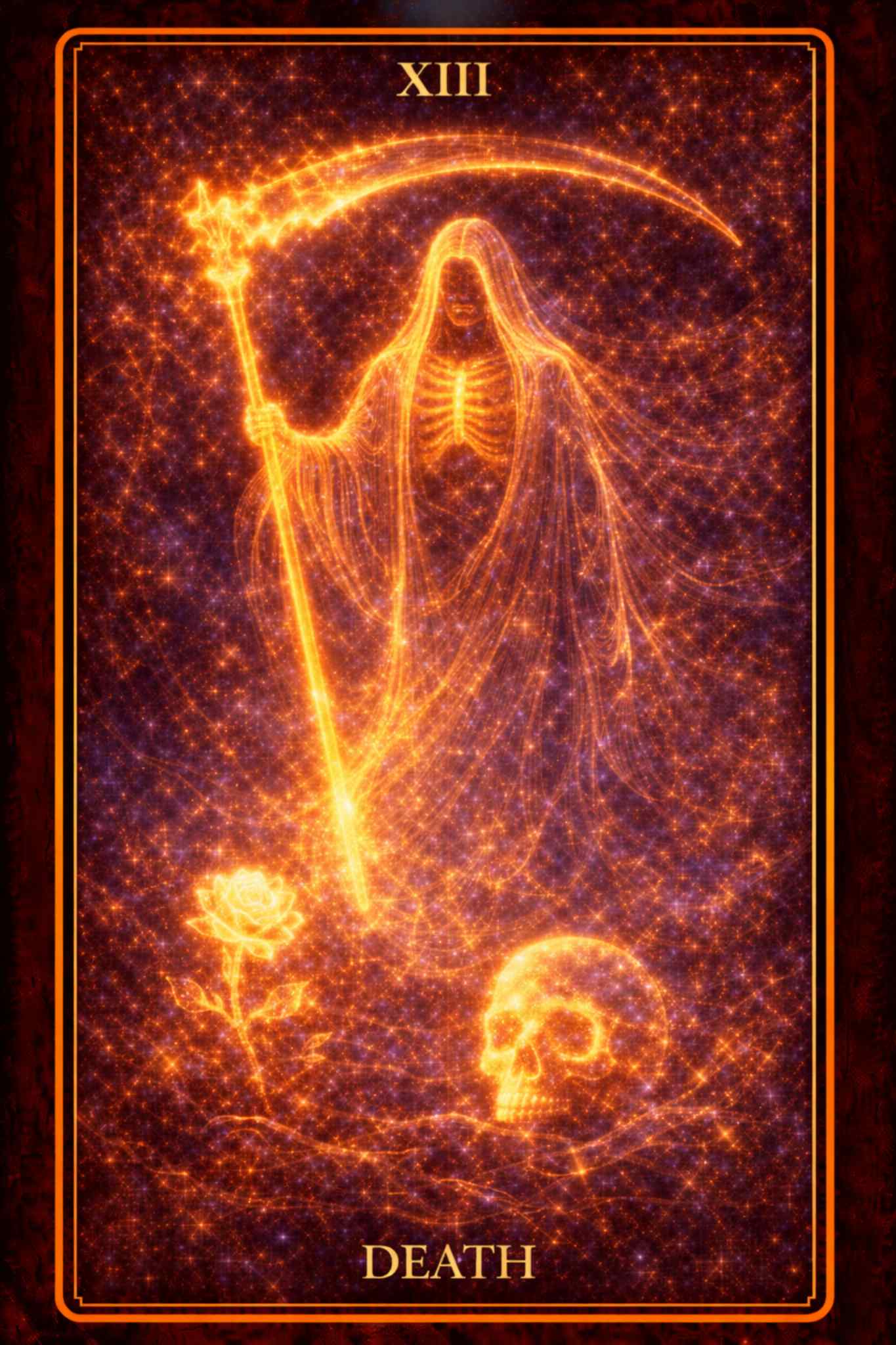
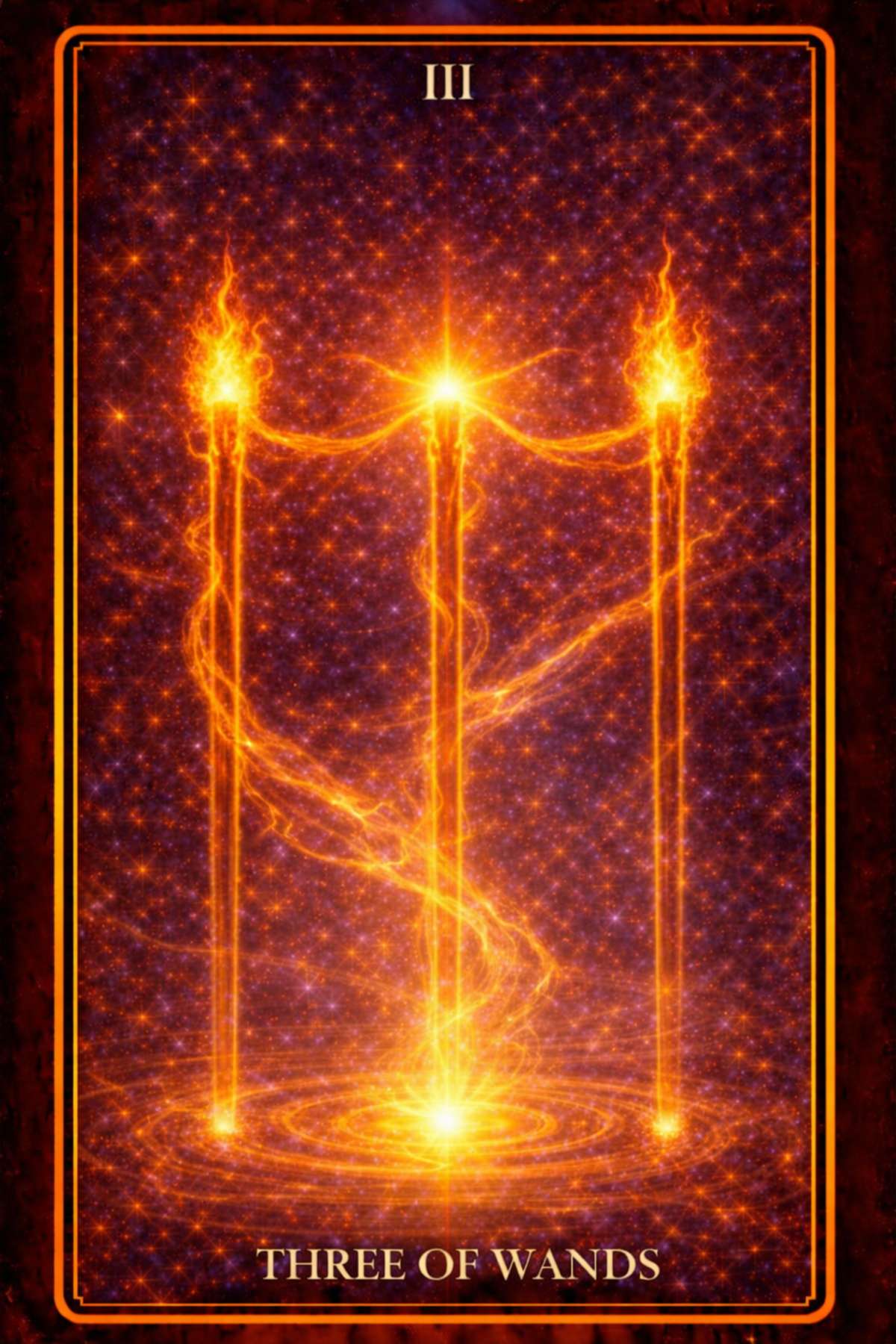
Death and Three of Wands Tarot Combination Meaning
Death and Three of Wands meet in the charged space where something has truly ended and the horizon is beginning to open beyond it. This pairing belongs to a later stage of transformation. The first shock has passed. The private realization has already done some of its work. Death has cut deeply enough that the person is beginning to sense distance, scale, and movement beyond the chapter that has closed. The Three of Wands brings that widened field into view. It is fire that looks outward. It sees beyond immediate reaction and begins to understand that endings do more than remove; they also change the range of what can now be reached. Together, these cards often appear when someone is standing just beyond a necessary transformation and asking what kind of landscape is becoming visible because of it. They speak to the moment when grief, truth, and future possibility begin to occupy the same inner terrain.
That is what makes this pair so distinctive. Death does not deal in minor revision. It marks irreversible change, the passing away of an old structure, identity, attachment, expectation, or life-pattern that has reached completion. The Three of Wands answers that depth with expansion, foresight, and a willingness to look beyond the immediate threshold. Yet the combination is not simple optimism. It asks a serious question: is the person truly stepping into wider ground, or are they projecting familiar desires onto a distant horizon while carrying too much of the old chapter inwardly intact? The future may indeed be opening. Death simply insists that what expands next should grow from altered inner ground. This is why the pairing feels mature. It does not rush to replace what ended. It asks whether the horizon itself is being approached with different eyes, different values, and a deeper capacity to live beyond what has already fallen away.
When an ending creates distance
One of the most striking qualities of the Three of Wands is its sense of perspective. It stands at the edge of what has already begun and looks farther. Beside Death, that perspective often arises because the old enclosure has broken apart. A relationship may have ended, but with it goes a worldview. A career path may have died, but with it falls an identity that once defined what success meant. A long attachment may have dissolved, and suddenly the person can see how much of their future had been arranged around preserving what had already begun to lose its life. Death creates the break. The Three of Wands creates the vantage point from which that break can finally be understood as space, range, and newly available distance rather than loss alone.
This does not make the ending easy. It makes it legible in a wider frame. The person begins to sense that what died may also have been limiting the scale of their life. Something more truthful may now be imaginable precisely because the dead form no longer governs the edge of the map. The Three of Wands can therefore feel both hopeful and exacting here. It invites a person to trust the widening field, but Death asks that this trust be rooted in transformation rather than fantasy. Distance should clarify. Vision should deepen. The future becomes more meaningful when it is no longer arranged around protecting a chapter that has already completed itself. In this sense, the pair often marks the first real experience of breathing room after a deep ending: the moment when the horizon begins to feel real again.
Expansion after transformation
Many people want expansion without metamorphosis. They want a larger life while remaining inwardly organized by the same loyalties, fears, habits, and identities that made the old chapter too small or too lifeless to continue. Death does not support that arrangement for long. It strips away what has completed its function. The Three of Wands then shows that expansion is possible because something definitive has been released. In this sense, the pairing is not about shallow recovery. It is about what becomes reachable after a person has been altered by necessary ending, and about how the future begins to widen once the old frame loses its authority.
Want to explore this combination in a more personal way?
If this pairing feels important right now, a simple tarot spread can help you reflect on it with more context.
This is why the combination can feel spiritually mature. The Three of Wands does not lunge toward immediate replacement. It begins to engage with what lies beyond the threshold. There is patience in that, but also courage. A person may have to trust a future they cannot fully control. They may have to stop measuring every new possibility against the dead standard of what once felt safe, familiar, or desirable. Death makes those comparisons less useful anyway. Once transformation is real, the old reference point no longer fits the same way. The Three of Wands asks whether the person can accept that and still keep moving outward. When they can, expansion becomes more than ambition. It becomes a sign that the soul is beginning to inhabit a larger field than the one it previously defended.
Love and relationship meaning
In relationship readings, Death and Three of Wands often point toward a profound relational shift after which the emotional horizon begins to change. Sometimes this refers to a relationship that has ended and cannot be restored in the same form. Sometimes it reflects an internal ending within the person: an attachment pattern that has run its course, an expired hope, a former idea of love, or an old relational script that no longer carries life. The Three of Wands then enters with widened relational vision. The person begins to sense there is more beyond this chapter, not only in the sense of someone else, but in the sense of a larger emotional life that no longer needs to orbit what has already ended. That shift matters. It changes how longing is interpreted, how openness is felt, and how the future is imagined.
At its healthiest, this can be a powerful combination for post-ending expansion. A person may be reclaiming openness after grief, not by minimizing what was lost, but by realizing that life continues beyond it. They may begin relating differently to love itself. Future possibilities appear less as replacements and more as new territory. This can also happen inside an ongoing bond. An old dynamic between two people may die, making room for a more spacious, honest, less constricted form of connection. The Three of Wands brings relational reach, but it becomes strongest when Death has already done its clearing work. If the horizon is approached too quickly, the old attachment can still shape the terms of what comes next. When the inner ending is honored, however, the future becomes much cleaner, and love regains its sense of width rather than repetition.
Career, work, and wider direction
In practical and career readings, Death and Three of Wands often suggest that a professional chapter is ending or has ended in a way that changes the person’s scale of vision. A role, model, strategy, or ambition may no longer be viable. Death reveals that continuing the old way would only preserve decline, emptiness, or a growing sense of disconnection. The Three of Wands then opens the next question: what larger field is visible now? What new audiences, directions, places, collaborations, or forms of work can be seen from this transformed edge? This is often where the reading becomes especially powerful, because the cards do not merely describe a loss of structure. They show how the ending itself begins to create a wider horizon of possibility.
This pairing can be especially meaningful for people whose lives are changing in scope as well as in content. The death of one path may suddenly make expansion possible elsewhere. A person may realize they were building too narrowly, staying too local, thinking too small, or remaining loyal to an old structure that no longer matched their deeper growth. The Three of Wands shows that after necessary loss, range can return. Yet the cards remain serious about sequence. Expansion is strongest when it emerges from real transformation rather than panic about emptiness or urgency to prove the ending was worthwhile. At its best, this combination supports measured outward movement after a substantial clearing. The person is no longer trying to revive a dead role. They are beginning to work with a wider horizon, and that horizon becomes far more durable when it is shaped by changed values rather than a larger version of the same exhausted logic.
Psychological and spiritual meaning
Psychologically, Death and Three of Wands often describe the mind’s relationship to future consciousness after major internal change. Death strips away the assumption of continuity. Something in the self has ended or is ending, and with it goes a familiar map. The Three of Wands appears when the psyche begins to tolerate perspective again. The person can imagine farther ahead. They can sense a world beyond the immediate ending. This is meaningful because it signals that the transformation is no longer only disintegrative. It is beginning to create a new relationship with possibility. The inner life becomes spacious enough to hold both memory and horizon at once.
Spiritually, the pair concerns the widening that follows surrender. Death asks for release of what no longer has life, even when the person would prefer to keep a known form intact. The Three of Wands reveals that surrender often creates more horizon, not less. Yet spiritual maturity here means avoiding the temptation to confuse widened possibility with permission to skip the depth of the transformation. The person still needs to remain answerable to what ended, what changed, and what is still rearranging within them. When that responsibility is honored, the wider horizon becomes real spiritual territory rather than a decorative fantasy. In that sense, the pair can mark a meaningful threshold: the moment when life begins to expand again because something false, finished, or depleted has finally been released.
Shadow expression and challenge
The shadow side of this combination appears when the Three of Wands becomes a beautifully articulated form of avoidance. A person may speak fluently about the future, the wider picture, new possibilities, travel, movement, expansion, or what lies ahead, all while resisting the deeper surrender that the ending still requires. Because the outward gaze seems constructive, the avoidance can be subtle. Yet Death reveals that something still needs burial, grief, or inner separation. The horizon may be real, but if it is used to outrun the ending, the same dead pattern often reappears farther down the road in altered clothing. The future then becomes another stage on which unfinished material continues to act.
There is also an opposite difficulty in which Death dominates so strongly that the person cannot trust expansion at all. They may remain emotionally fixed on what was lost, suspicious of every wider possibility, as though openness would diminish the seriousness of the ending. The Three of Wands corrects this by showing that movement beyond loss is part of life. The healthiest expression of the pair is neither premature outwardness nor permanent collapse. It is horizon-consciousness that grows from honest release. In that form, vision becomes grounded, movement becomes meaningful, and the future begins to carry depth instead of escape.
Timing and the right moment to look ahead
Timing matters deeply with this pair. Death asks when something has truly ended and should no longer be negotiated with in subtle ways. The Three of Wands asks when the time has come to lift the gaze and begin relating to a wider future. Sometimes those moments are close together. The ending becomes clear, and almost immediately the field beyond it begins to open. At other times, the person’s vision runs ahead of their actual transformation. They may already want the wider life while still inwardly bound to what is over. That is why these cards ask for honest pacing rather than simple enthusiasm.
Looking ahead is not the problem. In many cases, it is part of healing. But the horizon is best entered from altered ground. If the old attachment still defines the terms, then distance may only create a more elaborate repetition. When the timing is right, however, the Three of Wands can be one of the clearest signs that a person is beginning to move beyond the ending in a way that is spacious, real, and quietly powerful. The future stops feeling like compensation and starts feeling like range. That is a major difference, and this combination is deeply concerned with that difference.
FAQ — Death and Three of Wands
Is this combination about moving on after an ending? Often, yes, but in a deeper sense than simple recovery. It shows a widening horizon after transformation and asks whether that horizon is being entered from real release rather than from reaction alone.
Can this be positive? Yes. It can be strongly positive because it suggests that after a necessary ending, a larger field of life is becoming visible. Its strength comes from linking expansion with truth, depth, and altered perspective.
Does the Three of Wands mean the future is already clear? Sometimes the horizon is more visible than the details. What matters most is that the person can begin relating to a wider direction, even while the full shape is still unfolding.
Can this combination warn against premature optimism? Absolutely. It can show a person looking ahead too quickly, using distance, possibility, or future-thinking to avoid the surrender that Death still requires.
What is the core lesson here? Authentic expansion comes after transformation, not instead of it. The future becomes more meaningful when the past has truly been allowed to complete itself.
What this combination is really asking
Death and Three of Wands ask whether you can let the horizon widen without dragging the dead world into it. That is the heart of the pair. The ending may already be real. The future may also be genuinely opening. But the cards want to know whether the new distance is being seen with transformed eyes. They ask whether you are allowing loss to alter your scale, your standards, your desires, and your imagination, or whether you are only seeking a bigger stage for the same familiar pattern. This is why the pairing feels so exacting. It does not oppose hope; it refines it.
The deeper lesson is that endings can create range. Death strips away what is exhausted, false, or complete. The Three of Wands opens the larger field that becomes visible afterward. Together, they form a powerful image of post-transformation expansion: a life no longer confined by a dead form, a future no longer measured by a finished chapter, and a fire that can travel farther because it is no longer bound to what had already stopped living. When these cards are lived well, the future becomes something more than an escape route. It becomes evidence that transformation has changed the terms of what is now possible.
Explore the next layer of this reading.
This combination can mean different things depending on context. A short tarot reading can help you reflect on the question behind the cards.
Closing reflection
Some endings reduce the world for a time. Others reveal how much of the world had been hidden by what needed to end. This pairing belongs to that second kind of threshold. It honors grief, yet it also keeps opening the gaze beyond it. The person begins to understand that loss and distance can belong to the same process, and that what falls away may also be what allows the horizon to widen.
Death closes what can no longer carry life. The Three of Wands turns the gaze outward toward the wider horizon that follows. Between them is a serious kind of hope: one that does not skip the ending, does not sentimentalize it, and does not rebuild on unchanged inner ground. It recognizes that when something dead is finally released, life often becomes larger than it first appeared.
More combinations with Death
More combinations with Three of Wands
Continue with Death
Explore Related Guides by Topic
If you want to explore this combination through a more specific emotional lens, these tarot guides can help you follow the broader pattern behind the reading.