
Yes or No Tarot Spread
Card count: 3
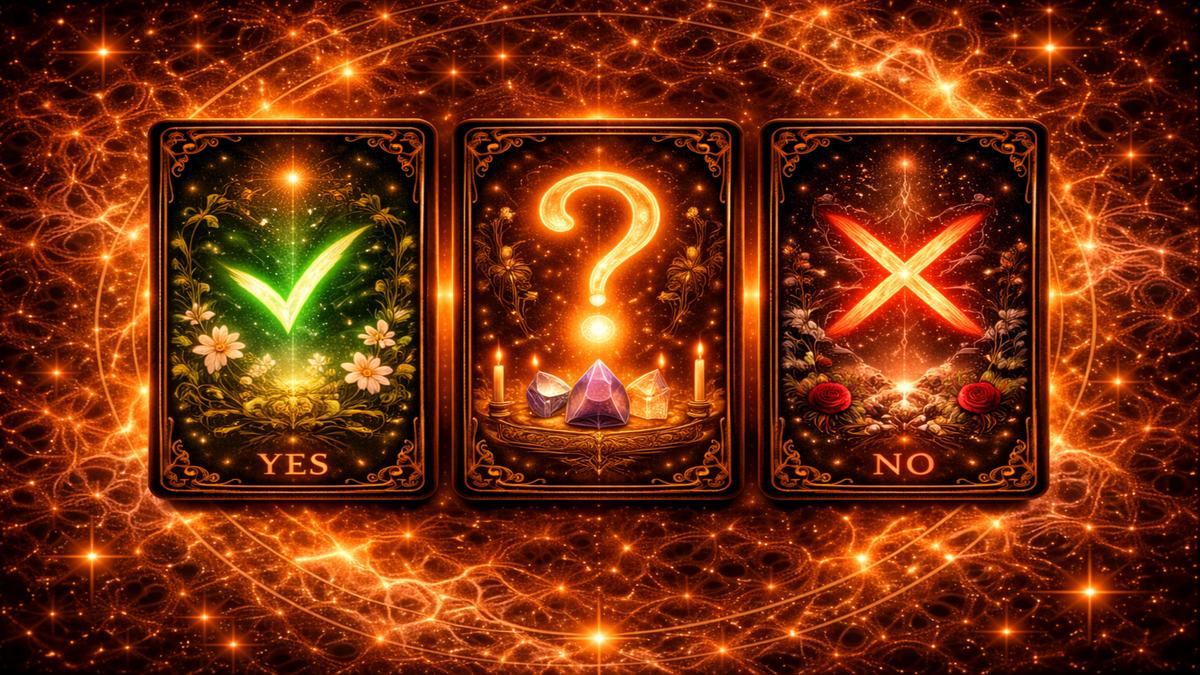
Introduction
The Yes or No Tarot Spread is one of the most searched tarot formats because it speaks directly to a very human need: clarity. People often come to tarot when they feel uncertain, emotionally divided, or stuck between options. In those moments, a spread that offers focused guidance can feel especially valuable. Among practical tarot spreads, the yes or no layout is designed to bring the core issue into sharper focus.
At first glance, yes or no tarot seems simple. A person asks a direct question and expects a direct answer. Yet meaningful tarot reading is rarely that mechanical. In Arvethis style, tarot is not treated as a rigid fortune machine. Instead, it is a symbolic system that reveals momentum, resistance, emotional truth, and likely direction. That means a yes or no spread works best when it does more than say yes or no. It should also show why.
This is why many readers prefer a structured three-card yes or no spread instead of relying on a single card alone. One card may capture the dominant energy, but three cards provide context. They can show support, tension, hidden factors, or advice. In this sense, the Yes or No Tarot Spread sits between the fast clarity of the One Card Tarot Spread and the layered analysis of the Three Card Tarot Spread.
This type of reading is especially useful for questions about decisions, communication, relationships, opportunities, and timing. It can help you see whether energy is opening, blocked, uncertain, or simply asking for patience. In many cases, the answer may not be a clean yes or a clean no. Instead, the cards may suggest not yet, only with caution, or yes if you change your approach. That nuance is what makes tarot more valuable than a coin flip.
Because yes or no readings are so popular online, they are also an important part of a strong tarot content structure. They connect naturally with focused guidance tools such as the Yes or No Tarot tool, and they can link meaningfully into card-specific interpretation pages across the Major Arcana and Minor Arcana.
Ultimately, the Yes or No Tarot Spread is not only about seeking permission from the cards. It is about understanding the energy behind a decision. When used well, it does not remove free will. It helps you meet uncertainty with greater awareness, honesty, and intuitive confidence.
Ready to put this spread into practice?
Yes or No Tarot Spread can be easier to explore when you use a guided reading instead of trying to interpret everything at once.
How to Use This Spread
Using the Yes or No Tarot Spread begins with one essential principle: the question must be clear. Tarot responds best when the focus is direct, specific, and emotionally honest.
1. Ask a focused yes or no question
Examples include:
- Is this relationship moving in a healthy direction?
- Should I pursue this opportunity now?
- Will this conversation help resolve the tension?
- Is this the right time to move forward?
Questions that are too vague tend to produce vague readings. If the issue is more emotional and layered than binary, a Three Card Tarot Spread or Celtic Cross may be more useful.
2. Use three cards for balance
A common yes or no method uses three cards rather than one. This makes the reading more reliable and more insightful. The positions can be read as:
- Card 1: energy supporting the question
- Card 2: challenge, condition, or resistance
- Card 3: likely direction or guidance
This structure keeps the spread focused while still giving space for explanation.
3. Shuffle with the question in mind
Hold the exact question in your mind while shuffling. The wording matters. Questions such as Should I? and Will this happen? can produce slightly different readings because one centers personal choice and the other centers unfolding events.
4. Read the overall tendency
After drawing the cards, do not count only positive and negative meanings. Instead, read the dominant current. If two cards strongly support action and the third asks for care, the answer may be yes, but proceed wisely. If the spread shows conflict, delay, fear, or confusion, the answer may be not now rather than a final no.
5. Watch for nuance
Tarot answers often come in shades:
- Yes - clear supportive momentum
- No - strong blockage or misalignment
- Maybe - unstable energy or mixed influences
- Not yet - timing is wrong, even if the path may open later
This nuance is especially important in love questions, where emotional readiness matters as much as outcome. If your question is relationship-focused, the Love Tarot Spread may provide deeper context.
6. Reflect before acting
Use the spread as guidance, not a substitute for responsibility. Tarot can reveal energy patterns and hidden dynamics, but your decisions still shape the future. The reading becomes most powerful when it helps you see truth more clearly, rather than handing you a fixed command.
How to Interpret It
Interpreting a Yes or No Tarot Spread requires discernment. The goal is not to flatten tarot into a simplistic system, but to understand whether energy is opening, resisting, or asking for greater awareness.
Read the energy, not only the label
Some cards naturally feel more affirmative, such as The Sun, Ace of Cups, or Six of Wands. Others often suggest caution, delay, or tension, such as Seven of Swords, Five of Pentacles, or The Moon. But context still matters. The Hermit in a yes or no spread may not mean no. It may mean step back, reflect, and move later with more wisdom.
Example reading
If the spread shows Two of Cups, Nine of Swords, and The Star, the answer may be yes, but emotional fear is distorting the process. If the cards are Four of Pentacles, The Hanged Man, and Eight of Swords, the reading may suggest no for now, because fear, stuck energy, or resistance are stronger than forward movement.
Why three cards work better
With one card, nuance can be lost. With three cards, you can see support, tension, and direction in the same reading. That makes the final answer more intelligent. It also helps build stronger internal links between spread pages and card meaning pages, because each reading naturally opens into deeper interpretation of individual tarot symbols.
Upright and reversed impact
If you read reversals, they can be especially useful in yes or no readings. A reversed card may point toward delay, internal conflict, or an answer that changes depending on personal growth. In many cases, reversals soften certainty and highlight conditions.
When this spread is best
The Yes or No Tarot Spread is ideal when the question is direct and the decision feels emotionally important. It is useful for fast guidance, but it also teaches an important tarot truth: binary questions often reveal non-binary answers. A symbolic system as rich as tarot does not exist merely to confirm or deny. It exists to illuminate.
That is why this spread works so well as both a practical tool and a gateway into deeper reading. It can stand alone, or it can lead into a broader layout such as the three-card spread or a dedicated relationship reading through the Love Tarot Spread.
In the end, the strongest yes or no reading is not the one that gives the quickest answer. It is the one that reveals the clearest truth about the energy behind the question.
Tarot is used here as a symbolic and reflective tool. Interpretations are offered for personal insight and do not replace professional advice.