
Three of Swords Intentions Meaning
Card: Three of Swords
Meaning type: Intentions Meaning
Introduction
Three of Swords in intentions readings carries the energy of heartbreak, painful truth, separation, grief, sharp realization, and the honesty that cuts through denial. In Arvethis interpretation, Swords cards are never reduced to simple negativity, coldness, or conflict. They belong to the element of air, which means they describe thought, language, truth, analysis, boundaries, conflict, perception, and the mental narratives that shape a situation before choices become visible on the surface.
When Three of Swords appears, it usually draws attention to the inner mental climate of the question. In this context, that often means motive, strategy, truthfulness, follow-through, honesty, hidden agenda, and whether a person plans to act with integrity or only with self-protective logic. The card may show a healthy breakthrough, a difficult truth, a guarded stance, a hidden strategy, a pressure point in communication, or a need to separate clean perception from anxiety, defensiveness, or projection. That is why Swords readings can feel both exact and intense: they ask you to tell the truth about what is actually being thought, avoided, or spoken.
At Arvethis, tarot is read symbolically and responsibly. The card may illuminate motive, timing, conflict pattern, and mental atmosphere, but it is not treated as legal, financial, medical, psychological, or employment advice. Symbolic clarity can support wiser decisions, yet real-life choices still require grounded communication, practical judgment, and respect for actual evidence.
The deeper lesson of Three of Swords is pain asks to be witnessed clearly, but it becomes wisdom only when truth is allowed to move toward healing. Whether the card appears upright or reversed, it invites you to examine the quality of the mental current. Is it clear, ethical, mature, and reality-based? Is it defensive, fragmented, harsh, avoidant, panicked, or more complicated than it first appears? That is what makes the card useful beyond surface-level keyword reading.
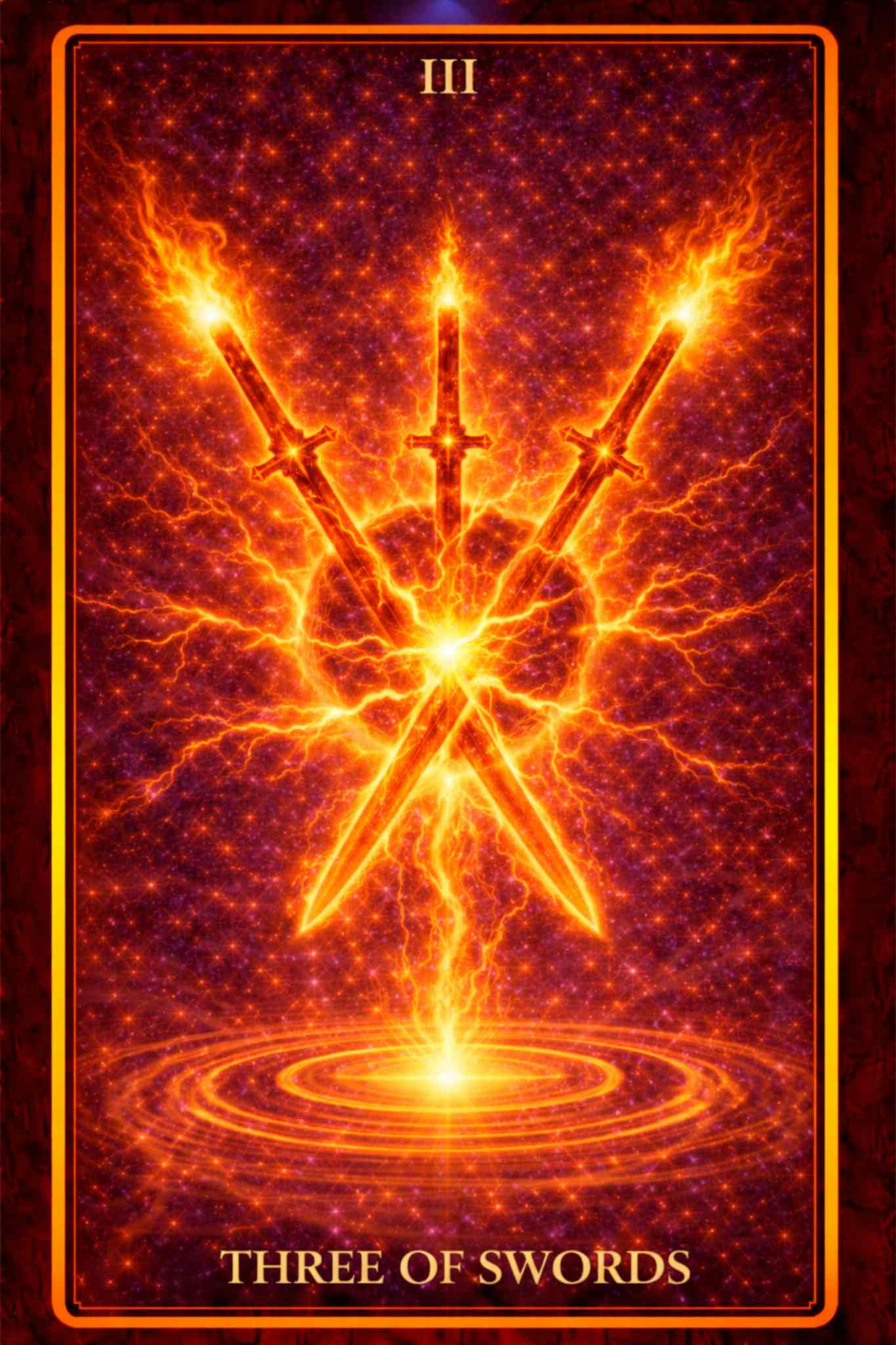
Three of Swords Upright in Intentions
Upright, Three of Swords shows the healthier expression of the archetype. The central themes here are heartbreak, painful truth, grief, separation, exposed sorrow, and clear recognition of what hurts. In Arvethis work, upright Swords energy is not read as sterile rationality. It is read as discernment that has enough coherence to become useful. The truth is not necessarily comfortable, but it is more likely to be honest, readable, and capable of supporting wise action.
With this card, the upright form often reveals heartbreak, painful truth, separation, grief, sharp realization, and the honesty that cuts through denial. In practical life, that may show up as cleaner communication, sharper judgment, stronger boundaries, more honest self-observation, or a willingness to face what is difficult without immediately collapsing into drama or denial. The mind is moving in a way that can clarify rather than merely intensify.
Still, upright does not mean automatic perfection. Even a strong Swords card can be mishandled if people confuse bluntness with maturity or assume that seeing the truth is the same as using it wisely. Arvethis always asks the next grounded question: is the clarity being supported by timing, behavior, and ethics? When the answer is yes, upright Swords energy can become one of the clearest signs of real alignment in a reading.
Because the upright current is usually more coherent, the situation often becomes easier to interpret. You can sense where the truth is crystallizing, where the decision point is forming, and where the lesson of discernment is becoming visible. That precision is one reason Swords cards can feel so powerful when read well: they help name what has already been structuring the story beneath the noise.
Three of Swords Reversed in Intentions
Reversed, Three of Swords shows that the mental current is not moving in a fully clean or simple way. The reversed themes here are healing after pain, private grief, delayed release, partial recovery, or wounds that still shape perception from underneath. In Arvethis interpretation, this does not mean the truth disappears. It means the truth is blocked, distorted, delayed, weaponized, fragmented, hidden, or difficult to trust at face value.
The shadow of this card often involves reopening pain through fixation, dramatizing hurt, or clinging to injury because it feels safer than change. That is why reversed Swords can be so nuanced. There may still be intelligence, awareness, motive, or insight present — but the mental energy does not yet have a healthy enough container to express itself clearly. Something about the way the truth is being held is complicating the picture.
Reversed air often reveals the difference between thought and wisdom. A person may see accurately but communicate badly. A situation may contain truth but also too much fear. A boundary may be necessary and yet be expressed harshly. A strategy may be clever and still fail ethically. The reversal helps show where the clear perception exists, and where its expression is still under strain.
In Arvethis work, reversals are diagnostic rather than punitive. Reversed Three of Swords says: slow down, name what is mentally unclear, and let reality test the story. That approach protects the reading from false certainty while still honoring the symbolic depth of the card.
What intentions pages are best for
Intentions readings are strongest when they focus on direction and follow-through. Ask what the card suggests about motive, readiness, avoidance, sincerity, and whether desire is likely to become consistent action.
What This Suggests About Intentions
Swords belongs to the suit of Swords, the air suit of tarot. Air symbolism governs thought, language, analysis, judgment, truth, perspective, conflict, boundaries, strategy, and the narratives that determine how a situation is understood. Because of that, Swords cards often speak to the mental architecture of a situation more than its visible surface. In Arvethis readings, this makes them especially valuable. They help reveal not only what is happening, but what is being thought, what is being defended, what story is being repeated, and what truth is trying to break through from underneath.
The core symbolism of Three of Swords is heartbreak, painful truth, separation, grief, sharp realization, and the honesty that cuts through denial. Upright, this tends to appear as heartbreak, painful truth, grief, separation, exposed sorrow, and clear recognition of what hurts. Reversed, it tends to appear as healing after pain, private grief, delayed release, partial recovery, or wounds that still shape perception from underneath. The difference between those expressions matters enormously. Strong tarot content does not simply label a card good or bad. It helps you understand how the card’s energy is functioning in the exact situation you are asking about.
Air as Symbolic Language
Air in tarot is often misunderstood as intellect alone. In reality, air can be precise, inspiring, detached, strategic, anxious, ethical, cruel, liberating, polarizing, or revelatory. It can separate, define, compare, judge, refine, expose, organize, and destabilize. That is why Swords cards can feel so exact. They describe how perception and language influence timing, expectations, conflict, relationships, and decisions long before anyone admits the full truth out loud.
With Three of Swords, the mental current has a very specific tone: heartbreak, painful truth, separation, grief, sharp realization, and the honesty that cuts through denial. That tone is part of the reading. It tells you whether the mind is clarifying, guarding, spiraling, strategizing, recovering, cutting through illusion, or trying to protect itself from what it already knows. Swords cards are especially useful when facts exist, yet interpretation and communication remain the real problem.
The Healthy Expression of the Card
When the healthier side of Three of Swords is active, the mental field tends to become more coherent. Thought does not vanish into panic or performance. Instead, it becomes more readable. With this card, that usually means heartbreak, painful truth, grief, separation, exposed sorrow, and clear recognition of what hurts. In practical life, this may show up as more honest communication, cleaner boundaries, improved judgment, better timing, or a stronger willingness to face complexity without pretending it is simple.
This is one of the reasons the Swords suit matters so much for authority-level tarot interpretation. Mental truth is not secondary. It is often the actual engine of the story. A person may feel deeply and still act according to fear. A career may look stable while the mental environment is corrosive. A yes-or-no question may not be answerable cleanly until distortion, timing, or conflict are understood. A spiritual path may look gentle on the outside while demanding ruthless honesty within. Swords cards help expose that layer.
The Shadow Expression and Why It Confuses People
The shadow of Three of Swords often misleads because intelligence itself feels convincing. A sharp argument can sound like truth. A defensive story can sound like wisdom. An anxious forecast can sound like intuition. Strategy can sound like maturity. Detachment can be confused with strength. The shadow of this card — reopening pain through fixation, dramatizing hurt, or clinging to injury because it feels safer than change — matters because it shows how mental energy can become persuasive before it becomes trustworthy.
In intentions readings, that confusion can create some of the most misleading interpretations if you are not careful. The card may contain real clarity and still require caution. It may hold a true observation and still not be ready to support a clean outcome. This is why Arvethis does not romanticize cleverness, pain, or certainty. The question is always: can this truth live well in reality?
Context, Pattern, and Evidence
At Arvethis, context is everything. The same Swords card can speak very differently in love, career, yes-or-no, feelings, intentions, and spirituality. The core symbolism stays the same, but the life area changes the way that symbolism enters practical life. This is why generic tarot text often fails. It treats the card like a single sentence. Real interpretation asks how the pattern shows up in this exact kind of question.
Evidence matters too. If the card suggests honesty, is honesty being shown consistently? If it suggests conflict, what is the actual behavior pattern? If it suggests strategy, is the strategy ethical? If it suggests fear, what facts support or challenge that fear? Symbolic tarot becomes much more accurate when it is compared with lived pattern. That is part of what makes the Arvethis voice more grounded and more trustworthy.
The Card as a Developmental Lesson
Three of Swords also carries a developmental lesson. Tarot becomes stronger when you ask not only what the card predicts, but what it asks of the seeker. With this card, the soul lesson often involves pain asks to be witnessed clearly, but it becomes wisdom only when truth is allowed to move toward healing. That may express itself through cleaner language, wiser boundaries, emotional honesty filtered through discernment, ethical strategy, deeper responsibility for one’s own thoughts, or a new understanding of what mature clarity actually requires.
Want a clearer read on intentions and follow-through?
A broader spread can help separate attraction, motive, avoidance, and real movement.
This is why Swords cards can feel intimate in a different way from Cups. They often touch the layer of experience that people justify most carefully. They bring attention to what the mind wants to prove, what it fears, what it is tired of carrying, and what it may still be using as a defense against vulnerability or change. That intimacy is also why Swords readings should be handled carefully. Mental truth is powerful. It deserves precision.
A Practical Arvethis Reading of This Card
A practical reading of Three of Swords always begins with the mental current. What is actually being thought here? Is the perception clear, guarded, exaggerated, strategic, exhausted, disciplined, fearful, or not yet fully admitted? What happens when the symbolism is compared to actions and timing? Where is the air clean, and where is it clouded? Those questions help prevent the reading from collapsing into vague certainty.
In intentions readings, the key is whether someone’s mental stance is aligned with truthful action, consistent follow-through, and ethical communication rather than strategy alone. That sentence is often more useful than a flat yes, a flat no, or a dramatic summary. It keeps the reading alive to nuance while still moving it toward practical clarity.
Why This Matters for Responsible Tarot
Tarot can become irresponsible when symbolic language is used to bypass reality. Arvethis takes the opposite route. The reading should honor the mystery of symbolism while still respecting facts, communication, consent, boundaries, and practical responsibility. That is why disclaimers matter. Swords cards especially need that grounding, because strong mental narratives can make symbolic language feel more absolute than it truly is.
Tarot readings are symbolic reflections for awareness, perspective, and interpretation. They are not legal, financial, medical, psychological, employment, or relationship counseling. At Arvethis, the card is used to illuminate patterns, communication dynamics, mental climate, and inner truth, while real-world decisions remain anchored in evidence and personal responsibility. That balance is part of what makes the reading spiritually meaningful without becoming careless.
Symbolic Disclaimer
Read Three of Swords as guidance for awareness, not as a binding promise. Its meaning deepens when you let it sharpen discernment instead of replacing it. The card can name the mental weather with remarkable accuracy, but it still asks you to live inside the wisdom of timing, truth, ethics, and grounded decision-making. That is the Arvethis standard — symbolic depth with real-life clarity.
Guidance Around Intentions
If this card appears as your advice card, begin by asking how the mental current wants to be handled more consciously. Swords advice is rarely about suppressing thought. It is more often about telling the truth about thought while refusing to let fear, defensiveness, or cleverness become the only authority in the room.
Helpful: work with the healthier side of the card — heartbreak, painful truth, grief, separation, exposed sorrow, and clear recognition of what hurts. Let the truth become cleaner, steadier, and more ethical. Respect reason, but test it. Respect boundaries, but support them with real maturity, context, and communication.
Less helpful: ignore the shadow — healing after pain, private grief, delayed release, partial recovery, or wounds that still shape perception from underneath. If the pattern includes projection, mental aggression, hidden agenda, fixation, avoidance, or instability, the card is asking for greater precision, not for pressure or superiority to take over.
A strong Arvethis reading always returns to one practical question: what is the next truthful step? With Three of Swords, that step is usually the one that honors clarity without surrendering compassion, and honors discernment without abandoning reality.
Continue the guidance
Subscribe to the Arvethis newsletter for daily tarot guidance, intuitive reflections, and gentle spiritual reminders delivered with calm clarity.
Sometimes a single card offers a starting point, but personal guidance can help you explore your situation in more depth.
This link may be an affiliate link. We may earn a small commission at no extra cost to you.
More ways to read Three of Swords
In major arcana pairings like Three of Swords, Three of Swords and The Fool often speaks through larger patterns of transformation, purpose, tension, and growth.
Explore More Three of Swords Meanings
If you want to explore this card from other angles, continue with Three of Swords — Love Meaning, Three of Swords — Career Meaning, Three of Swords — Yes / No Meaning, Three of Swords — Feelings Meaning, and Three of Swords — Spiritual Meaning. These pages help place Three of Swords into different emotional and interpretive contexts while keeping the symbolism grounded in the kind of question you are actually asking.