
The Chariot + Five of Wands
Explore how these two tarot cards interact in a reading through symbolic overlap, contrast, and shared narrative. Tarot combinations often reveal meaning that neither card fully expresses on its own.
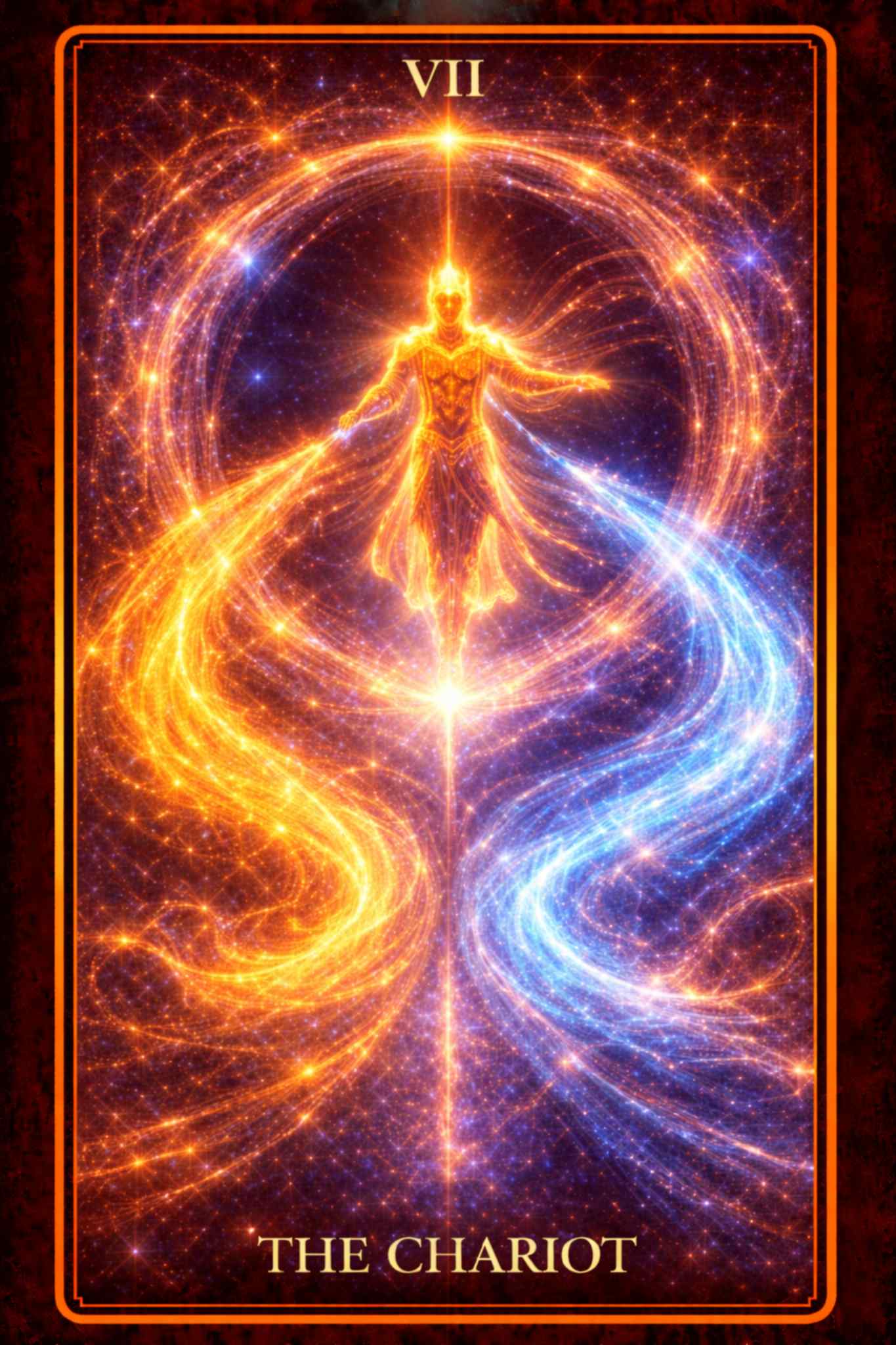

The Chariot and Five of Wands Tarot Combination Meaning
The Chariot and Five of Wands tarot combination speaks of contested momentum. This is one of the most revealing Chariot pairings because it shows what happens when movement meets friction, and when the desire to advance must pass through noise, rivalry, clashing motives, or internal contradiction. The Chariot is a card of control, willpower, self-discipline, and conscious direction. It advances not because the road is smooth, but because the person involved learns how to keep opposing forces aligned under pressure. The Five of Wands brings a very different kind of fire. It is scattered, provocative, competitive, and unsettled. It shows tension, competing agendas, creative conflict, ego friction, rough testing, and the kind of agitation that makes it difficult to determine what energy should actually be followed. Together, these cards often appear when progress is possible, but only if chaos is brought into form rather than allowed to dictate the pace.
There is nothing passive about this combination. It usually arrives in periods where a person is already trying to move forward, but finds that the path is crowded with interference. Sometimes that interference is external: competition, mixed signals, workplace politics, group disagreement, or too many moving parts fighting for dominance. Sometimes it is internal: wanting several incompatible things at once, confusing intensity with clarity, reacting defensively to challenge, or pouring energy into a battle that does not truly deserve the full force of one's will. The Chariot does not collapse in the face of conflict, but it does insist that conflict be handled intelligently. The Five of Wands sharpens that demand by showing how easy it is to lose direction when every force is trying to speak at once and every provocation seems to demand a response.
Psychologically, this is a pair about the difference between struggle that strengthens and struggle that fragments. Not all friction is destructive. The Five of Wands can represent the rough edge of development, the dynamic tension that clarifies leadership, stamina, creativity, and self-knowledge. Yet without The Chariot's centering force, that same tension becomes wasteful. The Chariot therefore enters this pairing as the demand for governance. It asks whether the person involved can stop feeding every provocation, stop identifying every challenge as a threat to identity, and learn how to channel heat rather than be ruled by it. This is why the combination can feel exhausting on the surface but deeply instructive underneath. It often appears when life is no longer asking whether you have energy, but whether you know how to direct that energy cleanly under pressure.
Core symbolic dynamic
At the symbolic level, The Chariot and Five of Wands bring together two different kinds of pressure. The Chariot is concentrated pressure: disciplined, contained, aimed. The Five of Wands is dispersed pressure: multiple directions, collisions of force, restless movement without a stable center. One wants to drive forward in a single line. The other reveals how difficult that becomes when the field is noisy, competitive, emotionally reactive, or internally split. Together, they often indicate a phase where success depends less on raw strength and more on the ability to sort signal from noise. That is what gives this combination its edge. It is not merely about conflict. It is about the quality of leadership required when conflict becomes part of the environment.
This pairing often revolves around questions like:
- which struggle is actually worth sustained effort
- where energy is leaking through unnecessary friction
- whether conflict is sharpening clarity or eroding it
- how to remain directed when multiple forces compete for attention
This makes the combination especially relevant whenever the environment feels heated. In healthy form, the Five of Wands can sharpen you. It can expose blind spots, test resolve, and bring out capacities that passivity never would. But The Chariot insists that testing must become coherent. If every clash is treated as equally important, progress stalls. If every opposing force is given the same weight, attention fragments. So the pair often asks a very grounded question: where is your energy leaking through unnecessary struggle? And just as importantly, which struggle is actually worth the discipline required to move through it? The answer is rarely “all of them.”
The fire element here is active but unstable. The Five of Wands does not bring the warm stability of shared fire or the clean propulsion of a spark. It brings sparks flying in several directions at once. With The Chariot beside it, the task becomes clear: fire must be harnessed, competition must be clarified, and inner contradiction must be named. Otherwise movement becomes jerky, defensive, and overcontrolled. What looks like ambition may in fact be agitation. What looks like drive may be a refusal to disengage from conflict. The cards ask for stronger discernment than that, because without discernment, force becomes waste.
Love and relationship interpretation
In love, The Chariot and Five of Wands often describe a connection with heat, tension, and a genuine question about direction. This is not necessarily a loveless pairing. In fact, it can show attraction that is vivid, dynamic, and difficult to ignore. But it is rarely simple. There may be clashing egos, conflicting expectations, competitive energy, poor timing, or unresolved emotional reactions that keep the connection from moving smoothly. The Chariot shows that someone may be trying hard to steer the situation. The Five of Wands shows how messy that attempt becomes when multiple emotional forces are pulling at once and each reaction threatens to become its own small battleground.
At its most constructive, this combination can reflect a relationship that grows through honest challenge. Two people may be strong-willed, passionate, or temperamentally different in ways that generate friction but also sharpen mutual understanding. The Five of Wands does not always mean destructive conflict. Sometimes it simply means the relationship is in a phase of sorting itself out, learning where boundaries are, discovering how each person argues, reacts, competes, and pushes. The Chariot in such a context can be useful because it asks whether the connection has enough maturity to stay directed through the turbulence rather than collapsing into power struggle, emotional scoring, or repeated escalation.
Still, the shadow side should not be romanticized. This pair can absolutely describe relationships where too much energy is being spent on control, reaction, one-upmanship, or unresolved tension. One person may be trying to force clarity while the other keeps generating noise. Or both may be feeding the conflict because conflict feels more familiar than vulnerability, and heat becomes a substitute for intimacy. The Chariot then becomes rigid. The Five of Wands becomes exhausting. Together they can create a loop where intense engagement is mistaken for depth, even though very little emotional safety is being built. In those cases, the issue is not whether there is feeling. It is whether that feeling is being used to build something or simply to keep the fight alive.
For singles, this pairing may reveal that the real obstacle is not absence of opportunity but relational scatter. Too many mixed signals, too much attraction to emotionally competitive dynamics, or too much internal conflict about what kind of connection is actually wanted can make dating feel like a battlefield. The Chariot asks you to reclaim the reins. The Five of Wands asks you to notice where your romantic energy is being consumed by scenarios that sharpen adrenaline but not clarity. For established relationships, the cards often point toward a phase where conflict needs leadership, not denial. If the bond is to move forward, the noise must be sorted instead of endlessly reenacted.
Career, work, and ambition
In work readings, The Chariot with Five of Wands often appears when ambition is moving through a competitive or unstable field. This can describe office politics, rival visions within a team, demanding collaboration, market pressure, creative disagreement, or the feeling that a person must hold their direction while everything around them is pulling in different ways. The Five of Wands shows active friction. The Chariot shows the need for disciplined navigation. Together, they create a picture of effort under contest, where progress does not come from avoiding pressure, but from refusing to let pressure define the whole strategy.
At their best, these cards can be excellent for people who need to perform under pressure. The Five of Wands can sharpen edge, improvisation, resilience, and competitive intelligence. It can create the kind of dynamic field in which leadership becomes visible because someone has to bring coherence where none exists yet. The Chariot then shows whether the person involved can stay composed enough to use that field productively. This is especially strong for entrepreneurs, competitors, project leads, and anyone trying to keep a plan intact while multiple voices, demands, or obstacles compete for priority. The combination does not promise ease, but it can reveal that challenge itself is forcing stronger strategy into existence.
But the pairing also warns against becoming consumed by battle-energy. Some people begin with a real goal and then lose months or years fighting peripheral battles that flatter the ego but do not serve the destination. The Five of Wands can tempt a person into constant proving. The Chariot can overcommit to control. The result is movement that feels intense but travels less far than it should. So the deeper work in career readings is often strategic simplification. Which conflicts matter? Which do not? Where are you leading, and where are you merely reacting? A great deal of wasted professional energy comes not from lack of strength, but from strength being spent in too many directions at once.
Spiritual and psychological lesson
Spiritually, this combination is about mastering the self under agitation. The Chariot always contains an inner lesson about aligning divided forces. The Five of Wands intensifies that lesson by making division louder and more visible. You may feel pulled by several impulses at once. Part of you wants progress. Another part wants recognition. Another wants to win a specific argument. Another wants to escape the struggle entirely. The cards do not shame this complexity. They reveal it. And once it is revealed, the spiritual task becomes governance rather than denial. You are not being asked to become emotionless. You are being asked to become less governable by emotional chaos.
You may also want to go one step deeper.
The Chariot + Five of Wands can open up differently inside a focused personal reading.
This is why the pair can be surprisingly mature. Self-command is not formed in ideal conditions. It is formed precisely where instinct, ego, fear, desire, and competition all try to seize the wheel at once. The Chariot asks which voice gets the reins. The Five of Wands shows how loud the field can become when every voice demands equal authority. In Arvethis terms, the lesson here is not to suppress conflict, but to learn what conflict is actually for. Some tension clarifies the path. Some tension only obscures it. Wisdom lies in learning the difference and refusing to pour sacred energy into noise simply because the noise is loud.
Arvethis Insight: conflict does not always mean you are off path. Sometimes it means the path is demanding stronger authorship from you. But not every conflict deserves your full force. Wisdom lies in choosing what to steer through and what to stop feeding.
Shadow expression and challenge
The shadow form of The Chariot with Five of Wands is burnout through overengagement. A person may become so identified with pushing, defending, competing, and holding everything together that they lose touch with why they were moving in the first place. Irritation becomes a lifestyle. Every conversation becomes a battle for territory. Every challenge becomes proof that one must tighten harder. The Chariot in shadow becomes controlling. The Five of Wands in shadow becomes endless provocation. Together they can produce an atmosphere where the person is technically active but inwardly depleted, constantly in motion yet rarely experiencing the clean satisfaction of real progress.
Another challenge is mistaking movement for progress. There may be plenty of activity, but no clean line. Plenty of debate, but no resolution. Plenty of passion, but no actual advancement. This is often where the pair becomes diagnostic. It shows that friction is real, but also that some of it may be self-perpetuated. Perhaps the person is trying to drive forward without simplifying priorities. Perhaps they are addicted to the heat of contest because stillness would feel unfamiliar or emotionally exposing. Perhaps they are spending heroic effort on a battle that should simply be left behind. The cards ask for ruthless honesty here, because without that honesty, conflict easily disguises itself as purpose.
Want to place this combination into a wider reading?
If this pairing feels close to something you are experiencing, a simple spread can help you reflect on the surrounding energy with more clarity.
When this combination appears
There are phases where progress does not slow down, but it stops feeling clean. Movement continues, yet everything around it becomes louder, more reactive, more demanding of attention. The Chariot and Five of Wands often show up exactly there — not at the beginning of effort, but in the middle of a field where too many forces are trying to matter at once.
What makes this moment important is not the presence of conflict, but the way attention is handled inside it. Not every challenge is equal. Not every tension deserves engagement. And not every voice competing for your energy is actually connected to the direction you chose. The risk here is not failure. It is dilution — the slow loss of clarity through constant reaction.
When these cards come together, they tend to mark a point where strength alone is no longer enough. Direction has to become selective. Energy has to become intentional. Something has to be ignored so that something else can actually move forward. Without that shift, effort spreads thin. With it, even a chaotic environment can be navigated without losing the line that matters.
This is not about fighting harder. It is about deciding what is no longer worth fighting at all.
As always, Arvethis reads this non-predictively. The cards do not declare inevitable victory or inevitable defeat. They reveal a pattern. The pattern here is demanding but useful: energy is being challenged, conflict is revealing what is divided, and the next clean step depends on bringing scattered fire under conscious direction. Not every battle deserves the reins. But the ones that do will require you to hold them with more clarity than heat.
More combinations with The Chariot
More combinations with Five of Wands
Continue with The Chariot
Explore Related Guides by Topic
If you want to explore this combination through a more specific emotional lens, these tarot guides can help you follow the broader pattern behind the reading.