
Justice + Page of Wands
Explore how these two tarot cards interact in a reading through symbolic overlap, contrast, and shared narrative. Tarot combinations often reveal meaning that neither card fully expresses on its own.
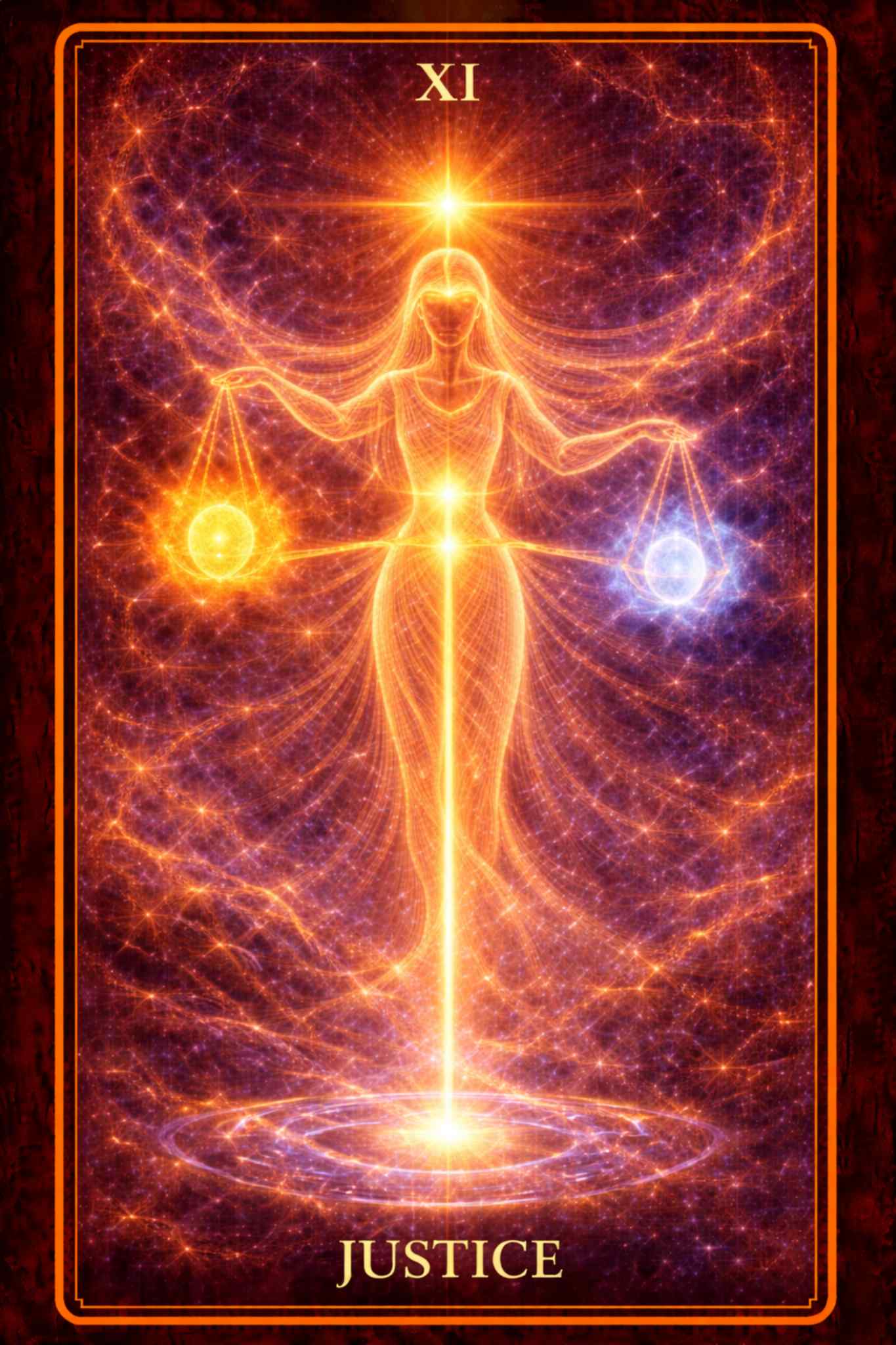

Justice and Page of Wands Tarot Combination Meaning
Justice and Page of Wands meet at a beginning that is alive, but not yet settled. Something has sparked. An idea, an attraction, a message, a desire to move, create, speak, or explore has entered the field with enough force that it can no longer be dismissed as a passing flicker. Yet the Page of Wands rarely arrives with finished structure. He appears when interest outruns certainty, when possibility comes first and explanation follows later. Justice enters this early fire with a very different instinct. It brings proportion, consequence, clean perception, and the question of whether what feels vivid is also being read truthfully. Together, these cards often appear when a new direction is real enough to matter, but still early enough that projection can easily attach itself to it.
This is what gives the combination its particular tension. The Page does not begin with proof. He begins with appetite, curiosity, ignition, and the readiness to move toward something that feels alive before life has fully explained what it is. Justice does not crush that impulse, and it does not ask for lifeless caution. Instead, it asks whether the person can let the beginning remain honest while it is still unfolding. What is actually known here? What is still only imagined? What motives are clean, and which ones are being hidden behind the language of exploration? The pair often appears at the stage where something genuine could become meaningful, but only if the beginning is allowed to stay truthful rather than being inflated too quickly into certainty, destiny, or identity.
Curiosity that must answer to reality
One of the deepest themes in this pairing is that curiosity is not neutral simply because it is early. The Page of Wands often gets interpreted as enthusiasm, openness, experimentation, and willingness to follow what feels fresh. All of that is true, but curiosity also creates movement, and movement always has effects. Justice makes that visible. It asks whether the spark is being followed with integrity or with the kind of vagueness that allows a person to enjoy aliveness without owning where it may lead. This matters because early-stage desire is often the place where distortion enters most quietly. A person does not always lie outright. More often, they exaggerate inwardly, minimize context, or speak as though they are “just exploring” while already knowing the exploration carries real consequence.
That is why the combination feels more mature than it first appears. The Page’s fire is real, and in many cases it should be honored. But Justice asks for straightness inside the fire. Are you curious because something true is opening, or because the newness gives temporary relief from what already feels demanding elsewhere? Are you letting the spark teach you something, or are you using it to bypass a truth that has already become inconvenient? The pair does not reduce curiosity to suspicion. It refines it. It suggests that the healthiest beginnings are often the ones that can admit how partial they still are.
The honesty of unfinished beginnings
The Page of Wands is not immature in a dismissive sense. He is unfinished in a developmental sense. He represents fire before it becomes doctrine, before it becomes a plan, before it has fully learned what its own momentum can set into motion. Justice is important here because it gives unfinished beginnings a frame without demanding premature finality. That is a subtle distinction, but an essential one. Many people handle beginnings badly in one of two ways: either they inflate them too quickly into something much larger than reality supports, or they suppress them because they cannot tolerate uncertainty. Justice and Page of Wands suggest a third path, one in which a beginning can remain open, exploratory, and alive while still being held to standards of truth.
This is part of what makes the combination so useful in real life. Not every new interest deserves a grand narrative. Not every attraction is a promise. Not every idea needs to become a mission before it has been tested. At the same time, some beginnings deserve to be followed precisely because they are alive, not because they are already guaranteed. Justice supports that kind of participation when it is clean. Explore, but do not pretend to know more than you know. Feel, but do not turn feeling into immediate certainty. Begin, but remain answerable to what the beginning actually reveals. That is the ethic of this pair.
Love and relationship meaning
In relationship readings, Justice and Page of Wands often point to attraction in its early and still-forming stage. There may be curiosity, flirtation, revived openness, a sense of possibility, or the feeling that something between two people has become bright enough to explore. The Page of Wands brings that first heat very clearly. It is lively, interested, and not yet burdened by fixed definitions. Justice then asks whether the way this newness is being handled is honest. Is the attraction being expressed cleanly, or kept suggestive because ambiguity allows excitement without accountability? Are intentions being acknowledged in proportion to what is actually known, or is the chemistry already being asked to carry more meaning than it can truthfully hold?
You may also want to go one step deeper.
Justice + Page of Wands can open up differently inside a focused personal reading.
This can be a very positive combination when lived well. Someone may be learning how to admit attraction without manipulation, how to speak directly without overpromising, or how to let something begin without using vagueness as a shield. Justice gives the early connection integrity. It allows the energy to remain fresh while reducing the confusion that often surrounds new relational fire. In that sense, the pairing can feel both light and clean at the same time.
In more difficult expressions, however, the pair can reveal a person who enjoys beginnings more than responsibility. They may be genuinely interested, yet not fully honest with themselves about their availability, their consistency, or the effect of inviting another person into their exploratory fire. Another version of the pattern appears when early chemistry is treated as proof of a much larger truth before enough shared reality has developed to support that conclusion. Justice asks the important question here: what is real already, and what is still only possible? The spark may matter. The attraction may matter. Yet early energy needs proportion if it is going to remain worthy of trust.
Career, creative work, and new directions
In work readings, Justice and Page of Wands often point toward a new idea, creative experiment, opportunity, message, or professional direction that is still in its formative phase. The Page of Wands brings appetite, fresh perspective, initiative, and the willingness to test a path before everything is settled. Justice asks for clean thinking inside that early momentum. Is the opportunity being assessed honestly? Are expectations being stated clearly? Are you exploring because something genuinely calls to you, or because novelty itself is functioning as relief from the slower demands of sustained work? These questions do not weaken the idea. They help reveal what kind of beginning it actually is.
This pairing is especially strong for creative people, entrepreneurs, and anyone standing at the edge of a new phase that feels alive but unproven. The Page brings excellent raw material: enthusiasm, courage, curiosity, and enough inner heat to move toward what is not yet guaranteed. Justice helps keep that fire from becoming scattered, inflated, or careless. It introduces clean agreements, realistic scope, and a more mature relationship to what an early opportunity can legitimately promise. Not everything needs to become a defining life path in order to deserve attention. Sometimes a beginning is simply promising, and that is enough.
At its best, this is a strong combination for experimentation done responsibly. Test the idea. Start the conversation. Try the new direction. But do not confuse first excitement with final truth. Justice strengthens the experiment by asking for honesty early, before later consequence begins to harden around wishful interpretation. The Page keeps the process alive. Justice keeps it aligned.
Psychological and spiritual meaning
Psychologically, Justice and Page of Wands often describe the challenge of staying truthful in the presence of novelty. Newness has its own effect on the mind. It stirs imagination quickly. It generates story. It can make the future feel brighter before reality has earned that brightness. The Page of Wands is beautiful partly because he restores this raw aliveness to the system. But that same aliveness can loosen discipline if it is not accompanied by discernment. Justice functions here as a steadying force. It asks whether the self can remain curious without becoming careless, and whether desire can remain exploratory without quietly turning into self-deception.
Spiritually, the pair often points toward a more honest relationship with instinct itself. Many people split desire into extremes. They either distrust it completely, or surrender to it too quickly. Justice and Page of Wands suggest another possibility. Desire is not the enemy, and curiosity is not a flaw. The work is to let both become answerable to truth. That means admitting what you feel without exaggerating what it means. It means moving toward what is alive while staying available to what unfolds. It means letting truth accompany the beginning rather than arrive only later as correction. There is something deeply mature in learning how to start without lying to yourself.
Where the beginning starts teaching you
A subtle but important layer of this combination is that beginnings often reveal their real nature only after movement has already started. The Page of Wands senses possibility before the full shape of the path is visible. Justice helps interpret what happens next. Once the first message is sent, the first conversation happens, the first sketch is made, the first plan is tested, reality begins answering back. This answer is one of the most important parts of the combination. The beginning stops being pure projection and starts becoming relational. It shows whether the spark has structure under it, whether it opens naturally into something deeper, or whether it was mostly intensity seeking a story to live inside.
This is why the pair does not support frozen caution. Some truths can only become visible in motion. If a person waits for complete certainty before every beginning, they may never allow life enough room to reveal itself. Yet Justice also insists that once reality begins speaking, it must be listened to. The Page teaches a person how to start. Justice teaches them how to read what the start is actually showing. Together, they create a process in which discovery remains alive, but interpretation becomes progressively cleaner.
FAQ — Justice and Page of Wands
Does this combination always mean a new beginning?
Very often it does, but usually a beginning that is still forming rather than fully defined. The emphasis is less on certainty and more on how honestly the early stage is being handled.
Is this a good sign in love readings?
It can be, especially when attraction or curiosity is being expressed directly and proportionately. The cards support clean early energy more than ambiguous excitement that avoids responsibility.
Does Justice weaken the Page of Wands?
No. It gives the Page a straighter path. The spark remains alive, but it becomes more trustworthy when it is not inflated, dramatized, or used to escape other truths.
Can this combination point to creative work?
Yes, very strongly. It often appears around ideas, experiments, messages, pitches, and beginnings that deserve exploration, provided they are approached with realism and honest scope.
What is the main challenge in this pair?
The main challenge is staying truthful while something new is exciting. Early fire can generate projection very quickly. Justice asks for enough clarity that the beginning can become real rather than merely stimulating.
Shadow expression and challenge
The shadow side of this combination appears when the Page’s fire becomes self-excusing. A person may say they are “just exploring” in order to avoid naming the effect of their behavior. They may keep options open not because openness is the cleanest truth, but because truth would require them to choose, disappoint, clarify, or let go of the pleasurable ambiguity that possibility provides. Justice exposes that distortion very quickly. Exploration is not the problem. Unowned impact is. The pair asks whether curiosity is being used honestly or whether it has become a socially acceptable language for not wanting responsibility yet.
There is also an opposite difficulty in which Justice becomes so rigid that the Page’s spark is constrained before it can teach anything at all. A person may demand full certainty, perfect ethical mapping, or total clarity before allowing themselves to move even one step toward what interests them. The result is not maturity, but paralysis disguised as wisdom. The healthier expression is neither chaotic experimentation nor overcontrolled refusal. It is exploration with accountability — enough openness for life to reveal something, and enough discernment for that revelation to be read cleanly.
Timing and the right pace for beginnings
This combination raises an important question about pace. The Page of Wands naturally wants movement. When something feels new and alive, the instinct is to follow it before the feeling cools. Justice asks whether the pace is truthful. Sometimes a quick beginning is completely appropriate. The situation is simple enough, the motive clean enough, and the consequence light enough that direct action serves the moment well. In those cases, the cards may support saying yes, sending the message, speaking first, or taking the first step without unnecessary delay.
At other times, the beginning is real but the interpretation is moving too quickly. The spark is ahead of the clarity. There may be no need to suppress the energy, but there may be every reason to slow the story forming around it. Let the interest remain interest for a while. Let the opening remain an opening. Let the beginning reveal its own scale before assigning it a larger destiny. Justice asks for this not to reduce life, but to protect it from distortion by eagerness. The Page teaches movement. Justice teaches proportion inside movement.
What this combination is really asking
Justice and Page of Wands ask: can you begin honestly before you understand everything? That is the heart of the pair. The newness is real. The curiosity is real. The call to explore may be entirely appropriate. But the cards ask whether the beginning can happen without exaggeration, without selective truth, and without using vagueness as a way to avoid responsibility for effect. They want the person to remain answerable to what is true, even while moving into territory that is not yet fully known.
The deeper lesson is that early fire does not need to be extinguished in order to become trustworthy. It needs guidance. Justice gives that guidance through clarity, proportion, ethical steadiness, and consequence-awareness. The Page of Wands gives aliveness, experiment, possibility, and the courage to let something new enter the field. Together, they create a beginning that is not naive, not overcontrolled, and not falsely certain. It is simply honest enough to keep discovering what it really is.
Want to place this combination into a wider reading?
If this pairing feels close to something you are experiencing, a simple spread can help you reflect on the surrounding energy with more clarity.
Closing reflection
Some beginnings arrive as answers. Others arrive as questions that carry enough life in them to deserve a real response. This pairing belongs to the second kind. It does not ask you to mistrust the spark. It asks whether the spark can be followed without being forced into a story it has not yet earned.
Justice keeps the beginning clean. The Page of Wands keeps it alive. Between them is a form of freedom that feels rare precisely because it does not rely on self-deception. You can be interested without pretending you are certain. You can move without pretending you already know where it ends. You can let something matter while still giving truth enough room to decide what it becomes. That is a beautiful kind of beginning, and a durable one.
More combinations with Justice
More combinations with Page of Wands
Continue with Justice
Explore Related Guides by Topic
If you want to explore this combination through a more specific emotional lens, these tarot guides can help you follow the broader pattern behind the reading.