
Justice + Ten of Cups
Explore how these two tarot cards interact in a reading through symbolic overlap, contrast, and shared narrative. Tarot combinations often reveal meaning that neither card fully expresses on its own.
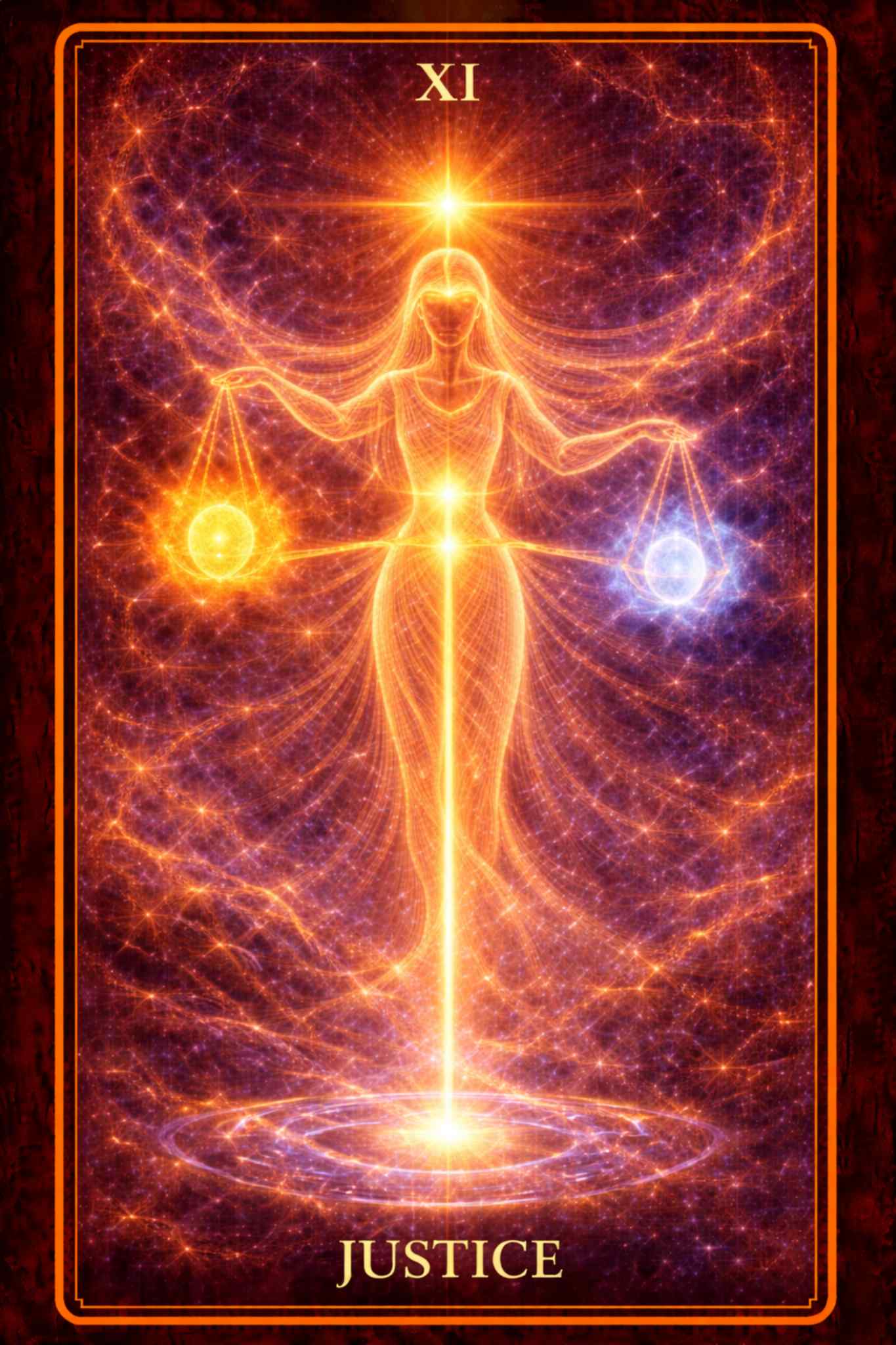

The Justice and Ten of Cups tarot combination meaning
Justice and Ten of Cups is a pairing that examines happiness as a structure rather than a moment. The Ten of Cups brings the image of emotional completion: connection that feels whole, relationships that seem to hold, a shared atmosphere where belonging appears natural and unforced. Justice shifts the focus away from the emotional surface and toward the framework that makes such harmony possible. Instead of asking whether happiness is present, it asks what holds it together, what maintains it, and whether the underlying agreements between people are strong enough to support what is being felt. This creates a reading that is less about celebrating fulfillment and more about understanding how fulfillment continues to exist without collapsing under pressure.
This perspective changes the meaning of the Ten of Cups in a significant way. Emotional wholeness is no longer treated as a static state, but as something actively sustained through balance, clarity, and ongoing alignment. Justice introduces proportion into the picture. It asks whether each person is equally invested, whether communication remains open even when it is difficult, and whether the emotional environment allows truth to circulate freely rather than being shaped around comfort alone. When these conditions are present, happiness becomes durable. It does not depend on perfect conditions. It depends on a system that can adapt while remaining fair and honest.
What makes this combination especially important is that it recognizes how easily happiness can be misunderstood. People often assume that when something feels complete, it has reached its final form. Justice suggests something more dynamic. Emotional harmony remains alive only when it continues to be supported by conscious participation. The Ten of Cups shows what that harmony looks like. Justice shows what keeps it functioning. Together, they describe a form of fulfillment that is not accidental, but maintained through awareness and shared responsibility.
Emotional systems and the architecture of happiness
The Ten of Cups can be seen as the visible expression of an emotional system that works. There is connection, shared experience, mutual recognition, and a sense that life is being lived in a way that feels coherent. Justice brings attention to the invisible structure behind that expression. Every stable emotional environment rests on agreements, whether spoken or unspoken. These agreements define how people treat each other, how they respond to conflict, and how they handle imbalance when it appears. Justice asks whether those agreements are clear, fair, and consistently upheld.
This is where the idea of emotional architecture becomes relevant. Harmony is not only a feeling. It is the result of patterns that repeat over time. When those patterns are balanced, the emotional field stabilizes. When they are uneven, the appearance of harmony can begin to drift away from reality. Justice identifies these patterns and evaluates whether they remain aligned. It looks at how decisions are made, how responsibility is shared, and whether each person’s position within the relationship or environment reflects genuine equity.
A useful contrast appears in Justice and Wheel of Fortune, where circumstances shift and external change disrupts stability. In Justice and Ten of Cups, the emphasis is not on change itself but on continuity. The question is not how to adapt to movement, but how to maintain coherence when things remain in place. This requires a different kind of awareness, one that focuses on consistency rather than reaction.
When the structure is sound, emotional life becomes easier to inhabit. People do not need to constantly interpret each other’s intentions or manage hidden tensions. The system carries part of the weight. Justice supports this by reinforcing clarity and accountability, allowing the Ten of Cups to express itself without distortion. The result is a form of harmony that feels natural because it is supported at every level, from small daily interactions to larger shared values.
Relational equilibrium and shared responsibility
In relationship readings, Justice and Ten of Cups often points to a dynamic where equilibrium is either established or being actively negotiated. The Ten of Cups suggests that emotional fulfillment is possible or already present, though Justice examines how that fulfillment is distributed. It looks at whether both people experience the relationship as equally nourishing, whether effort flows in both directions, and whether decisions are made with mutual consideration rather than silent imbalance.
This is particularly relevant in long-term connections, where emotional patterns tend to settle into routines. Over time, these routines can either reinforce balance or gradually create asymmetry. Justice brings attention to this process, asking whether the current structure still reflects fairness. If it does, the relationship gains strength. If it does not, the cards highlight where adjustment is needed to restore equilibrium before the appearance of harmony begins to drift away from the truth of the experience.
A different relational tone can be seen in Justice and The Emperor, where structure is more hierarchical and authority plays a stronger role. In Justice and Ten of Cups, authority is replaced by shared participation. The balance comes from mutual engagement rather than defined control, creating a softer but equally structured form of stability.
For deeper insight into how emotional fulfillment operates within connection, the Ten of Cups love meaning expands on the card’s relational dimension. In combination with Justice, this fulfillment becomes more precise, showing how satisfaction is sustained through fairness rather than simply experienced through feeling.
Harmony under pressure and the role of truth
Every emotional system is eventually tested. Pressure may come from external circumstances, internal changes, or simple time. Justice and Ten of Cups examines how harmony responds under these conditions. Does the connection remain stable when difficulties arise, or does it depend on ideal conditions to function? This question reveals whether the harmony is resilient or conditional.
Want to explore this combination in a more personal way?
If this pairing feels important right now, a simple tarot spread can help you reflect on it with more context.
Justice plays a crucial role in this process by maintaining openness to truth even when it is uncomfortable. In a strong system, truth does not disrupt harmony. It strengthens it by allowing adjustment before imbalance grows too large. The Ten of Cups benefits from this because it prevents the emotional field from becoming rigid or dependent on perfection. Instead of protecting the image of happiness, the system adapts to maintain its integrity.
This dynamic creates a more flexible form of fulfillment. Rather than trying to preserve a perfect state, the relationship or environment remains alive, capable of responding to change without losing coherence. Justice ensures that adjustments are made fairly, while the Ten of Cups provides the emotional incentive to maintain connection. Together, they create a balance between stability and responsiveness that allows harmony to persist over time.
Long-term alignment and the evolution of shared life
Justice and Ten of Cups often appears in readings focused on long-term direction, especially when the question involves whether a current state can continue to develop. The Ten of Cups suggests that the emotional foundation is strong enough to support growth, though Justice evaluates whether the alignment required for that growth is present. This includes shared values, compatible expectations, and a willingness to evolve together rather than separately.
Alignment is not static. It changes as people change. Justice ensures that this evolution remains conscious. It asks whether both individuals continue to move in ways that support the shared system, or whether divergence is beginning to create subtle tension. When alignment is maintained, the Ten of Cups deepens. Fulfillment becomes more integrated, less dependent on circumstances and more rooted in shared understanding.
If you need a clear view of how present conditions influence future development, the Past Present Future Tarot Spread works well with this combination. It highlights how alignment has formed, how it currently functions, and where it is likely to move next.
Shadow expression and structural imbalance
The shadow side of Justice and Ten of Cups appears when the structure of happiness becomes misaligned while the appearance remains intact. This can happen when one person contributes more than the other, when communication becomes selective, or when difficult truths are avoided to preserve emotional comfort. The Ten of Cups continues to project harmony, though Justice reveals the imbalance beneath it.
This form of distortion is subtle because it often develops gradually. The system continues to function, though small inconsistencies accumulate over time. Justice identifies these inconsistencies and brings them into awareness, allowing correction before the imbalance becomes too large to ignore. Without this intervention, the emotional field may eventually lose coherence, even if the image of happiness is maintained for a period.
Another challenge arises when analysis begins to outweigh experience. A person may become so focused on maintaining fairness that they struggle to fully inhabit the emotional state the Ten of Cups offers. In this case, Justice becomes overly rigid, and the system loses some of its warmth. The balance between structure and feeling must remain intact for the pairing to function at its highest level.
Spiritual coherence and inner alignment
On an inner level, Justice and Ten of Cups reflects the alignment between emotional life and personal truth. The Ten of Cups represents a state where the inner world feels integrated, where desires, values, and experiences begin to form a coherent whole. Justice ensures that this coherence is grounded in honesty rather than constructed from selective perception.
This alignment creates a sense of stability that extends beyond external relationships. A person may feel more at ease with themselves, more consistent in their choices, and less dependent on external validation to maintain their emotional state. Justice supports this by reinforcing integrity, while the Ten of Cups provides the experience of fulfillment that arises from it.
For insight into how Justice shapes internal direction, the Justice spirituality meaning offers a deeper perspective on how clarity and balance influence personal development. In this combination, those qualities contribute directly to emotional wholeness.
Explore the next layer of this reading.
This combination can mean different things depending on context. A short tarot reading can help you reflect on the question behind the cards.
Where harmony becomes sustainable through structure
Justice and Ten of Cups ultimately describes a form of happiness that is supported by structure rather than dependent on circumstance. The Ten of Cups provides the emotional experience of fulfillment, while Justice ensures that this experience is built on a foundation that can sustain it. Together, they shift the focus from achieving happiness to maintaining it through conscious alignment.
This creates a different understanding of fulfillment. Instead of viewing it as a final state, it becomes an ongoing process shaped by interaction, responsibility, and awareness. The system continues to function because it is actively supported, not because it has reached a perfect form. Justice keeps the system balanced, while the Ten of Cups keeps it meaningful.
In this way, the pairing offers a grounded vision of emotional life. It shows that harmony is most valuable when it can remain intact under real conditions, supported by fairness, clarity, and shared participation. This form of happiness does not require protection from truth. It is strengthened by it, becoming more stable, more coherent, and ultimately more real.
More combinations with Justice
More combinations with Ten of Cups
Continue with Justice
Explore Related Guides by Topic
If you want to explore this combination through a more specific emotional lens, these tarot guides can help you follow the broader pattern behind the reading.