
Justice + King of Wands
Explore how these two tarot cards interact in a reading through symbolic overlap, contrast, and shared narrative. Tarot combinations often reveal meaning that neither card fully expresses on its own.
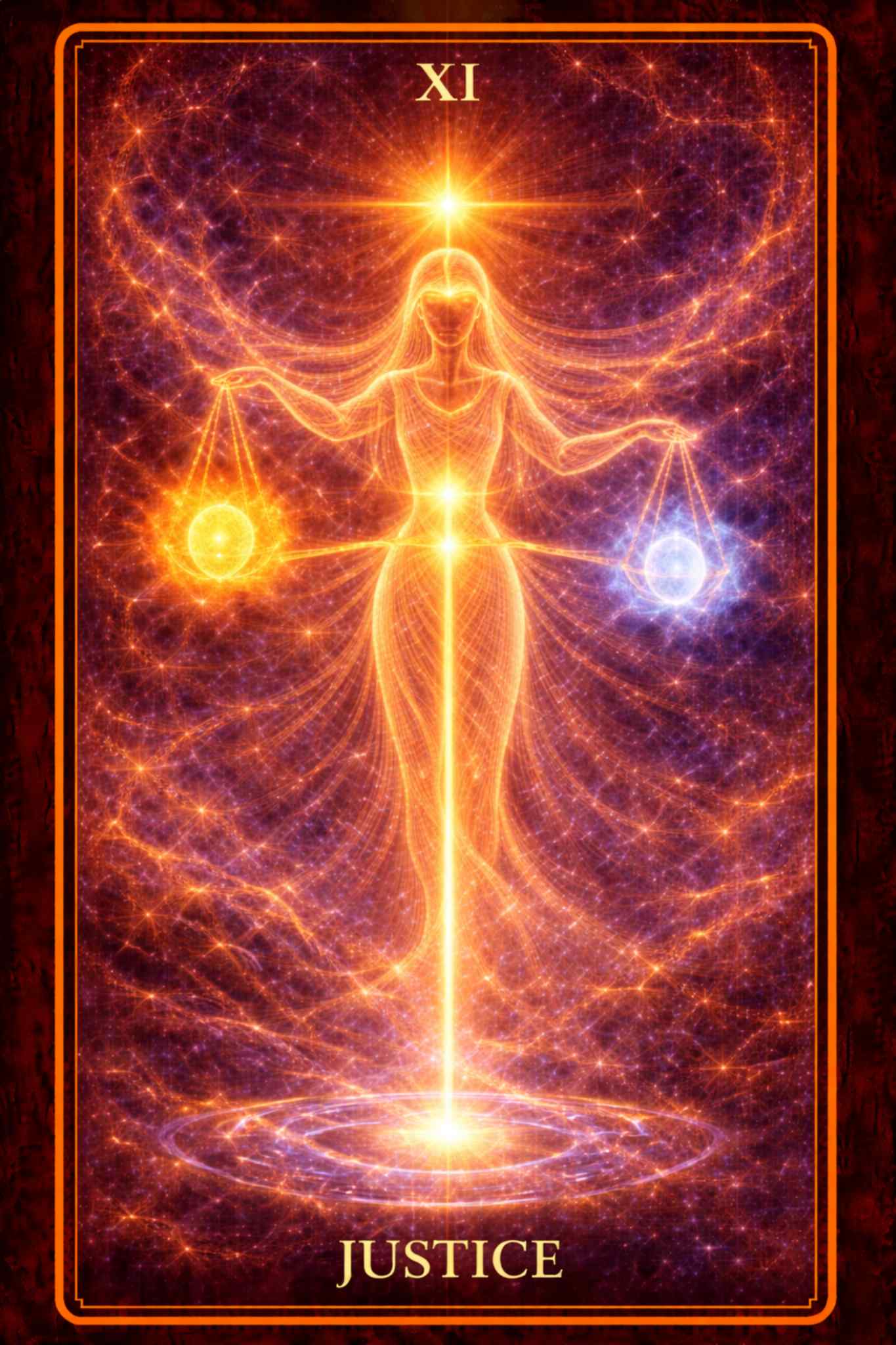

Justice and King of Wands Tarot Combination Meaning
Justice and King of Wands meet where power stops being abstract and starts becoming ethically visible. This is not only a combination about strength, vision, or leadership in the ordinary sense. It is about what happens when strong will, visible authority, and directional fire are placed beside truth, consequence, and proportion. The King of Wands knows how to move energy outward. He can initiate, organize, direct, persuade, and keep momentum alive long enough for other people to gather around a shared aim. Justice brings a very different standard into that field. It asks whether the force being used is aligned with reality, whether the direction being set can withstand scrutiny, and whether the one leading is willing to be measured by the same standards they apply to others. Together, these cards often appear when the central issue is no longer desire alone, but the quality of the authority shaping what happens next.
This is what gives the pair its weight. The King of Wands can be deeply impressive. He often represents certainty, leadership, charisma, executive power, and the ability to turn possibility into movement. Justice does not reduce those qualities, but it does remove the automatic glamour around them. It asks what governs the fire. Is the direction disciplined by truth, or is truth being rearranged to support the direction? Is the person’s confidence rooted in tested understanding, or in the emotional force of their own conviction? The cards do not oppose leadership. They oppose leadership that slowly begins to treat itself as proof. At their strongest, these two create a picture of principled force — visible authority that does not need distortion in order to remain effective. At their most difficult, they expose one of the oldest risks around power: when certainty becomes so persuasive that it starts mistaking itself for truth.
Power that must answer to truth
One of the clearest themes in this combination is that leadership is not tested only by whether it can move people. It is tested by whether it remains answerable to what is real once movement has started. The King of Wands is often strongest when he is setting direction, rallying energy, and holding a larger horizon clearly enough that others begin orienting themselves around it. Justice does not challenge the value of that gift. In many cases, it affirms it strongly. But it asks what happens when consequence appears, when reality resists the preferred narrative, or when other people begin carrying the effects of decisions made with conviction. This is where the pairing becomes especially meaningful. It insists that strong direction must still remain corrigible. Otherwise, vision gradually shifts into domination, and confidence becomes harder to separate from self-exemption.
Justice matters so profoundly beside the King because it keeps authority from becoming theatre. It asks whether the leader is willing to evaluate impact rather than relying too heavily on intention. Are they noticing what their certainty creates in others? Are they listening to parts of reality that complicate the vision, or only to the parts that strengthen it? Are they applying standards fairly, including to themselves, or only using standards to organize everyone else? The most mature form of the King of Wands can do this. He does not become smaller through accountability. He becomes far more trustworthy. Justice refines commanding energy into principled authority rather than leaving it as force of personality alone.
Vision, will, and the discipline of consequence
The King of Wands is not short on will. He often moves while others are still hesitating, and that is part of why he can achieve so much. He is capable of decisive commitment, sustained force, and a kind of directional confidence that gives shape to the field around him. But will is not wisdom by default, and Justice exists to keep that distinction visible. A person may have an impressive vision and still be partially distorted in how they read the wider situation surrounding it. They may sincerely believe in the rightness of their direction while minimizing the disproportions it creates. They may lead boldly while remaining ethically underexamined. Justice introduces a discipline the King needs if his fire is to remain clean: the discipline of consequence.
Want to explore this combination in a more personal way?
If this pairing feels important right now, a simple tarot spread can help you reflect on it with more context.
Consequence here is not merely punishment or reward. It is the real result of what one sets in motion. Justice asks whether those results are being tracked honestly. Is the leader willing to see the cost of their choices, not just their power? Are they able to correct course without treating correction as humiliation? Are they honest enough to distinguish vision from ego investment? When integrated well, this makes the combination unusually strong. The King stops being merely impressive and becomes reliable. His strength no longer depends on being unquestioned. It becomes stronger precisely because it can be questioned and still remain intact.
- Leadership that can still receive correction
- Vision that remains answerable to consequence
- Authority that does not rely on confusion
- Confidence grounded in tested reality
- Direction that includes responsibility, not only momentum
Love and relationship meaning
In relationship readings, Justice and King of Wands often point toward a bond shaped by strong presence, decisive energy, desire, and questions of power, accountability, and relational leadership. The King of Wands may indicate someone who is charismatic, direct, passionate, and capable of moving a connection forward with confidence. Justice asks whether that movement is fair, honest, and proportionate. Does the person truly know what they want and communicate it clearly, or do they rely on force of presence to shape the emotional field in their favor? Are they taking responsibility for the impact of their certainty, or are they assuming that conviction alone makes their position valid?
At its healthiest, this can be a strong pairing for mature and honest relational leadership. Someone may finally be prepared to take clear responsibility for their role in the relationship, to speak directly without manipulation, and to bring both desire and integrity into the same space. The King gives direction, courage, and steadiness. Justice ensures that this direction does not become one-sided or self-serving. The result can be a bond where strong feeling does not create chaos because it is held inside a framework of truth and reciprocity.
In more difficult expressions, however, the pair can expose imbalance rooted in confidence, dominance, or the assumption that the stronger-willed person should define reality for the relationship as a whole. One person may be compelling, attractive, and sure of themselves, yet less fair than they believe. Or they may genuinely care but still fail to see how their intensity influences the emotional proportion of the bond. Justice interrupts that drift. It asks whether both people’s realities are being held, whether desire is being used responsibly, and whether the direction of the relationship is being shaped by truth or simply by the strongest force in the room.
Career, work, and visible authority
In work readings, Justice and King of Wands can be one of the strongest combinations for ethical leadership, disciplined ambition, and the responsible use of influence. This is a pairing of command and evaluation. The King of Wands brings vision, executive force, creative direction, and the capacity to organize large amounts of energy toward a coherent aim. Justice asks whether the methods, policies, judgments, and consequences of that direction remain fair and structurally sound. This can be an excellent sign when someone is genuinely prepared to lead with both strength and principle.
The combination is especially relevant for roles involving decision-making, entrepreneurship, public leadership, high-level creative direction, or any environment in which one person’s vision can shape outcomes for many others. Justice asks essential questions. Are standards being applied evenly? Is success being built on truth rather than only on charisma? Is challenge still allowed into the system, or has the leader’s certainty become too central to question cleanly? The King of Wands has enormous constructive potential, but he must be governed by something more stable than appetite for achievement. Justice provides that governing principle.
At its best, this pairing can mark a stage where leadership is maturing. The person may no longer need to prove strength through force, urgency, or image. Instead, they direct with clearer standards, stronger accountability, and a deeper willingness to let truth — not only will — shape their decisions. In more difficult expressions, however, the cards can warn that someone is becoming too convinced by their own vision. The results may still look impressive from the outside, yet the ethical line underneath them is beginning to blur. Justice asks for that line to be restored before consequence becomes more visible and much harder to revise.
Psychological and spiritual meaning
Psychologically, Justice and King of Wands often describe the task of integrating vision with self-accountability. Many people either hesitate too much to lead or lead too strongly without enough reflection. This pair asks for a rarer maturity. The person must be capable of wanting strongly, deciding clearly, and acting boldly without becoming seduced by their own force. That is not a small task. It requires an internal structure sturdy enough that the ego does not automatically identify leadership with correctness. The King’s gift is conviction. Justice ensures conviction remains in dialogue with reality rather than becoming its replacement.
Spiritually, the pairing often points toward one of the deepest tests of fire: what happens when a person becomes capable of influencing outcomes? It is one thing to seek truth when one has little power. It is another to remain truthful when power, visibility, and strong will make self-distortion easier to hide. Justice and King of Wands together ask whether power can become a disciplined instrument rather than a self-reinforcing identity. Can vision remain answerable? Can command remain fair? Can intensity remain honest enough to correct itself? The lesson here is not anti-power. It is anti-unexamined power. When the King allows his fire to be shaped by Justice, leadership becomes less theatrical and far more real.
FAQ — Justice and King of Wands
Is this a strong leadership combination?
Yes. It often points toward visible authority, strong direction, and the ability to influence outcomes. The deeper issue is whether that leadership remains fair, accountable, and grounded in reality.
Can this be positive in relationships?
It can be, especially when strong desire and confident action are matched by honesty, reciprocity, and responsibility. It becomes more difficult when one person’s force starts defining the entire emotional field.
Does Justice weaken the King of Wands?
No. It refines him. Justice gives the King proportion, consequence-awareness, and ethical structure so that leadership becomes more trustworthy rather than less powerful.
Can this combination warn about ego?
Yes. It can show a person who is effective and charismatic but increasingly convinced by their own certainty. The warning is less about obvious arrogance and more about becoming harder to question honestly.
What is the main lesson in this pair?
The main lesson is that power becomes strongest when it remains answerable to truth. Vision is not enough on its own. It must also withstand consequence, fairness, and honest evaluation.
Shadow expression and challenge
The shadow side of this combination appears when leadership becomes self-exempting. A person may be effective, admired, even right in many ways, and still begin to believe that their power, track record, or insight places them above ordinary accountability. The King of Wands can drift there because strong figures often receive less challenge over time, especially if others are inspired by them or reluctant to question them openly. Justice is the antidote. It reminds the person that consequence still applies, that fairness still matters, and that charisma is not proof of clean perception. The shadow here is not only overt domination. It is the quieter habit of assuming that because the vision is strong, the whole field should bend around it.
There is another imbalance as well. Justice can become so severe, so overcommitted to perfect proportion, that the King’s fire becomes overcontrolled and underused. A person may fear their own power, hesitate to decide, or become so focused on measured fairness that decisive leadership never fully emerges. The King of Wands corrects that problem. Sometimes truth needs not only balance, but force. Sometimes leadership is the honest response. The healthier form of the pair does not choose between discipline and vitality. It asks that vitality become disciplined enough to remain trustworthy.
Timing and the moment to lead, decide, or correct
This combination often raises timing issues around authority and decision-making. There are moments when a strong, visible, decisive move is genuinely needed. The field lacks direction, the truth is sufficiently clear, and delay would only create more drift or confusion. Justice can support leadership strongly in those cases. The King of Wands then becomes not an egoic actor, but the one willing to direct, decide, and carry consequence responsibly.
At other times, the pair may warn that the person is too ready to lead from conviction that has not yet been fully tested by reality. The vision may be compelling, but there may still be relevant facts being minimized or opposing views not yet honestly weighed. Justice asks for one more level of exactness before power turns into action. The timing question is subtle but crucial: is this the moment for strong direction, or the moment to make sure the direction is clean enough that strength will not later need to be unwound at greater cost?
What this combination is really asking
Justice and King of Wands ask: can you wield strong fire without needing truth to serve your will? That is the heart of the pair. The leadership may be real. The ambition may be justified. The direction may genuinely be necessary. But the cards want to know whether the person’s power remains answerable to consequence, fairness, and honest evaluation. They ask whether the vision is strong enough to be corrected without collapsing, and whether the one who leads is willing to be measured by the same truth they bring to everyone else.
The deeper lesson is that authority becomes most powerful when it does not rely on distortion. Justice gives ethical proportion, accountability, and the discipline of cause and effect. The King of Wands gives vision, strength, charisma, and the courage to set direction. Together, they create one of the clearest images of principled leadership in tarot: not passive, not weak, not merely impressive, but strong enough to move the field and honest enough to remain worthy of that power.
Ready to see how this applies to your situation?
A focused tarot reading can help you explore how Justice + King of Wands may reflect your current situation, not just the general meaning of the cards.
Closing reflection
There is a kind of leadership that depends on volume, force, and the ability to keep others from questioning it. This pairing points toward something better. It suggests a strength that does not fear truth, a vision that can survive scrutiny, and a power that becomes more credible when it is held accountable to consequence.
Justice keeps the standard clean. The King of Wands gives that standard reach, force, and direction. Between them is a demanding but remarkable possibility: leadership that does not confuse certainty with truth, authority that does not ask for exemption, and fire that knows how to govern itself well enough to guide others without scorching the field around it. That is a serious kind of strength, and a rare one.
More combinations with Justice
More combinations with King of Wands
Continue with Justice
Explore Related Guides by Topic
If you want to explore this combination through a more specific emotional lens, these tarot guides can help you follow the broader pattern behind the reading.