
Death + Eight of Wands
Explore how these two tarot cards interact in a reading through symbolic overlap, contrast, and shared narrative. Tarot combinations often reveal meaning that neither card fully expresses on its own.
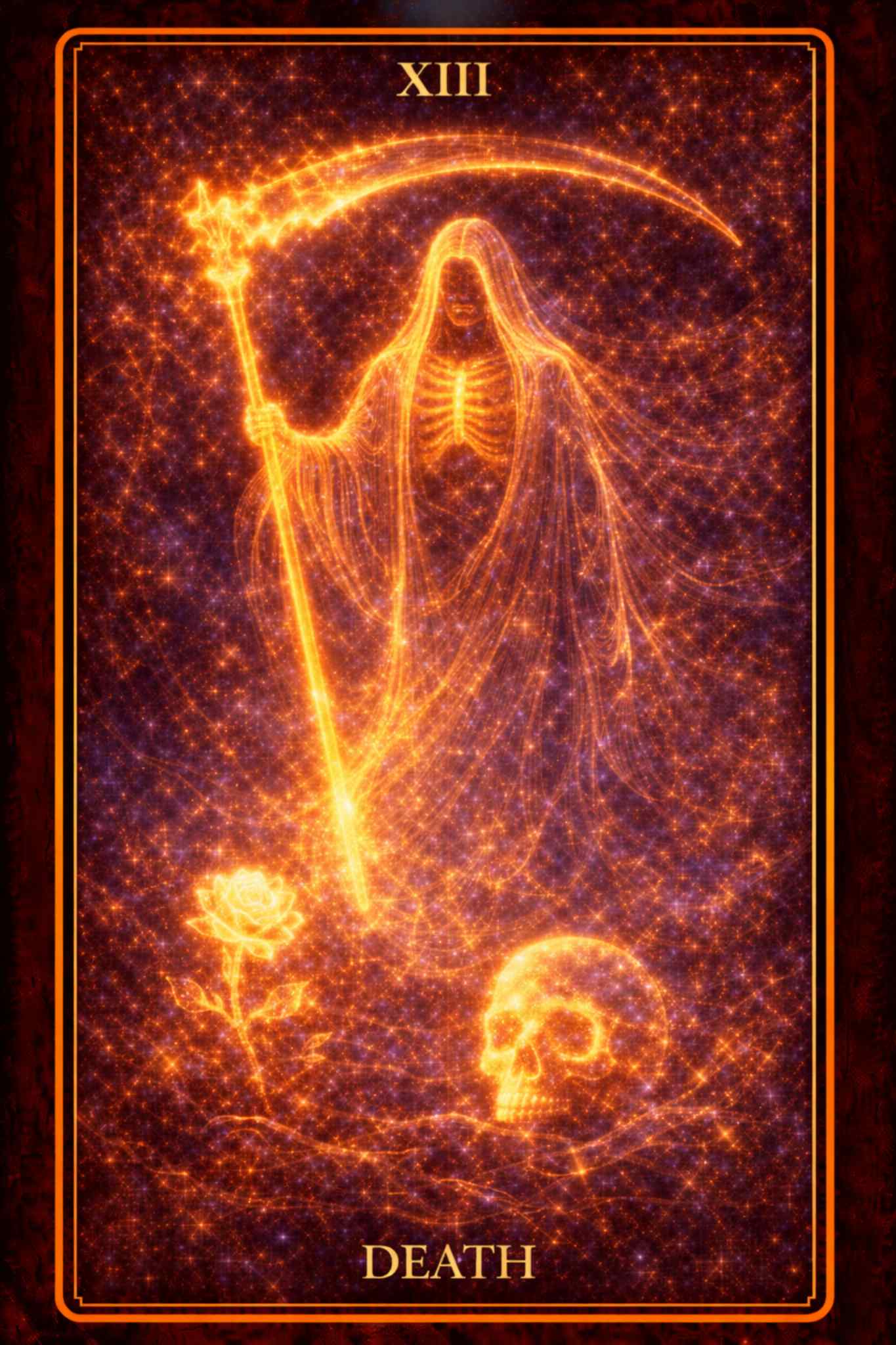
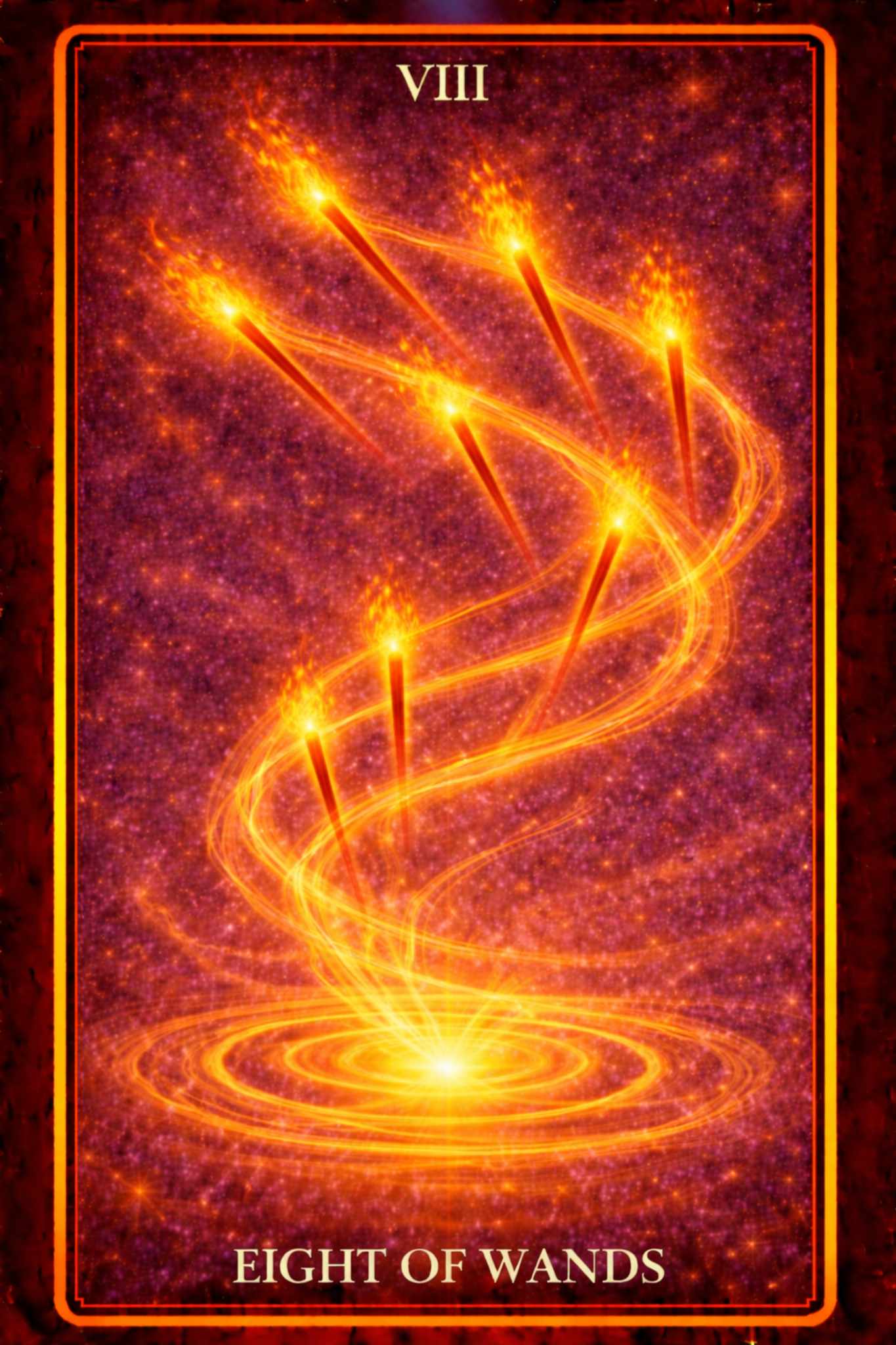
Death and Eight of Wands Tarot Combination Meaning
Death and Eight of Wands meet where transformation stops lingering in the background and begins moving with unmistakable speed. This is not a quiet emotional shift that stays private for long. Death marks the point where a chapter has already lost its old structure from within. A role, attachment, expectation, identity, or whole emotional pattern has reached the threshold where it cannot keep operating in the same way. The Eight of Wands brings motion to that reality. It carries messages, decisions, reactions, developments, and sudden forward movement. Together, these cards often appear when something that has been changing beneath the surface for quite some time finally gains outer momentum. What once felt suspended starts moving. What once seemed delayed begins aligning. What once remained unspoken may now arrive directly, quickly, and with a force that is difficult to ignore.
This gives the pair its distinctive intensity. Death is deep, irreversible, and exacting. It asks for surrender at the level of structure, not only preference. The Eight of Wands is swift, responsive, and kinetic. It does not want to linger after the path opens. When these energies align well, the result can be remarkably clean: a necessary ending is no longer stretched out through denial, and change moves through with clarity instead of stagnation. Yet the pair can also reveal a more fragile situation, one in which outer momentum begins racing ahead of inner release. A person may move quickly, communicate quickly, decide quickly, or enter the next phase quickly while part of the psyche is still trying to catch up. That is why this combination asks a more subtle question than simple speed. It asks whether the momentum is carrying truth forward, or helping the personality avoid the sacred emptiness that follows real ending.
When a hidden ending suddenly moves
One of the clearest messages in this pair is that some endings spend a long time unfolding beneath the visible surface and then gather momentum all at once. A relationship may have been losing life inwardly for months before a decisive conversation takes place. A career direction may have been finished in spirit long before the resignation, redirection, or outward shift becomes real. A self-image may have been thinning for a long time before the social world can see that it no longer fits. Death often ripens in the dark. The Eight of Wands shows the moment when that inner ripening begins to translate into visible motion.
You may also want to go one step deeper.
Death + Eight of Wands can open up differently inside a focused personal reading.
This is why the speed can feel surprising even when the truth itself is not new. People often assume that quick outer movement means sudden change. These cards suggest otherwise. The rapid phase may simply be the visible release of something that has been inwardly completing itself for a long time. Once a threshold has been crossed, events can line up quickly. Conversations happen. Messages arrive. Plans change. Doors close or open with unusual precision. The feeling can be intense, even fated, not because something arbitrary is happening, but because a long-developing process has finally reached the point where movement is possible. The Eight of Wands does not necessarily create the transformation. It often delivers it into time.
Clean momentum versus emotional bypassing
Because the Eight of Wands is so dynamic, one of the most important distinctions in this pair is the difference between clean momentum and emotional bypassing. Clean momentum appears when enough inner truth has already been accepted that movement becomes the natural continuation of what is real. The person is not forcing speed. They are allowing a completed process to move through without unnecessary delay. In that expression, rapid change can feel sharp yet coherent. It may still be painful, but it carries direction. The movement has integrity because it comes from completion rather than from panic.
Bypassing looks similar from the outside and very different underneath. It happens when speed is recruited against feeling. A person may fill the space with texts, decisions, travel, plans, explanations, attraction, work, or immediate reinvention because stillness would place them face to face with grief, emptiness, or inner reorganization. The activity is real, yet its psychological function is defensive. Death asks whether the movement is emerging from surrender or shielding the person from it. This matters deeply, because transformation supported by truth tends to leave the person clearer, while transformation driven by avoidance often leaves the next chapter carrying more unresolved material than it first appears to hold.
- Death marks a chapter that has reached irreversible inner completion.
- Eight of Wands brings speed, messages, timing, and visible movement.
- Momentum can carry truth forward or help the personality outrun feeling.
- Acceleration often reveals a process that was ripening quietly for much longer.
- Discernment is needed to tell liberated movement from defended movement.
Love and relationship meaning
In relationship readings, Death and Eight of Wands often point toward a relational transition that suddenly becomes active after a long hidden phase. A bond that has been changing beneath the surface may now move quickly toward ending, redefinition, honesty, or a more decisive next step. Communication can intensify. Long-delayed truths may arrive directly. One or both people may finally say what has been known inwardly for some time. In many cases, the speed itself is what feels startling. The emotional truth may have been present all along, yet the outer movement now happens fast enough that it becomes impossible to pretend the old chapter is still intact.
At its healthiest, this can be a deeply clarifying pair. It can show a relationship moving out of ambiguity and into unmistakable truth. A dead dynamic may finally end. A necessary conversation may happen without further avoidance. A pattern that has been draining both people may be released quickly enough that emotional life can begin moving again. This can also apply after a real ending has already been inwardly accepted. Attraction, communication, or relational movement may return, yet in that healthier expression the speed feels precise rather than chaotic. It feels like life resuming after a chapter has actually closed, not like a frantic effort to deny the gap.
In more difficult expressions, however, the Eight of Wands becomes a way to outrun grief. Someone may rush toward new attraction, intense communication, instant redefinition, or rapid relational movement because the stillness after loss feels too exposed. They may interpret motion as healing when it is really a form of anesthesia. Death challenges that illusion directly. The heart may be moving, but has it released? The field may be active, but has the old bond truly completed itself within the person? These questions determine whether the next development will feel aligned or prematurely accelerated.
Career, work, and practical change
In practical life, Death and Eight of Wands often describe fast-moving change in work, professional identity, or the larger direction of life. A job may end suddenly after a long period of inward decline. A career pivot may happen quickly once a private realization becomes clear enough to act upon. Opportunities, interviews, departures, launches, restructures, or important communications may gather speed all at once. The Eight of Wands frequently reflects the outer mechanics of transition: what had been stalled starts moving with unmistakable force.
This can be a powerful combination when the person has already sensed that the old chapter is finished. The acceleration may even bring relief. Instead of remaining trapped in a long ambiguous middle, life begins rearranging itself. Dead momentum breaks apart. Fresh channels open. Death clears what has become obsolete, and the Eight of Wands gives genuine movement to what follows. The result can feel intense, but also deeply right, especially when the person has already been doing the quieter inner work of letting go.
The shadow expression is different. A person may fill every available space with action and call that transformation. They may believe that constant movement proves they have successfully moved on, when in fact the speed is helping them avoid the slower psychological work of metabolizing a real ending. Death asks whether the new opportunities and movements are emerging from completion or serving as a shield against deeper reorganization. That distinction shapes whether the next chapter feels coherent or strangely overdriven.
Psychological and spiritual meaning
Psychologically, this pair often describes the strange experience of deep inner change unfolding alongside very rapid outer movement. One part of the person may know with great certainty what is over, while another part is still grieving, lagging, or trying to make sense of what is now happening in real time. This can create a bewildering mixture of clarity and shock. Life moves. The nervous system catches up more slowly. The cards are helpful precisely because they normalize that mismatch. Quick outer motion does not prove shallow change. Some rapid shifts belong to processes that were ripening far below conscious awareness for a long time.
Spiritually, Death and Eight of Wands speak to the discipline of moving without losing depth. The person may be asked to trust that transformation does not always unfold at a ceremonial pace. Sometimes life speeds up once a threshold has been crossed. Yet spiritual maturity here does not mean keeping up at any cost. It means staying inwardly honest while events accelerate. It means allowing movement without converting movement into a defense against emptiness. The deeper invitation is to let the chapter close and move forward while still honoring what has died, rather than burying it beneath speed.
Shadow expression and challenge
The shadow side of this combination appears when rapid activity becomes a strategy of self-avoidance. A person may keep texting, planning, reacting, traveling, launching, speaking, or searching because speed creates the temporary feeling of protection. The life-force is indeed moving, but it may be moving in service of avoidance rather than truth. Death exposes this sooner or later. The ending remains real whether the person stays busy enough to feel temporarily ahead of it or not. If momentum is being used to suppress surrender, the next stage often arrives carrying more unresolved material than the person expected.
There is also an opposite distortion in which the person mistrusts acceleration simply because it feels intense. They may slow down a process that is already ready to move, holding onto extended analysis or repeated revisiting because speed feels unsafe. The Eight of Wands corrects that tendency. Some changes are complete enough to move. Delay is not always wisdom. Sometimes it is attachment to the familiar pace of a self that has already changed. The challenge is to distinguish sacred timing from fear-based dragging, and bold movement from defended motion.
Timing and the speed of transition
Timing is central to this pair. Death asks when the ending is real enough that it should no longer be cosmetically managed or quietly postponed. The Eight of Wands asks whether the movement now gathering force should be trusted. Often the answer is yes. Messages come. Decisions line up. Inner and outer realities converge. The person suddenly finds themselves in a fast corridor of change, and although that can feel disorienting, it may also be the clearest sign that the process has ripened enough to move.
At other times, the cards warn that momentum is outpacing integration. The person may want immediate closure, immediate reinvention, immediate emotional certainty. But logistics often move faster than grief. Outer life can change in a week while the inner world continues rearranging for much longer. Death asks for honesty about that gap. You may indeed need to move. You may not need to pretend the transformation is fully integrated already. Timing becomes cleaner when movement is allowed without demanding that the whole psyche perform instant completion.
FAQ — Death and Eight of Wands
Does this combination mean things will happen quickly? Very often, yes. It frequently points to a process that has been developing below the surface and is now moving rapidly through communication, decisions, or visible change.
Can this be positive? Yes. It can be highly positive when swift outer movement is aligned with a transformation that has already ripened inwardly and is ready to unfold.
Can it warn against rushing? Absolutely. One of its central lessons is that momentum can carry truth forward, but it can also become a way to outrun grief or inner reorganization.
What does it mean in relationships? It often points to rapid developments around an ending, major shift, or emotional truth. Communication may intensify, and the deeper issue becomes whether the heart has truly released what is over.
What is the core lesson here? Real transformation may move fast once it ripens, but deep release still matters. The healthiest momentum carries truth rather than defending against it.
What this combination is really asking
Death and Eight of Wands ask whether the momentum now building is carrying your transformation or carrying you away from feeling it. That is the heart of the pair. The movement may be real. The events may be undeniable. The message may already be on its way. Yet the cards want to know whether speed is emerging from completion or from fear of the emptiness that follows real ending. They ask whether you can let life move quickly without turning motion itself into denial.
The deeper lesson is that transformation and momentum are not opposites. Death clears what has completed itself. The Eight of Wands gives movement to what is now ready to unfold. Together, they form a sharp and powerful image of accelerated change: one that can free the person from long delay, but only if they remain honest enough not to mistake movement for emotional completion. When those two forces align, change becomes both swift and true.
Want to place this combination into a wider reading?
If this pairing feels close to something you are experiencing, a simple spread can help you reflect on the surrounding energy with more clarity.
Closing reflection
Some chapters fade slowly. Others gather themselves quietly and then begin moving all at once. This pairing belongs to that second kind of threshold. It reminds us that quick movement does not automatically mean shallow change, and that what ripened invisibly may arrive in outer life with startling speed.
Death brings the deeper ending. The Eight of Wands brings the current that carries it forward. Between them is a demanding form of grace: the ability to move without pretending you are untouched, to let life accelerate without losing contact with what is actually ending, and to trust that fast change can still be profound when it is aligned with truth rather than used to escape it.
More combinations with Death
More combinations with Eight of Wands
Continue with Death
Explore Related Guides by Topic
If you want to explore this combination through a more specific emotional lens, these tarot guides can help you follow the broader pattern behind the reading.