
Nine of Swords Spiritual Meaning
Card: Nine of Swords
Meaning type: Spiritual Meaning
Introduction
Nine of Swords in spirituality often reflects a phase where the inner world feels crowded by fear, mental strain, or persistent worry. This card tends to appear when spiritual sensitivity becomes entangled with anxiety, making it harder to tell the difference between intuitive awareness and thoughts that are looping under pressure. The result can feel heavy, especially when the mind keeps searching for certainty and finds only more tension.
In many readings, this card points toward spiritual distress that is more internal than external. You may be carrying unresolved fears, overinterpreting what you sense, or feeling emotionally and mentally burdened by what your path seems to be asking of you. This does not mean your spirituality is absent. More often, it suggests that your awareness is moving through a difficult mental atmosphere that makes peace harder to access in the present moment.
There is also a deeper invitation here. The Nine of Swords can reveal where spiritual practice has become mixed with fear, guilt, self-judgment, or the need to control what cannot be controlled. When that happens, the path may feel less like connection and more like pressure. Seeing that clearly is part of the healing this card begins.
The card asks for gentleness with the mind. Spiritual depth does not grow through panic. It grows through honesty, grounding, and learning how to hold difficult inner experiences without letting them define the whole meaning of your path. Even when this phase feels intense, it can still become a point of understanding.
Arvethis Lens: Nine of Swords in spirituality reflects mental and emotional strain within the inner path, while also pointing toward the need for grounding, compassion, and a more balanced relationship with fear and inner pressure.
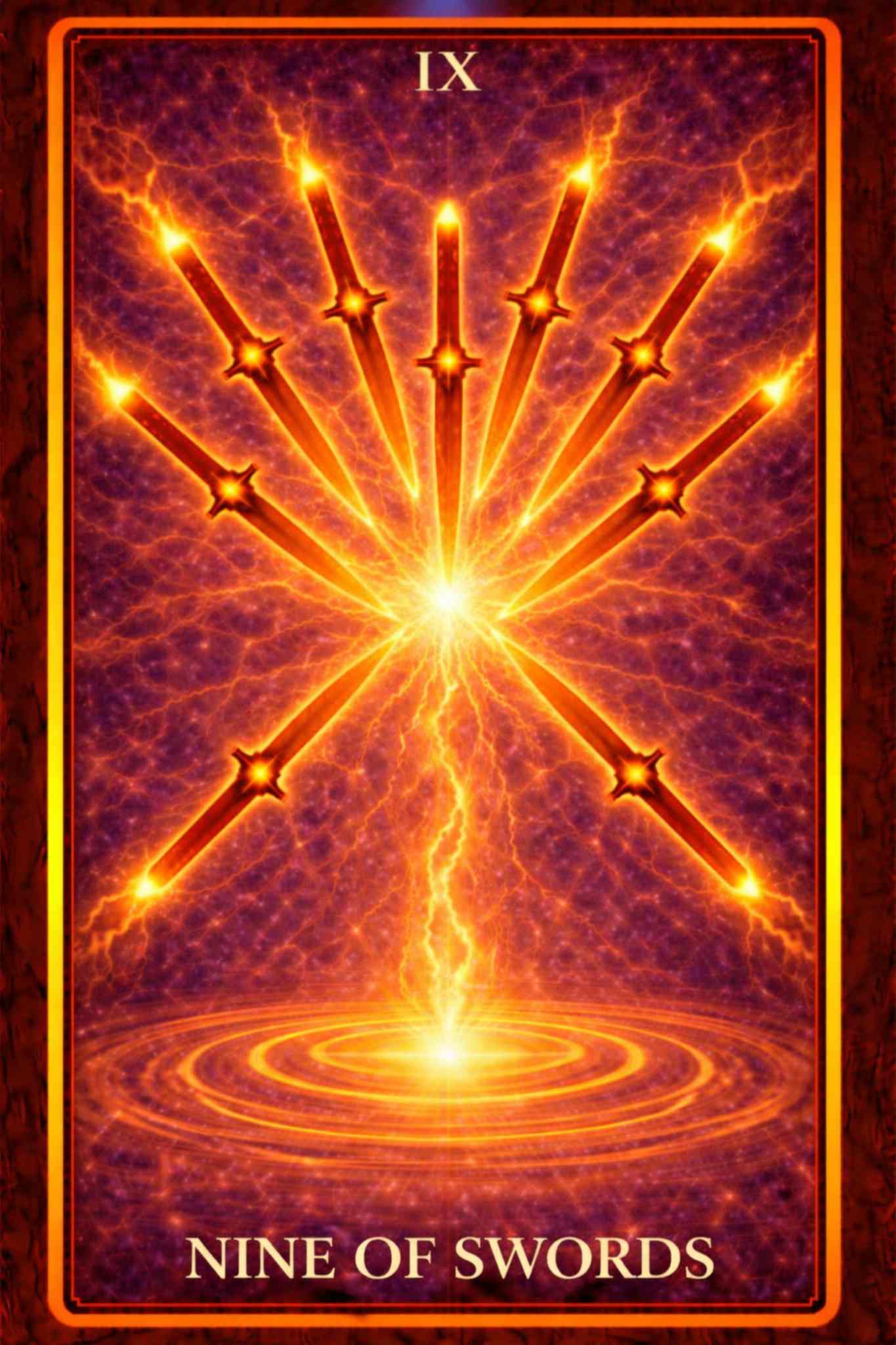
Nine of Swords Upright in Spiritual Meaning
Upright, Nine of Swords shows the healthier expression of the archetype. The central themes here are anxiety, dread, insomnia, guilt, rumination, and private suffering that feels larger in the dark. In Arvethis work, upright Swords energy is not read as sterile rationality. It is read as discernment that has enough coherence to become useful. The truth is not necessarily comfortable, but it is more likely to be honest, readable, and capable of supporting wise action.
With this card, the upright form often reveals anxiety, insomnia, mental anguish, guilt, dread, and the suffering created when thoughts turn relentlessly against the self. In practical life, that may show up as cleaner communication, sharper judgment, stronger boundaries, more honest self-observation, or a willingness to face what is difficult without immediately collapsing into drama or denial. The mind is moving in a way that can clarify rather than merely intensify.
Still, upright does not mean automatic perfection. Even a strong Swords card can be mishandled if people confuse bluntness with maturity or assume that seeing the truth is the same as using it wisely. Arvethis always asks the next grounded question: is the clarity being supported by timing, behavior, and ethics? When the answer is yes, upright Swords energy can become one of the clearest signs of real alignment in a reading.
Because the upright current is usually more coherent, the situation often becomes easier to interpret. You can sense where the truth is crystallizing, where the decision point is forming, and where the lesson of discernment is becoming visible. That precision is one reason Swords cards can feel so powerful when read well: they help name what has already been structuring the story beneath the noise.
Nine of Swords Reversed in Spiritual Meaning
Reversed, Nine of Swords shows that the mental current is not moving in a fully clean or simple way. The reversed themes here are relief beginning, truth shared, healing support, or anxiety that remains but is no longer completely hidden. In Arvethis interpretation, this does not mean the truth disappears. It means the truth is blocked, distorted, delayed, weaponized, fragmented, hidden, or difficult to trust at face value.
The shadow of this card often involves treating fear as prophecy, or letting repeated worry harden into identity. That is why reversed Swords can be so nuanced. There may still be intelligence, awareness, motive, or insight present — but the mental energy does not yet have a healthy enough container to express itself clearly. Something about the way the truth is being held is complicating the picture.
Reversed air often reveals the difference between thought and wisdom. A person may see accurately but communicate badly. A situation may contain truth but also too much fear. A boundary may be necessary and yet be expressed harshly. A strategy may be clever and still fail ethically. The reversal helps show where the clear perception exists, and where its expression is still under strain.
In Arvethis work, reversals are diagnostic rather than punitive. Reversed Nine of Swords says: slow down, name what is mentally unclear, and let reality test the story. That approach protects the reading from false certainty while still honoring the symbolic depth of the card.
Spiritual Reflection
The Nine of Swords is one of tarot's clearest cards for inner distress. In spirituality, it often reflects a phase where the mind is under pressure and the emotional field feels difficult to settle. Thoughts may become repetitive, fears may gain intensity, and your inner life may feel less like a place of refuge and more like a space charged with tension. This can be especially challenging for sensitive people, because spiritual awareness can become mixed with anxiety in ways that are hard to separate at first.
This card does not mean your path has lost value. It more often suggests that fear, stress, or self-judgment is distorting how the path is being experienced right now. When the mind is overwhelmed, even meaningful insight can become difficult to receive clearly. The first task under this card is therefore not to interpret everything more deeply. It is to recognize the strain honestly.
When Spiritual Sensitivity Meets Anxiety
One of the most important themes of the Nine of Swords is the difference between awareness and fear. In spiritual life, this distinction matters greatly. A person may sense subtle things, feel deeply, and notice shifts that others miss. Yet when the nervous system is under pressure, those same sensitivities can become tangled with anxious thinking. The result can feel like hypervigilance rather than intuition.
This card often appears when the inner world is carrying too much at once. There may be worry about meaning, guilt about past choices, fear of getting something wrong, or concern that you are missing an important spiritual lesson. The mind tries to solve the discomfort through more thinking, but the thinking itself may be part of what keeps the discomfort active.
Fear, Guilt, and Inner Pressure
The Nine of Swords can also point toward guilt or self-judgment within the spiritual path. You may be expecting too much of yourself, holding yourself to an impossible inner standard, or believing that your spiritual life should feel clearer, calmer, or more elevated than it currently does. These expectations can create pressure that turns natural uncertainty into suffering.
Fear under this card is often deeply personal. It may connect to your future, your decisions, your purpose, or your worth. In spiritual readings, that fear can sometimes take on a symbolic tone, making everything feel unusually significant. This is why the card asks for care. Not every difficult thought is sacred truth. Some are simply signs of exhaustion, strain, or the need for support.
The Burden of Over-Interpretation
Another spiritual lesson of this card is the danger of over-interpretation. During anxious phases, it becomes easy to treat every symbol, dream, silence, or emotional wave as something urgent that must be decoded immediately. The Nine of Swords suggests that this approach can intensify suffering rather than relieve it.
There is wisdom in stepping back from constant interpretation and returning to steadier forms of grounding. A spiritual path becomes healthier when it can include mystery without turning mystery into panic. This card often appears when that balance is ready to be restored.
Night, Solitude, and the Amplification of Thought
The imagery of the Nine of Swords often carries the sense of being alone with difficult thoughts, especially in quiet hours when the mind has fewer distractions. In spiritual terms, solitude can be deeply meaningful, but it can also magnify inner pressure when fear is active. What feels manageable during the day may feel overwhelming in private, reflective space.
This does not mean solitude is the problem. It means solitude may be revealing the emotional and mental burden already present. The card invites you to notice what happens in those quieter moments and to respond with compassion rather than harshness.
Spiritual Crisis as a Threshold
Sometimes the Nine of Swords appears during a spiritual crisis. This can be a period where old meanings are falling away, where familiar practices feel less supportive, or where difficult emotions rise more strongly than expected. Although the experience can feel destabilizing, it may also be part of a deeper reorganization of your inner life.
A crisis on the path does not automatically mean failure. At times it means that a former structure is no longer able to hold what your awareness is becoming. Even so, the card suggests that this process needs gentleness and support. Growth that comes through fear alone is rarely well integrated.
The Difference Between Conscience and Punishment
This card can also raise the question of conscience. At times, spiritual discomfort is linked to something that does need honest attention: a truth avoided, a pattern repeated, or a value that has been compromised. Yet the Nine of Swords asks for discernment here as well. Conscience can guide repair. Punishment only deepens suffering. The inner path becomes healthier when responsibility is joined with compassion instead of shame.
This is an important distinction because many people confuse spiritual seriousness with inner harshness. The card suggests that real growth comes through clearer awareness, not through endless self-attack.
Grounding as Spiritual Medicine
When the Nine of Swords appears, grounding becomes essential. The card often indicates that the spiritual life needs stabilizing influences rather than more intensity. Simpler practices may be more useful than expansive or highly interpretive ones. Breath, rest, routine, embodiment, honest conversation, and practical support can all become forms of spiritual care under this card.
Grounding does not reduce the value of your spiritual path. It protects it. It creates enough steadiness for insight to return in a form the nervous system can actually hold.
What This Card May Be Asking You to See
The Nine of Swords is often less about external danger and more about the shape of the inner struggle. It may be showing where fear has become too central, where thought has become harsher than wisdom, or where your sensitivity needs support rather than more pressure. These are important realizations, because they shift the path from panic toward care.
At its deepest level, this card asks whether your spirituality currently leaves room for mercy. Can your path include uncertainty? Can it include pain without making pain the whole truth? Can it include imperfection without turning that into condemnation? These questions are part of the card's medicine.
The Arvethis Perspective on Nine of Swords in Spirituality
From this perspective, the Nine of Swords reflects a spiritual phase where the mind and heart are under strain, and where inner experience may feel sharper, heavier, or more difficult to trust. It highlights the importance of distinguishing insight from anxiety and of meeting inner pressure with grounding rather than escalation.
This card does not ask you to deny what feels difficult. It asks you to hold it differently. Fear may be present. Worry may be present. Spiritual confusion may be present. Yet none of these alone define the full truth of your path. They are part of the weather, not the whole sky.
The invitation is to reduce the pressure to interpret everything perfectly, and to bring care to the parts of yourself that feel burdened. When the inner world becomes less punitive and more supported, spiritual clarity often returns in a quieter, steadier form. The Nine of Swords can therefore become a turning point: away from fear-driven spirituality and toward a path that has more honesty, more balance, and more compassion within it.
Spiritual Guidance
If this card appears as your advice card, begin by asking how the mental current wants to be handled more consciously. Swords advice is rarely about suppressing thought. It is more often about telling the truth about thought while refusing to let fear, defensiveness, or cleverness become the only authority in the room.
Helpful: work with the healthier side of the card — anxiety, dread, insomnia, guilt, rumination, and private suffering that feels larger in the dark. Let the truth become cleaner, steadier, and more ethical. Respect reason, but test it. Respect boundaries, but support them with real maturity, context, and communication.
Less helpful: ignore the shadow — relief beginning, truth shared, healing support, or anxiety that remains but is no longer completely hidden. If the pattern includes projection, mental aggression, hidden agenda, fixation, avoidance, or instability, the card is asking for greater precision, not for pressure or superiority to take over.
A strong Arvethis reading always returns to one practical question: what is the next truthful step? With Nine of Swords, that step is usually the one that honors clarity without surrendering compassion, and honors discernment without abandoning reality.
How to read the spiritual layer
Spiritual meanings are not escape routes from reality. They are most helpful when they illuminate the deeper lesson, inner posture, or healing movement underneath the situation without replacing grounded judgment.
Explore More Nine of Swords Meanings
If you want to explore this card from other angles, continue with Nine of Swords — Love Meaning, Nine of Swords — Career Meaning, Nine of Swords — Yes / No Meaning, Nine of Swords — Feelings Meaning, and Nine of Swords — Intentions Meaning. These pages help place Nine of Swords into different emotional and interpretive contexts while keeping the symbolism grounded in the kind of question you are actually asking.
Related Spiritual and Tarot Resources
Spiritual FAQ
What does Nine of Swords mean spiritually?
Spiritually, Nine of Swords speaks to anxiety, insomnia, mental anguish, guilt, dread, and the suffering created when thoughts turn relentlessly against the self and often reveals how truth, discernment, fear, or mental purification are shaping the soul path.
Is Nine of Swords a spiritual growth card?
Yes. Swords cards can be deeply spiritual because they describe discernment, ethical speech, shadow-thinking, and the mind’s relationship to truth.
What does Nine of Swords reversed mean spiritually?
Reversed, it often points to relief beginning, truth shared, healing support, or anxiety that remains but is no longer completely hidden, asking for more honesty, grounding, healing, or integration on the path.
What is the deeper soul lesson of Nine of Swords?
The deeper lesson is usually about learning to use clarity ethically — with discernment, humility, and enough honesty to let truth transform the inner life.