
Five of Swords Feelings Meaning
Card: Five of Swords
Meaning type: Feelings Meaning
Introduction
Five of Swords as feelings often reflects an emotional space shaped by tension, defensiveness, pride, or unresolved inner conflict. This is rarely a simple card in feelings readings. It can suggest that someone is affected by the connection, yet their emotional response may be filtered through irritation, self-protection, frustration, or the desire to maintain control rather than vulnerability.
In many cases, this card appears when feelings have become entangled with conflict. A person may feel hurt, challenged, misunderstood, or emotionally unsettled. Instead of expressing those feelings openly, they may respond through distance, sharpness, resistance, or a need to protect their position. The emotional landscape can feel active, yet difficult to access directly.
This card can also point toward mixed emotional motives. There may be attachment, yet also resentment. There may be attraction, yet also fear of losing power or emotional footing. Because of this, the Five of Swords tends to show feelings that are real but complicated, often influenced by mental tension as much as by the heart itself.
The card invites a careful reading of emotional behavior. What is being expressed may be only part of what is being felt. Beneath guarded words or difficult dynamics, there may be hurt, insecurity, disappointment, or an internal struggle around how much to reveal.
Arvethis Lens: Five of Swords as feelings reflects emotional conflict, defensiveness, and reactions shaped by pride, hurt, or unresolved tension rather than simple emotional openness.
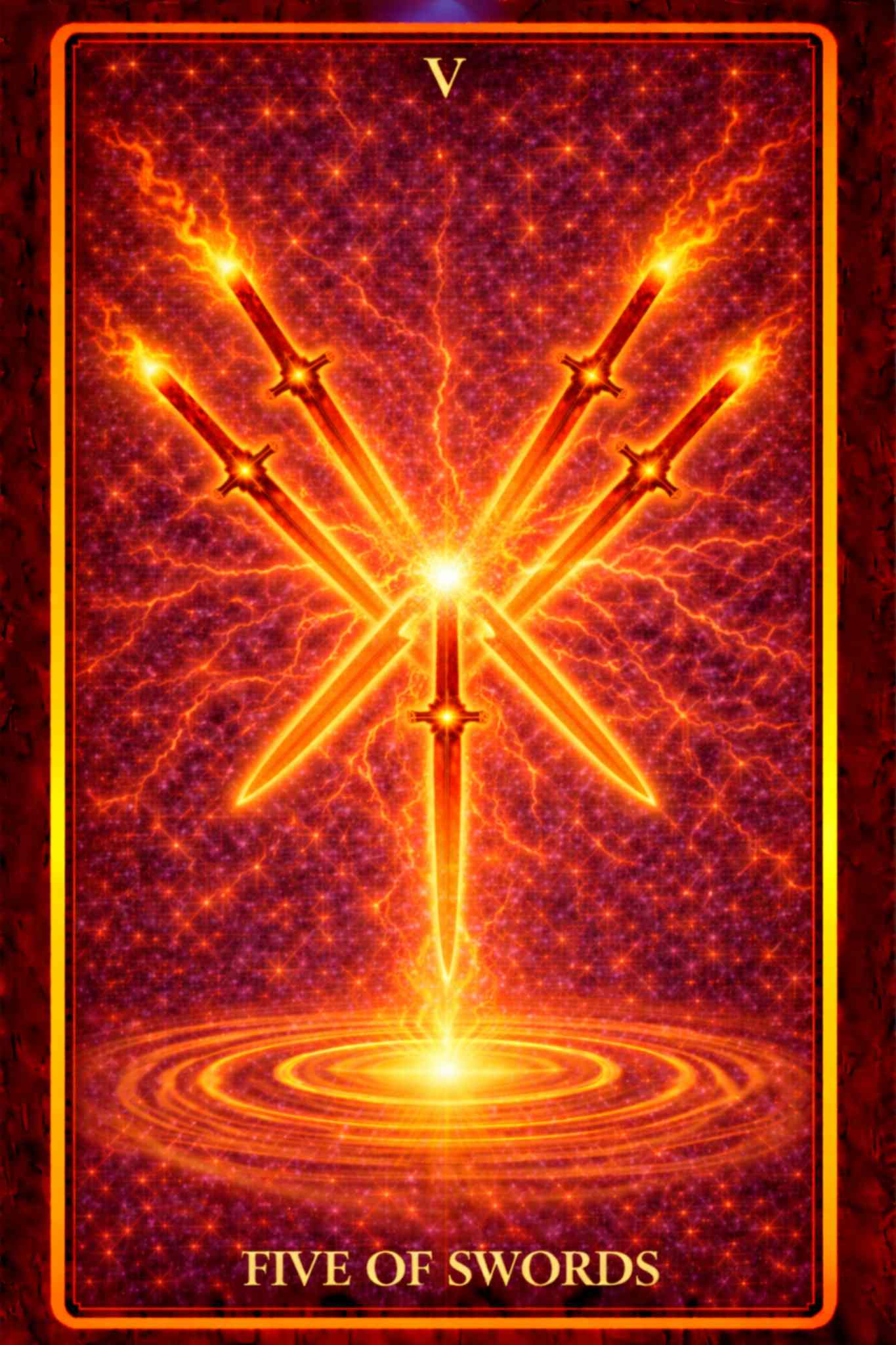
Five of Swords Upright in Feelings
Upright, Five of Swords shows the healthier expression of the archetype. The central themes here are conflict, tension, self-interest, verbal warfare, strategic friction, and outcomes shaped by pride or defensiveness. In Arvethis work, upright Swords energy is not read as sterile rationality. It is read as discernment that has enough coherence to become useful. The truth is not necessarily comfortable, but it is more likely to be honest, readable, and capable of supporting wise action.
With this card, the upright form often reveals conflict, ego tension, hollow victory, strategic imbalance, mental aggression, and the cost of winning without wisdom. In practical life, that may show up as cleaner communication, sharper judgment, stronger boundaries, more honest self-observation, or a willingness to face what is difficult without immediately collapsing into drama or denial. The mind is moving in a way that can clarify rather than merely intensify.
Still, upright does not mean automatic perfection. Even a strong Swords card can be mishandled if people confuse bluntness with maturity or assume that seeing the truth is the same as using it wisely. Arvethis always asks the next grounded question: is the clarity being supported by timing, behavior, and ethics? When the answer is yes, upright Swords energy can become one of the clearest signs of real alignment in a reading.
Because the upright current is usually more coherent, the situation often becomes easier to interpret. You can sense where the truth is crystallizing, where the decision point is forming, and where the lesson of discernment is becoming visible. That precision is one reason Swords cards can feel so powerful when read well: they help name what has already been structuring the story beneath the noise.
Five of Swords Reversed in Feelings
Reversed, Five of Swords shows that the mental current is not moving in a fully clean or simple way. The reversed themes here are de-escalation, remorse, unresolved resentment, hidden hostility, or conflict that continues below the surface. In Arvethis interpretation, this does not mean the truth disappears. It means the truth is blocked, distorted, delayed, weaponized, fragmented, hidden, or difficult to trust at face value.
The shadow of this card often involves confusing domination with strength, or acting as if being right automatically makes the outcome healthy. That is why reversed Swords can be so nuanced. There may still be intelligence, awareness, motive, or insight present — but the mental energy does not yet have a healthy enough container to express itself clearly. Something about the way the truth is being held is complicating the picture.
Reversed air often reveals the difference between thought and wisdom. A person may see accurately but communicate badly. A situation may contain truth but also too much fear. A boundary may be necessary and yet be expressed harshly. A strategy may be clever and still fail ethically. The reversal helps show where the clear perception exists, and where its expression is still under strain.
In Arvethis work, reversals are diagnostic rather than punitive. Reversed Five of Swords says: slow down, name what is mentally unclear, and let reality test the story. That approach protects the reading from false certainty while still honoring the symbolic depth of the card.
Emotional Interpretation
The Five of Swords is one of tarot's more challenging cards in a feelings reading because it often shows emotion under strain. Feelings may be present, sometimes strongly, yet they are rarely flowing in a calm or transparent way. Instead, they may be shaped by conflict, self-protection, wounded pride, disappointment, or the need to defend an emotional position.
This card often appears when a person feels emotionally activated but does not know how to handle that activation with softness or clarity. The result can be behavior that feels guarded, sharp, avoidant, or difficult to interpret. Underneath that behavior, however, there is often more emotional complexity than the surface suggests.
Conflict in the Emotional Field
One of the clearest themes of this card is emotional conflict. A person may feel torn between wanting connection and wanting distance, between caring and protecting themselves, or between vulnerability and the need to appear unaffected. This inner friction can make their feelings feel unstable, tense, or contradictory.
Because of this, the Five of Swords often shows a person who is not at ease with what they feel. They may be reacting to the connection while also resisting it. They may care, yet feel triggered. They may remain engaged, yet do so with tension rather than emotional ease.
Defensiveness and Emotional Protection
This card frequently indicates that someone is guarding themselves. Their feelings may be filtered through a defensive style, especially if they feel hurt, misunderstood, or emotionally exposed. Instead of speaking from openness, they may become argumentative, distant, cold, or overly focused on being right.
That does not remove the emotional charge. In many cases, it suggests that the charge is strong enough to create discomfort. The person may be trying to protect themselves from perceived loss, rejection, embarrassment, or loss of control.
If You Are Asking About Romantic Feelings
In romantic contexts, the Five of Swords can suggest feelings that are complicated by ego, conflict, or emotional mistrust. A person may feel drawn, yet also resistant. They may care, yet feel too guarded to express it cleanly. In some cases, attraction and frustration may exist side by side, creating a dynamic that feels tense rather than tender.
This is rarely a card of peaceful emotional flow. It tends to indicate that feelings are present within a more conflicted internal landscape. The emotional truth may be harder to access because it is protected by pride, irritation, or a need to avoid vulnerability.
If You Are Asking About an Existing Relationship
Within an established relationship, this card can reflect unresolved arguments, emotional strain, or feelings that have become entangled with power struggles. One or both people may feel hurt, defensive, or unwilling to soften first. The emotional connection may still exist, yet it may be obscured by the tension that has built around it.
In this context, the Five of Swords often suggests that feelings are active but expressed in distorted ways. What appears as conflict may be covering disappointment, sadness, fear, or the need to regain emotional footing after feeling challenged.
If You Are Asking About Someone New
With someone new, the Five of Swords can indicate caution mixed with emotional tension. The person may feel intrigued, affected, or mentally preoccupied by the connection, yet also resistant to becoming emotionally exposed. They may prefer to keep control of the dynamic rather than let themselves move into deeper openness too quickly.
This can create mixed signals. There may be engagement, but it may come with challenge, distance, or inconsistency. The card suggests that the feelings may be complicated by inner defensiveness rather than simple lack of interest.
Hurt, Pride, and Unspoken Vulnerability
One of the most important layers of this card is the connection between pride and hurt. A person may be carrying emotional sensitivity that they do not want to reveal directly. Instead of naming pain or uncertainty, they may react through control, withdrawal, criticism, or emotional gamesmanship. This can make the feelings seem harsher than they truly are at their core.
That does not make the dynamic easier, but it can make it more understandable. The Five of Swords often shows someone whose emotional response is shaped by discomfort with vulnerability. The defensive posture becomes a shield against what feels harder to name.
The Shadow Side of Five of Swords as Feelings
The shadow of this card can appear as resentment, emotional manipulation, the desire to win rather than understand, or a tendency to stay in conflict rather than move toward repair. In some cases, the person may be so focused on self-protection that they reduce the possibility of honest emotional exchange.
There can also be moments where feelings are expressed through competition or subtle hostility rather than directness. This does not automatically mean there is no emotional significance. It suggests that the significance is being carried in a difficult form.
Feelings Versus Behavior Under This Card
The Five of Swords is a strong reminder that behavior and feelings may be very different here. Someone may behave in a guarded or combative way while feeling more affected than they are willing to admit. They may appear cold while inwardly carrying disappointment, attachment, or inner conflict. This is why interpretation under this card needs caution.
At the same time, difficult behavior still matters. Even if deeper feelings exist, they do not cancel the impact of how those feelings are being expressed. The card asks for both insight and discernment.
Reading This Card with Clarity
When the Five of Swords appears in a feelings reading, it helps to look at the emotional environment rather than only the visible reaction. Is there pride involved? Is there old hurt? Is there a fear of losing emotional ground? These questions often reveal more than taking the surface behavior at face value.
The card rarely suggests a straightforward emotional picture. It points instead toward feelings that are shaped by internal and relational tension. Understanding may come from seeing the emotional conflict clearly rather than simplifying it too quickly.
The Arvethis Perspective on Five of Swords as Feelings
From this perspective, the Five of Swords reflects feelings complicated by conflict, self-protection, and emotional defensiveness. It can suggest that a person is affected, yet unable or unwilling to express that impact with openness. Pride, hurt, and tension may all be influencing how the connection is being experienced.
This is not a card of clean emotional availability. It is a card of friction in the emotional field. Sometimes that friction comes from unresolved pain. Sometimes it comes from fear of vulnerability. Sometimes it reflects a dynamic where the connection has become entangled with control, misunderstanding, or emotional strain.
The invitation is to read this card honestly. There may be feeling here, but it is moving through a difficult structure. Clarity comes from recognizing both the emotional charge and the ways it is being defended against.
Tarot is used here as a symbolic tool for reflection and interpretation. It supports awareness and personal understanding, and it does not replace direct communication or professional guidance where needed.
Emotional Advice
If this card appears as your advice card, begin by asking how the mental current wants to be handled more consciously. Swords advice is rarely about suppressing thought. It is more often about telling the truth about thought while refusing to let fear, defensiveness, or cleverness become the only authority in the room.
Helpful: work with the healthier side of the card — conflict, tension, self-interest, verbal warfare, strategic friction, and outcomes shaped by pride or defensiveness. Let the truth become cleaner, steadier, and more ethical. Respect reason, but test it. Respect boundaries, but support them with real maturity, context, and communication.
Less helpful: ignore the shadow — de-escalation, remorse, unresolved resentment, hidden hostility, or conflict that continues below the surface. If the pattern includes projection, mental aggression, hidden agenda, fixation, avoidance, or instability, the card is asking for greater precision, not for pressure or superiority to take over.
A strong Arvethis reading always returns to one practical question: what is the next truthful step? With Five of Swords, that step is usually the one that honors clarity without surrendering compassion, and honors discernment without abandoning reality.
What feelings pages are best for
Feelings pages work best when you want emotional tone, not guaranteed outcomes. A card may reveal attraction, distance, hesitation, warmth, defensiveness, or confusion, but it should still be read alongside real behavior and communication.
Continue the guidance
Subscribe to the Arvethis newsletter for daily tarot guidance, intuitive reflections, and gentle spiritual reminders delivered with calm clarity.
Sometimes a single card offers a starting point, but personal guidance can help you explore your situation in more depth.
This link may be an affiliate link. We may earn a small commission at no extra cost to you.
Interesting combinations with Five of Swords
Some of the most interesting shifts in meaning appear when this card interacts with other major arcana, such as Five of Swords and The Fool. These pairings often highlight larger archetypal movement, turning points, and broader inner transitions.
Explore More Five of Swords Meanings
If you want to explore this card from other angles, continue with Five of Swords — Love Meaning, Five of Swords — Career Meaning, Five of Swords — Yes / No Meaning, Five of Swords — Intentions Meaning, and Five of Swords — Spiritual Meaning. These pages help place Five of Swords into different emotional and interpretive contexts while keeping the symbolism grounded in the kind of question you are actually asking.
Related Feelings and Tarot Resources
Feelings FAQ
What does Five of Swords mean as feelings?
As feelings, Five of Swords often shows conflict, ego tension, hollow victory, strategic imbalance, mental aggression, and the cost of winning without wisdom and reveals how emotion is being filtered through thought, restraint, fear, or directness.
Does Five of Swords show real feelings?
It can, but real feeling is best confirmed through consistent action, communication, and emotional capacity — not symbolic language alone.
What does Five of Swords reversed mean for someone’s feelings?
Reversed, it may point to de-escalation, remorse, unresolved resentment, hidden hostility, or conflict that continues below the surface, which can translate into distance, confusion, defensiveness, or difficulty expressing what is truly felt.
Can Five of Swords show mixed or guarded emotions?
Yes. Especially in reversed form, feeling may be real while openness, clarity, or emotional availability remain under strain.